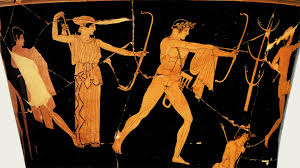
Introduction: The Evolution of the Missile Weapon
For generations, classical Greek warfare was defined by a single, dominant image: the heavily armored citizen-soldier (hoplite) locked in a dense, pushing wall of bronze shields and iron spears known as the phalanx. In this aristocratic, martial culture, hand-to-hand combat was celebrated as the ultimate test of manhood (andreia). Conversely, missile weapons—and archers (toxotai) in particular—were frequently dismissed by early poetic traditions as the tools of cowards who refused to look their opponents in the eye.
However, the gritty reality of the battlefield consistently clashed with this romantic ideology. As the Greco-Persian and Peloponnesian Wars forced Greek military science to evolve, commanders realized that a pure hoplite phalanx was a rigid, fragile instrument, highly vulnerable to terrain anomalies and rapid flanking maneuvers. Archaeology and historical texts reveal that archers transitioned from marginalized skirmishers into vital tactical assets. Far from being auxiliary afterthoughts, skilled archers became the asymmetric counterweight of Greek combined-arms doctrine, essential for protecting vulnerable infantry flanks, disrupting enemy formations, and securing victories across the challenging, fractured geography of the Mediterranean.
1. The Ideological Clash: The Hero vs. The Bow
To understand the practical importance of archers, one must first navigate the deep cultural bias they had to overcome within the Greek psyche.
The Homeric Legacy: In the Iliad, archers are often depicted with a degree of moral suspicion. While heroes like Teucer fight bravely, Paris—the ultimate foil to masculine Greek virtue—uses a bow to fatally strike Achilles from a safe distance.
The Hoplite Ethos: The rise of the city-state (polis) tied civic duty directly to the phalanx. True citizen virtue required a man to purchase his own heavy bronze armor and stand lock-step with his neighbors, absorbing a direct frontal assault. The archer, who wore little to no armor and relied on mobility and distance, did not fit this idealized model of civic sacrifice.
The Tragic Dialogue: This cultural tension is famously captured in Euripides' play Heracles, where a character slurs the bow, calling it "the weapon of a coward," arguing that an archer is a slave to his weapon because if his bow string breaks, he has no defense. The play counters this by arguing that the archer is actually the wisest warrior, because he can wound his enemies while remaining safe, keeping his life within his own control rather than relying on the luck of the front line.
2. The Specialized Mercenaries: Cretan Supremacy
Because mainstream Greek cities did not culturally foster archery among their citizen classes, they had to look abroad to secure elite missile units. This birthed a lucrative market for highly specialized foreign mercenary archers.
The Cretan Toxotai: The undisputed masters of the bow in the Greek world were the inhabitants of Crete. The rugged, mountainous terrain of the island favored asymmetric skirmishing over heavy infantry warfare. Cretan archers underwent rigorous training from childhood, mastering a heavy, powerful recurve bow.
The Heavy Arrow Doctrine: Unlike eastern archers who often prioritized rapid volleys of light arrows, Cretan archers utilized a heavier arrow equipped with substantial bronze or iron trilobite points. This gave their missiles immense kinetic energy, allowing them to pierce leather armor and thin bronze greaves or shields at long range.
The Versatile Kit: Cretans were highly prized because they were not fragile snipers. They routinely went into battle carrying a small bronze shield (pelte) strapped to their left forearm and a short sword. If an enemy cavalry unit or light skirmisher managed to close the distance, the Cretan archer could seamlessly transition into a close-quarters light infantryman, making them highly resilient assets on campaign.
3. Tactical Doctrines: Combined-Arms Synergies
In actual combat, archers were deployed to solve the inherent structural flaws of the heavy hoplite phalanx, operating within a sophisticated combined-arms network.
[ ARCHER BARRAGE ] ──► [ Disrupts Enemy Shield Wall ] ──► [ Hoplite Phalanx Advances Safely ]
         │
         └──► [ Screens Vulnerable Unarmored Flanks from Cavalry ]
The Softening Barrage: As two rival phalanxes marched toward one another, archers were deployed in front of the line. They loosed high-angle barrages of arrows into the advancing enemy. While these arrows rarely caused mass casualties against heavy bronze breastplates, they forced opponents to lift their heavy shields up, blocking their vision, fracturing their rhythm, and creating gaps in the line before the physical clash of the phalanxes occurred.
Flank Protection: A hoplite phalanx was incredibly strong from the front but dangerously blind on its right flank, where a soldier’s unshielded side was exposed. Archers were systematically placed on these extreme wings to act as a defensive screen, using their ranged coverage to keep enemy cavalry and light javelin-throwers (peltasts) from encircling and devastating the infantry core.
The Denied Pursuit: If a Greek army was forced to retreat, archers became the ultimate rearguard. They would deploy in loose formations, firing backward at advancing enemy troops to slow their momentum, preventing a controlled retreat from turning into a chaotic, total slaughter.
4. The Peloponnesian War: The Asymmetric Turning Point
The strategic necessity of archers was permanently sealed during the Peloponnesian War (431–404 BC), where asymmetric skirmishing repeatedly humiliated traditional heavy infantry doctrines.
The Disaster at Sphacteria (425 BC): In this legendary engagement, an elite contingent of Spartan hoplites—long considered invincible in standard combat—was trapped on a rugged, brush-covered island by an Athenian force composed heavily of light skirmishers and archers.
The Death by a Thousand Cuts: The Spartans tried repeatedly to charge the Athenians, but the light-armored Athenian archers simply ran backward, maintaining their distance while launching an uninterrupted storm of arrows. Trapped in rough terrain where they could not form a cohesive phalanx, choked by ash and dust, and unable to strike back, the surviving Spartans eventually laid down their shields and surrendered, shattering the myth of Spartan martial invincibility. This victory proved decisively that armor meant nothing if it could be out-maneuvered and systematically picked apart by ranged velocity.
5. The Scythian Police Force of Athens
The importance of archers extended beyond the borders of the battlefield, playing a distinct role in the civic and political administration of classical Athens.
The State Purchase: Following the Persian Wars, the Athenian democracy purchased a permanent state-owned corps of roughly 300 to 1,200 Scythian archers from the Black Sea region.
The Civic Enforcers: Recognizable by their distinct, brightly patterned tunics, pointed caps, and curved gorytos (combination bow-case and quiver), these public slaves functioned as the primary police force of Athens.
Maintaining Democracy: They were tasked with maintaining public order during turbulent political assemblies on the Pnyx, guarding public buildings, and managing criminals. By utilizing foreign, enslaved archers rather than armed citizen soldiers to police the city, the Athenian democracy ensured that no internal military faction could easily launch a domestic coup, turning the bow into a literal safeguard of constitutional law.
6. The Imperial Finale: The Legacy of Alexander
The ultimate maturation of the archer's role in Greek military science was achieved during the campaigns of Philip II of Macedon and his son, Alexander the Great.
The Integrated Tactical Web: Alexander completely abandoned old ideological prejudices against missile weapons. In his army, elite Cretan and Macedonian archers were integrated directly into the frontline strike force alongside the Companion Cavalry and the sarissa-wielding phalanx.
The Global Conquest: At battles like the Issus and Gaugamela, Alexander utilized his archers to systematically neutralize the deadly chariot charges of the Persians, ordering his bowmen to target the horses and drivers at long distance before they could reach the Greek lines. By weaving the long-range coverage of the archer directly into the heavy impact of the cavalry, the Hellenistic army created an unstoppable, highly adaptive war machine that successfully exported Greek military dominance across the known world, permanently etching the bow into the annals of classical military genius.