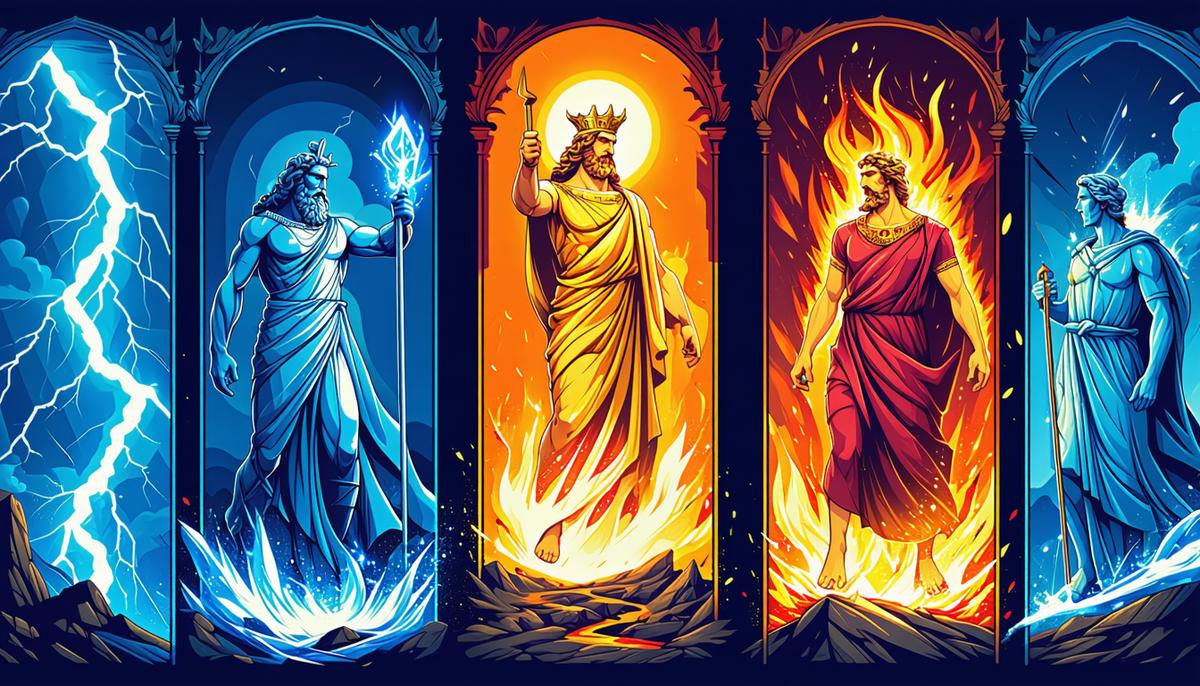
The Aegean region is one of the most seismically active zones on Earth. Straddled by volatile fault lines and populated by active volcanoes like Santorini and Mount Etna, the ancient Greeks lived under the constant threat of earthquakes, tsunamis, and volcanic eruptions.
To cope with a landscape that could literally swallow cities overnight, Greek thought underwent a fascinating evolution. They shifted from attributing catastrophes to the volatile moods of anthropomorphic gods to seeking rational, structural mechanics hidden within the earth itself.
1. The Mythological Era: Divine Wrath and Bound Monsters
In the archaic period, natural disasters were viewed entirely through a narrative lens. Catastrophes were personal—they were actions taken by specific deities who had been insulted, neglected, or enraged.
Poseidon the Earth-Shaker
Long before he was popularized as a serene god of the sea, Poseidon was feared primarily as Ennosigaios—the "Earth-Shaker." The Greeks noticed a profound relationship that modern seismology confirms: major coastal earthquakes are frequently accompanied by devastating tsunamis.
To the ancient mind, a tsunami wasn't a displaced water wave; it was the sea rising up in tandem because Poseidon had violently struck the bedrock with his trident, cracking open the earth and unleashing subterranean waters.
The Subterranean Prison: Typhon and the Giants
Volcanic eruptions required a different narrative framework. The Greeks explained the smoke, ash, and lava of Mount Etna by mapping their political mythology onto the landscape.
According to Hesiod’s Theogony, after Zeus defeated the monstrous, multi-headed serpentine giant Typhon, he imprisoned him deep beneath the crust of Sicily under Mount Etna. Whenever Typhon shifts his massive weight or breathes his smoky, fiery breath in frustration, the earth above shakes and spews molten rock. A volcanic eruption was literally the muffled, trapped rage of a vanquished cosmic rebel.
2. The Thales Revolution: Earth Floating on Water
In the sixth century BCE, a profound intellectual shift occurred in the city of Miletus. Thales (c. 624–545 BCE) put forward a radical hypothesis: what if natural disasters happen not because a god is angry, but because of the physical properties of the materials that make up the world?
Thales pioneered the first purely mechanical theory of earthquakes by using a simple analogy:
[ Subterranean Primordial Ocean ] ──► Waves swell ──► Ships rock ──► Earthquakes occur
Thales believed that the entire terrestrial disk of the Earth floats like a massive log on top of a vast, infinite primordial ocean. When this underground ocean experiences rough currents or swells, the landmass above rocks back and forth just like a ship tossed by a wave.
While technically incorrect, Thales’ theory was revolutionary because it removed divine caprice from the equation, substituting it with consistent physical laws.
3. The Pneumatic Theory: Aristotle’s Subterranean Winds
By the fourth century BCE, Aristotle systematized natural science in his treatise Meteorologica. He rejected Thales’ floating earth theory, arguing instead that earthquakes and volcanic eruptions were caused by the violent movement of trapped gases—a concept known as Pneuma (subterranean wind).
Aristotle mapped out a highly influential, multi-stage mechanical process for seismic events:
1.Solar Heating:Phase 1.
The sun beats down on the surface of the Earth, drying out the soil and warming the air.
2.Infiltration:Phase 2.
This warm, dry air, along with external winds, gets sucked deep into the earth through porous caves, fissures, and subterranean hollows.
3.Compression:Phase 3.
As the moisture inside the earth evaporates, it generates more dry gas. This air becomes tightly compressed inside sealed underground caverns, seeking an exit.
4.The Seismic Blast:Phase 4.
If the gas cannot find a clear vent, it surges violently against the rock walls. If the caverns are dry, it creates an earthquake; if the gas mixes with underground sulfur or bitumen and catches fire, it erupts out of a volcano.
The Windless Cliché: Because Aristotle believed earthquakes were caused by wind trapped inside the earth, he claimed that the weather right before an earthquake would invariably be exceptionally calm, clear, and stiflingly hot, because all the world's wind had been sucked underground.
Summary Comparison of Explanations
Disaster TypeMythological NarrativeNatural Philosophy (Presocratics / Aristotle)EarthquakesPoseidon striking the sea floor with his trident in a fit of rage.Trapped underground wind (pneuma) hammering violently against the cavern walls.VolcanoesThe fiery breath and shifting weight of the buried monster Typhon.Subterranean wind catching fire as it frictionally rubs against underground deposits of sulfur.TsunamisDeliberate punishment by the sea gods to submerge a sacrilegious coastal city.A natural secondary reaction where seismic shocks beneath the ocean floor displace coastal waters.
Through this steady transition from divine monsters to trapped subterranean gales, the Greeks laid the foundational groundwork for the modern scientific method—proving that the most terrifying aspects of nature could ultimately be investigated, categorized, and understood by human reason.