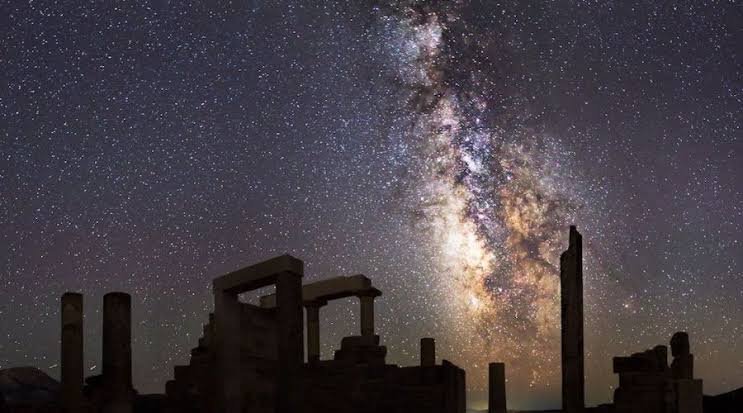
Before Telescopes Existed, Greek Astronomers Were Already Mapping the Cosmos
When modern people think about astronomy, they often imagine telescopes, observatories, satellites, computers, and spacecraft. Yet many of the fundamental questions that modern astronomers continue to investigate were already being asked by thinkers in ancient Greece.
How far away are the stars?
Why do planets appear to move differently from ordinary stars?
What causes the seasons?
How can the movements of celestial bodies be predicted?
Can the heavens be explained mathematically rather than through mythology?
Ancient Greek astronomy did not answer these questions correctly in every case. In fact, some of its most influential models were eventually proven wrong. But the Greeks transformed the study of the heavens by increasingly treating celestial phenomena as subjects that could be measured, calculated, geometrically modeled, and systematically observed.
That intellectual shift was enormously important.
From Mythological Sky to Mathematical Cosmos
Earlier civilizations had sophisticated astronomical traditions, particularly in Mesopotamia and Egypt. Greek astronomy did not develop in isolation.
Greek thinkers inherited and adapted knowledge from older civilizations.
Babylonian astronomers, for example, had accumulated detailed records of celestial observations over centuries. Greek intellectuals encountered this tradition and incorporated some of its mathematical and observational knowledge into their own theories.
The distinctive Greek contribution was increasingly theoretical.
Rather than simply recording that a planet appeared in a particular location, Greek thinkers asked:
What mathematical system could explain why it appears there?
This question changed astronomy forever.
The Pythagorean Universe
Some early Greek philosophers associated the cosmos with mathematical order.
The Pythagorean tradition emphasized numerical relationships and harmony.
Although many Pythagorean cosmological ideas were speculative, they encouraged the belief that the universe possessed an underlying mathematical structure.
This became one of the most influential assumptions in the history of science.
The heavens were not merely a collection of divine events.
They could potentially be understood through mathematics.
Anaximander and the Shape of the Earth
Early Greek philosophers proposed remarkable ideas about the structure of the cosmos.
Anaximander is traditionally associated with models in which celestial bodies were understood through geometric structures rather than purely mythological narratives.
Other thinkers proposed different models.
There was no single “Greek theory.”
Instead, Greek astronomy developed through disagreement.
This is important.
Science does not advance simply because one person discovers the truth.
It often advances because competing explanations force people to examine evidence more carefully.
Pythagoras and the Spherical Earth
The idea that Earth is spherical became increasingly important in Greek intellectual traditions.
The evidence available to ancient observers included:
The changing appearance of the horizon.
The shape of Earth's shadow during lunar eclipses.
Changes in visible stars with latitude.
Ships disappearing below the horizon.
A spherical Earth could explain these observations elegantly.
By the Classical period, the spherical Earth had become a serious scientific proposition.
Aristotle's Evidence
Aristotle offered several arguments for Earth's spherical shape.
One involved lunar eclipses.
When Earth passes between the Sun and Moon, it casts a shadow on the lunar surface.
The shadow appears curved.
A spherical Earth naturally produces a consistently curved shadow.
Another observation concerned the stars.
Traveling north or south changes which stars are visible above the horizon.
This makes sense if the observer is moving across a curved surface.
Eratosthenes Measures the Earth
One of the most extraordinary achievements of ancient Greek science came from Eratosthenes.
Working in the third century BCE, Eratosthenes developed a method for estimating Earth's circumference.
His reasoning relied on shadows.
At a particular location, the Sun could be nearly overhead at a specific time of year.
At another location farther north, the Sun cast a measurable shadow.
The difference in solar angle could be related to the distance between the locations.
Using geometry, Eratosthenes estimated Earth's circumference.
The exact details and accuracy of the calculation depend on the historical assumptions used, but the conceptual achievement was extraordinary.
He was measuring the planet using geometry and sunlight.
Hipparchus and Stellar Observation
The astronomer Hipparchus made major contributions to positional astronomy.
He compared stellar observations and developed methods for organizing stars according to brightness.
He also made important discoveries concerning the gradual shift in the apparent position of the celestial poles, known as precession of the equinoxes.
This demonstrated something profound:
The heavens themselves changed in ways that could be detected only through careful comparison of observations made over time.
The Antikythera Mechanism
Perhaps the most astonishing physical evidence of ancient Greek astronomical technology is the Antikythera Mechanism.
Recovered from a shipwreck, the device contained an elaborate system of gears.
Its exact original capabilities remain a subject of research, but it was clearly designed to represent astronomical cycles.
The mechanism demonstrates that some ancient Greek engineers understood how to translate astronomical relationships into mechanical systems.
It was essentially a mechanical model of celestial time.
Ptolemy's Mathematical Universe
Centuries later, Claudius Ptolemy developed an extraordinarily influential astronomical system.
His Almagest presented mathematical models designed to predict planetary positions.
The system used combinations of circles, including deferents and epicycles, to reproduce observed planetary movements.
The model was geocentric.
Earth remained at or near the center of the system.
Modern astronomy eventually replaced this framework with heliocentric and later gravitational models.
Yet Ptolemy's system was mathematically sophisticated and extremely useful for prediction.
Why the Greeks Matter to Modern Astronomy
Modern astronomy rejects many ancient Greek cosmological assumptions.
We know Earth orbits the Sun.
We know the stars are distant suns.
We understand galaxies.
We measure gravitational waves.
We send spacecraft beyond the planets.
But modern astronomy inherited an essential habit from ancient scientific traditions:
the belief that the heavens can be described mathematically.
The Greeks did not discover modern astronomy.
They helped establish one of its intellectual foundations.
Their greatest achievement was not that they were always correct.
It was that they learned to ask increasingly precise questions about the universe.