Introduction
Kozani, located in western Macedonia, developed as an important regional center during the Ottoman period. Its position connected mountain communities, agricultural districts, and commercial routes linking inland Macedonia with other parts of the Balkans.
Markets and bazaars were central to urban economic life. They provided places where merchants, craftsmen, farmers, and travelers exchanged goods and information.
The possibility of Ottoman water clocks in the Kozani Bazaar raises questions about timekeeping, commercial organization, and the technologies used in public spaces.
Water clocks were known in the ancient and medieval worlds, but a specific Ottoman installation in Kozani requires historical or archaeological verification.
Kozani Under Ottoman Rule
Kozani developed during the Ottoman period into an important settlement in western Macedonia.
Its economy depended on trade, crafts, agriculture, and connections with surrounding communities.
The town's merchants participated in regional networks.
Commercial activity required coordination, particularly when markets, workshops, religious institutions, and public services operated according to different daily schedules.
The Importance of Timekeeping
Timekeeping was essential in premodern societies.
It helped organize religious observances, commercial activity, public administration, and daily work.
Mechanical clocks were not always available or affordable.
Communities therefore relied on several methods of measuring time, including sundials, water clocks, astronomical observations, and traditional systems based on daylight.
The availability of a reliable public timekeeping device could be useful in a busy commercial center.
How Water Clocks Worked
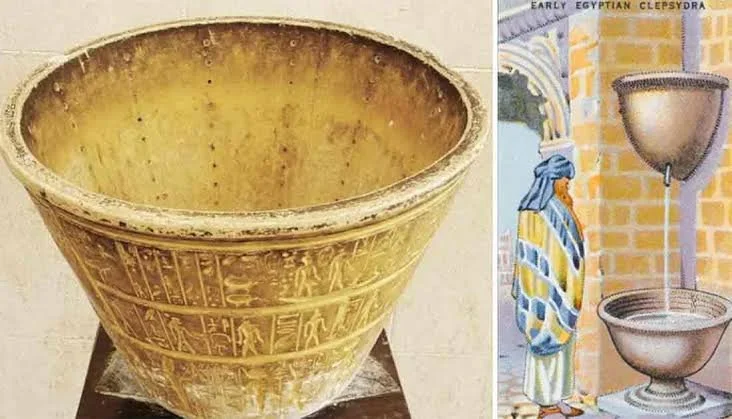
A water clock measures time through the movement of water.
One common design uses a vessel from which water flows at a controlled rate.
As the water level changes, markings on the vessel indicate elapsed time.
Other designs use a container that gradually fills.
The movement of a float can then indicate the passage of time.
More elaborate systems could incorporate gears, mechanical indicators, or other devices.
The accuracy of a water clock depended on its construction, water pressure, temperature, and the consistency of the flow.
Water Clocks in the Ancient and Medieval World
Water clocks were used in several ancient civilizations.
Greek and Roman examples included devices designed for measuring intervals during legal proceedings, public activities, and scientific observations.
In the medieval Islamic world, engineers developed increasingly sophisticated timekeeping devices.
Some incorporated elaborate mechanical features and artistic decoration.
These traditions influenced later technological developments across parts of the Mediterranean and Middle East.
Ottoman Timekeeping Traditions
Ottoman society used a variety of timekeeping systems.
Mechanical clocks became increasingly important in urban environments, particularly during the later Ottoman period.
Public clock towers appeared in different towns and cities.
Water clocks also belonged to a much older technological tradition, although they were not necessarily the dominant public timekeeping devices in Ottoman bazaars.
Religious timekeeping often relied on astronomical observations and established local practices.
The Bazaar as a Public Space
A bazaar was more than a collection of shops.
It was a center of economic and social interaction.
Merchants needed to coordinate deliveries, opening times, transactions, and transport.
Public buildings and commercial spaces could also become meeting points.
A timekeeping device located near a market might therefore have served practical and symbolic purposes.
However, a public clock near a bazaar would not necessarily have been a water clock.
Investigating a Proposed Kozani Water Clock
To establish the existence of an Ottoman water clock in Kozani, researchers would need documentary or material evidence.
Historical descriptions, municipal records, waqf documents, travel accounts, and architectural surveys could provide clues.
Archaeological remains might include a water container, channels, calibrated markings, mechanical components, or a purpose-built structure.
The device's date and function would need to be established independently.
A fountain or water installation should not automatically be interpreted as a clock.
Engineering and Water Supply
A functioning water clock required a controlled supply of water.
The system might depend on a reservoir, channel, cistern, or manually filled container.
Water quality and flow consistency affected accuracy.
In a town such as Kozani, an installation would also need maintenance.
The relationship between the proposed clock and nearby water infrastructure would therefore be important to its interpretation.
Conservation and Reconstruction
Water clocks can be difficult to reconstruct because their mechanisms may be incomplete.
Organic components such as wood could decay, while metal parts might corrode.
Stone or ceramic vessels may survive more effectively, but their original functions can be ambiguous.
Digital reconstruction can help researchers test how a proposed mechanism might have operated.
Any reconstruction should be based on surviving evidence and comparisons with securely documented historical devices.
Conclusion
Ottoman water clocks in the Kozani Bazaar would offer an intriguing perspective on the history of technology and everyday commercial life in western Macedonia.
A functioning water clock could have helped organize public activity and demonstrated the practical engineering knowledge available in the Ottoman world.
However, the specific claim of water clocks in Kozani's bazaar remains unverified without documentary or archaeological evidence. The broader history of water-based timekeeping is well established, but identifying a particular Kozani device requires evidence of its mechanism, location, and date.