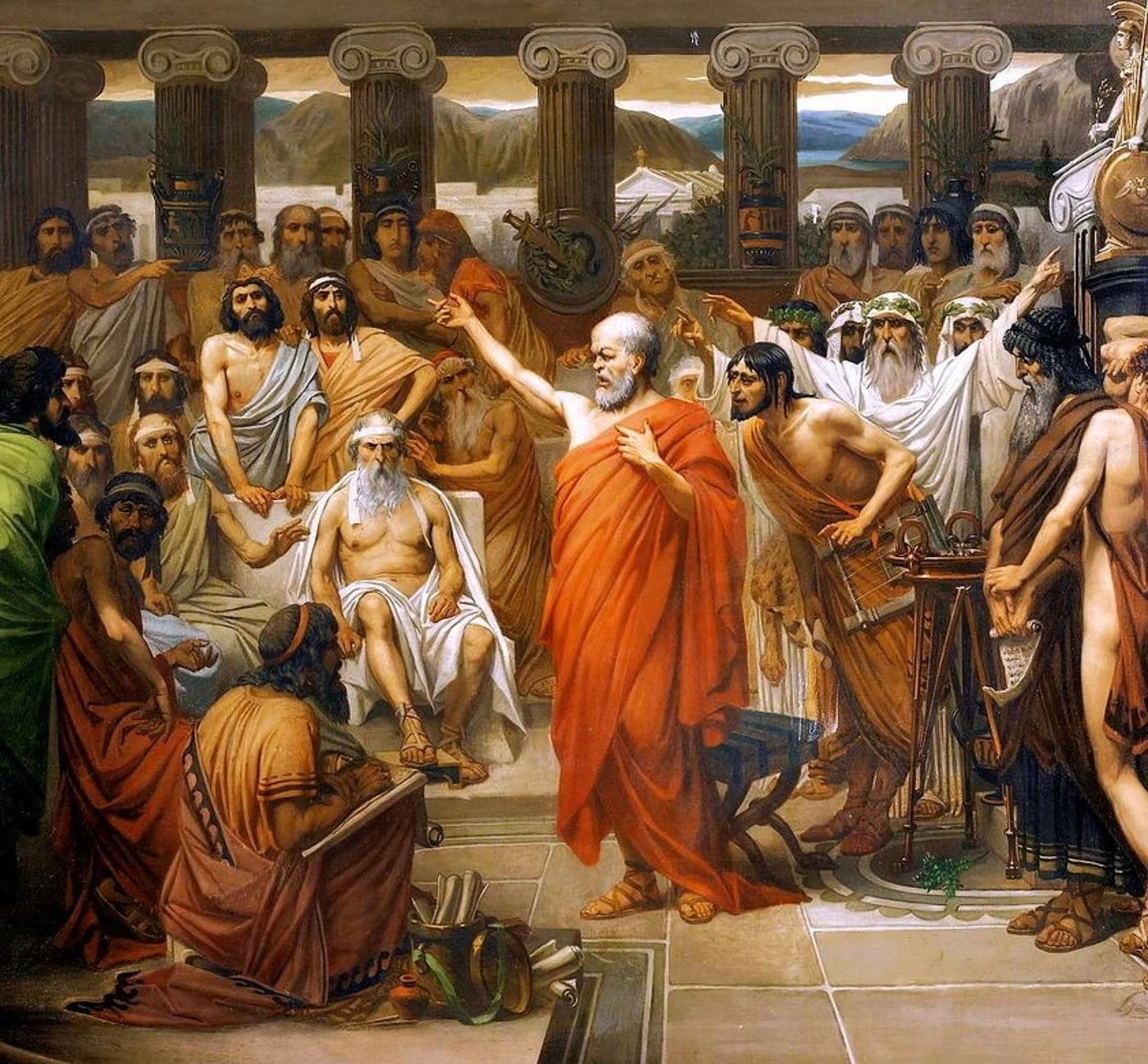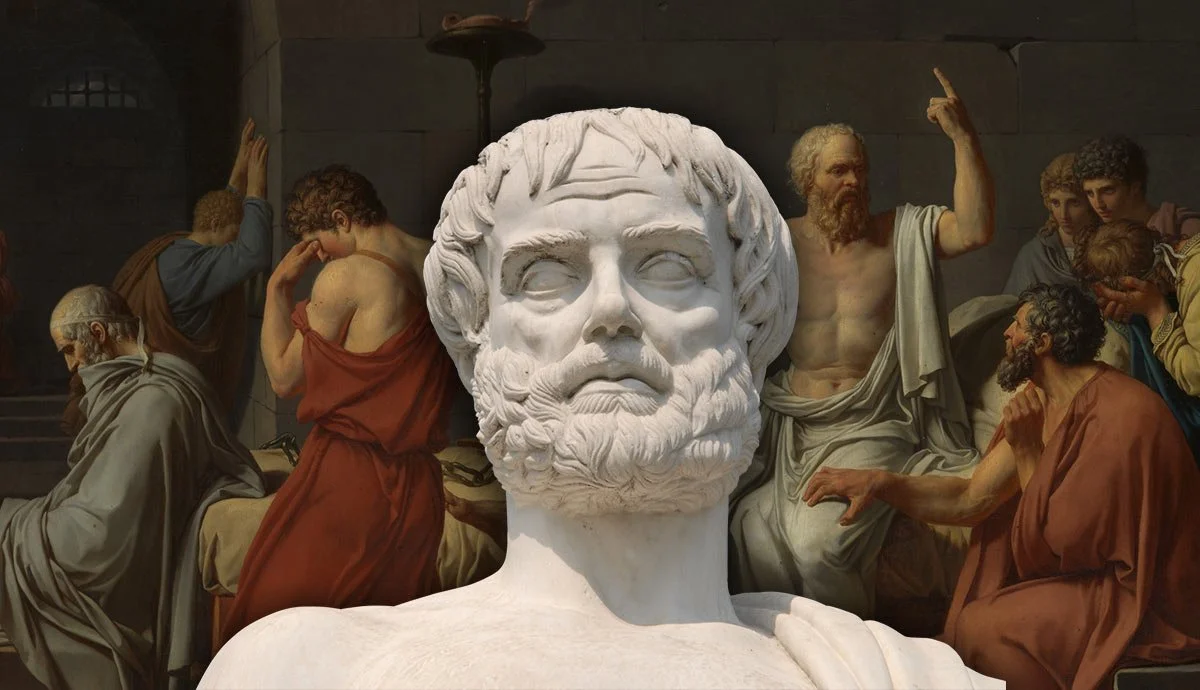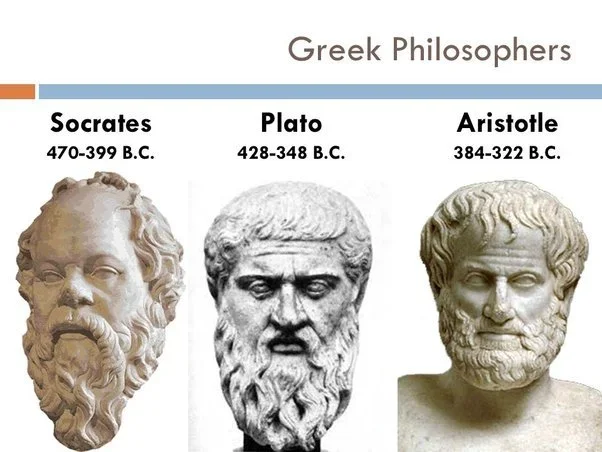
Socrates, Plato, and Aristotle form one of the most influential intellectual lineages in the history of philosophy.
They lived in different generations, yet their ideas are connected through a remarkable teacher-student relationship.
Socrates taught Plato.
Plato founded the Academy and taught Aristotle.
Aristotle eventually developed philosophical positions that differed substantially from those of Plato.
Together, they represent three major stages in the development of classical Greek philosophy.
Comparing them reveals both continuity and disagreement.
Socrates: Philosophy as Examination
Socrates lived in Athens during the fifth century BCE.
Unlike Plato and Aristotle, he left no known writings of his own.
Most knowledge about him comes from later authors, particularly Plato and Xenophon, as well as the comic playwright Aristophanes.
This creates what scholars often call the Socratic problem: determining how accurately later sources represent the historical Socrates.
Nevertheless, a recognizable philosophical image emerged.
Socrates spent much of his life questioning people about concepts such as justice, courage, virtue, piety, and knowledge.
He was less interested in memorizing information than in examining assumptions.
The Socratic Method
The Socratic method typically involves questioning.
Someone claims to know what justice is.
Socrates asks for a definition.
The person provides one.
Socrates identifies an example that seems inconsistent with the definition.
The definition is revised.
Another problem emerges.
The process continues.
The goal is not necessarily to embarrass the person.
Ideally, the process reveals the difference between believing something and genuinely understanding it.
This intellectual humility became one of Socrates' most enduring contributions.
Socrates and Virtue
Socrates frequently connected knowledge and virtue.
He explored whether people who truly understand what is good can knowingly choose evil.
His ethical philosophy therefore focuses heavily on the condition of the soul.
Wealth, reputation, and political power are less important than becoming a good person.
This emphasis distinguishes Socrates from purely rhetorical approaches to education.
Plato: Building a Philosophical System
Plato was one of Socrates' most important students.
Unlike Socrates, Plato wrote extensive philosophical dialogues.
His works address metaphysics, ethics, political philosophy, epistemology, education, psychology, art, and cosmology.
Plato transformed the Socratic practice of questioning into a broader philosophical system.
The Theory of Forms
One of Plato's most famous ideas is the Theory of Forms.
According to this framework, the changing physical world does not provide the deepest level of reality.
Things that we encounter through our senses are imperfect examples of more stable realities or Forms.
For example, beautiful objects differ from one another, yet humans can discuss beauty itself.
Plato uses such distinctions to explore the relationship between particular things and universal concepts.
Modern philosophers disagree about how literally Plato intended the Forms to be understood.
Nevertheless, the theory became one of the defining ideas of ancient metaphysics.
Plato's Allegory of the Cave
The Allegory of the Cave in Republic provides one of Plato's most famous images.
Prisoners are chained inside a cave and can see only shadows projected onto a wall.
They mistake the shadows for reality.
One prisoner eventually escapes and discovers the outside world.
The journey represents intellectual education.
Education is not simply placing information into an empty mind.
It is a transformation in how reality is understood.
Aristotle: Observation and Analysis
Aristotle studied at Plato's Academy for approximately two decades.
He later founded his own school, the Lyceum.
Although deeply influenced by Plato, Aristotle disagreed with important aspects of Platonic philosophy.
He became more interested in analyzing the physical world through systematic observation, classification, and investigation.
His works cover extraordinary subjects.
He studied animals, constitutions, logic, rhetoric, poetry, ethics, metaphysics, and natural phenomena.
Aristotle's Four Causes
Aristotle developed the theory of four causes to explain things.
These include:
material cause;
formal cause;
efficient cause;
final cause.
Consider a statue.
The material cause is the substance from which it is made.
The formal cause concerns its form.
The efficient cause concerns the maker or process that produced it.
The final cause concerns its purpose.
This framework demonstrates Aristotle's interest in explaining things through multiple dimensions rather than a single principle.
Ethics: Three Different Approaches
The differences between the three philosophers become particularly interesting in ethics.
Socrates
Socrates focuses heavily on virtue and knowledge.
The central concern is the condition of the soul.
Plato
Plato develops a broader theory in which justice involves proper order within both the individual and the political community.
The rational part of the soul should govern.
Aristotle
Aristotle develops the concept of eudaimonia, usually translated as flourishing or living well.
A good life involves developing virtues through practice and habit.
These theories overlap but are not identical.
Aristotle's Golden Mean
Aristotle famously describes virtue as a mean between extremes.
Courage, for example, lies between cowardice and recklessness.
Generosity lies between stinginess and wastefulness.
The "mean" does not mean mathematical equality.
The appropriate response depends on circumstances.
A courageous action in one situation could be reckless in another.
Therefore, practical judgment is essential.
Political Philosophy
The three thinkers also differed in their political interests.
Socrates did not leave a systematic political treatise.
Plato examined political organization extensively, especially in Republic and Laws.
His ideal political system in Republic is organized around social functions and philosophical education, with philosopher-rulers governing the ideal city.
Aristotle took a more empirical approach.
In Politics, he examines different constitutions and considers how political systems function.
His analysis is based partly on comparative study of constitutions.
Plato and Aristotle on Reality
Perhaps their deepest disagreement concerns metaphysics.
Plato gives Forms a fundamental role in explaining reality and knowledge.
Aristotle criticizes the separation of Forms from physical things.
For Aristotle, form and matter are integrated into concrete substances.
This difference became enormously influential.
Later philosophical traditions often had to position themselves in relation to Platonic and Aristotelian metaphysics.
Their Approaches to Knowledge
Socrates emphasizes questioning.
Plato emphasizes rational understanding and intellectual ascent.
Aristotle combines reasoning with systematic investigation of the natural world.
These differences are important.
Socrates asks:
What do you really know?
Plato asks:
What is the deeper reality behind appearances?
Aristotle asks:
How can we systematically understand the things that exist?
These are simplified formulations, but they capture something of their differing intellectual styles.
Their Influence
The influence of these philosophers is difficult to exaggerate.
Plato influenced Christian, Islamic, Jewish, and European philosophy.
Aristotle became foundational to medieval philosophy and later influenced scientific and educational traditions.
Socrates became a symbol of philosophical inquiry and intellectual integrity.
Their works continue to be studied because their questions remain relevant.
Three Philosophers, Three Styles
Socrates can be associated with questioning.
Plato can be associated with system-building and metaphysical inquiry.
Aristotle can be associated with classification, observation, and systematic analysis.
These labels should not be treated as absolute.
Socrates developed arguments.
Plato investigated empirical questions.
Aristotle engaged deeply with abstract metaphysics.
Still, the contrast helps illustrate their distinctive contributions.
Conclusion
Socrates, Plato, and Aristotle should not be viewed as three thinkers who simply repeated the same philosophy.
They formed a chain of influence, but each transformed what he inherited.
Socrates emphasized examination and ethical self-knowledge.
Plato transformed Socratic questioning into a vast philosophical vision involving Forms, knowledge, justice, politics, and the soul.
Aristotle inherited Plato's philosophical tradition while developing a distinctive approach centered on systematic analysis, empirical investigation, logic, ethics, and natural philosophy.
Their disagreements are just as important as their similarities.
Together, they demonstrate that philosophy develops not only through agreement but through criticism, revision, and reinterpretation.
That intellectual relationship is one of the reasons their work remains central to the history of Western philosophy.