Ancient Greece is not a single archaeological destination.
It is an enormous historical landscape scattered across mountains, valleys, islands, coastal plains, and modern cities. Temples stand beside modern streets. Ancient theaters remain embedded in hillsides. Fortifications overlook the same landscapes that Bronze Age rulers once controlled.
For anyone interested in archaeology and history, Greece offers the unusual opportunity to encounter ancient monuments within the landscapes where their original communities lived.
The following ten sites represent different dimensions of Greek civilization—from Bronze Age palace culture to Classical religion, theater, athletics, Byzantine civilization, and ancient technology.
1. The Acropolis of Athens
The Acropolis is arguably the most recognizable archaeological landscape in Greece.
The rocky hill rises above Athens and has been associated with human occupation and fortification for thousands of years. UNESCO notes that the earliest major fortification dates to the Mycenaean period, while the hill gradually developed a strong religious identity associated with Athena.
The monuments most visitors associate with the Acropolis belong primarily to the fifth century BCE.
They include:
the Parthenon;
the Erechtheion;
the Propylaea;
the Temple of Athena Nike.
The Parthenon was dedicated to Athena and became one of the defining achievements of Classical Greek architecture.
But the Acropolis is more than a collection of temples.
It represents the intersection of religion, politics, art, architecture, civic identity, and imperial ambition.
Standing on the Acropolis also provides an opportunity to understand Athens geographically. The hill dominates the surrounding urban landscape, helping explain its defensive and symbolic importance.
2. Delphi
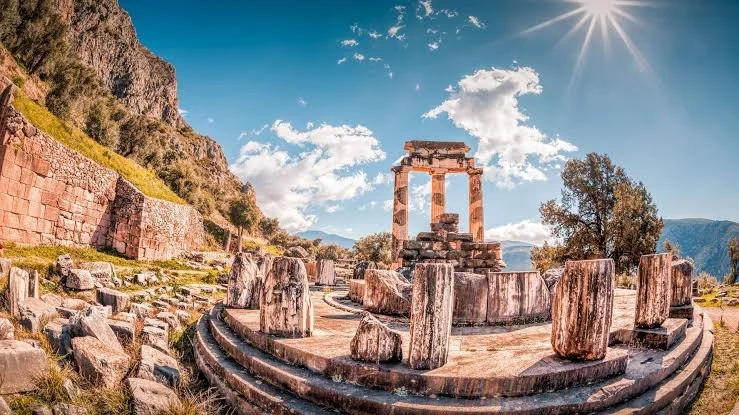
Delphi was one of the most important religious centers of the ancient Greek world.
Located on the slopes of Mount Parnassus, the sanctuary of Apollo became famous for its oracle, where the priestess known as the Pythia delivered prophetic responses.
Ancient Greeks regarded Delphi as the omphalos, or "navel," of the world.
UNESCO describes Delphi as a Pan-Hellenic sanctuary whose religious and political influence expanded substantially from the eighth century BCE onward.
Visitors today encounter remains including:
the Temple of Apollo;
the Sacred Way;
ancient treasuries;
the theater;
the stadium;
the archaeological museum.
The landscape is essential to understanding the site.
Delphi was not built on an empty plain.
Its dramatic mountains and cliffs contributed to its sacred character.
The sanctuary also reveals the competitive nature of Greek city-states. Cities dedicated treasuries and monuments at Delphi, demonstrating wealth, political identity, and religious devotion.
3. Olympia
Olympia was the sanctuary of Zeus and the birthplace of the ancient Olympic Games.
The site was inhabited long before the Classical period and became an important religious center by the first millennium BCE.
The Olympic Games were traditionally held every four years, with the earliest recorded celebration conventionally dated to 776 BCE. UNESCO identifies Olympia as simultaneously a religious, political, and athletic center.
The archaeological site includes:
the Temple of Zeus;
the Temple of Hera;
the ancient stadium;
the palaestra;
the gymnasium;
treasuries;
administrative buildings;
workshops.
One of Olympia's most fascinating features is the relationship between athletic competition and religion.
The Games were not originally a secular sporting event.
Athletics existed within a sacred environment dedicated to the gods.
The famous olive wreath awarded to victors was symbolically far more important than a modern financial prize.
4. Mycenae
Mycenae transports visitors much further back in time.
The city was one of the major centers of the Mycenaean civilization during the Late Bronze Age.
UNESCO identifies Mycenae and nearby Tiryns as among the most important surviving archaeological representatives of Mycenaean civilization, which flourished particularly between approximately the 15th and 12th centuries BCE.
The site's most famous feature is the Lion Gate.
Massive defensive walls surround the citadel.
These walls became known as "Cyclopean" because later Greeks believed that only enormous mythical Cyclopes could have moved such enormous stones.
The site is also associated with the legendary Agamemnon.
Archaeology, however, must be distinguished from Homeric mythology.
The archaeological Mycenaean world predates the Classical Greek civilization by centuries, while the historical relationship between the real Bronze Age rulers and later Homeric characters remains uncertain.
5. Epidaurus
Epidaurus is famous for its ancient theater.
But the theater was only one part of a much larger sanctuary dedicated to Asklepios, the Greek god associated with healing.
The sanctuary became one of the ancient Mediterranean's important centers of medicine and religious healing.
The theater is renowned for its proportions and acoustics. UNESCO describes it as an exceptionally accomplished ancient theater whose design and acoustic qualities have attracted sustained scholarly attention.
The theater demonstrates the sophistication of Greek architecture.
Its semicircular seating arrangement allows audiences to see the performance while its geometry helps distribute sound.
But the surrounding sanctuary provides a broader historical lesson.
Ancient medicine was not separated neatly from religion.
Healing could involve ritual, prayer, dreams, sacred space, physical treatment, and observation.
6. Mystras
Mystras introduces a completely different period of Greek history.
Located near modern Sparta, Mystras is a remarkably preserved Byzantine settlement.
The city developed around a fortress built in 1249 by William II of Villehardouin, ruler of the Frankish Principality of Achaea. It was later taken by the Byzantines and became a major center of political and cultural power in the Peloponnese.
Mystras became the capital of the Byzantine Despotate of Morea.
Its churches preserve important examples of Late Byzantine architecture and fresco painting.
The city also became an intellectual center.
The philosopher Georgios Gemistos Plethon lived there and contributed to the revival of interest in ancient Greek philosophical thought.
Walking through Mystras therefore provides an unusual perspective on Greek history.
Ancient Greece did not simply disappear after the Classical period.
Greek intellectual and artistic traditions continued through the Byzantine world.
7. Ancient Corinth
Ancient Corinth occupied a strategically important position between mainland Greece and the Peloponnese.
Its location allowed it to participate in maritime and overland trade.
The archaeological site contains the remains of temples, streets, fountains, administrative structures, and other buildings that reveal the city's long history.
The Temple of Apollo is among the most recognizable surviving monuments.
Corinth is particularly useful for understanding how geography influenced Greek urban development.
Its location near important routes allowed the city to become commercially and politically significant.
8. Delos
Delos is one of the most extraordinary archaeological islands in Greece.
According to Greek mythology, it was associated with the births of Apollo and Artemis.
Historically, it became an important religious and commercial center.
Today the island is essentially an enormous archaeological landscape, with temples, houses, mosaics, sanctuaries, and public buildings spread across the terrain. The Greek tourism authority describes Delos as one of the country's most significant island archaeological sites, with exceptionally extensive remains from the Archaic through Hellenistic periods.
The residential areas are particularly valuable.
They reveal that ancient cities were not simply collections of temples.
People lived, worked, traded, worshipped, entertained themselves, and decorated their homes.
9. Knossos
Knossos on Crete is essential for understanding the Minoan civilization.
The palace complex is associated with a Bronze Age society that flourished long before Classical Athens.
The site became famous through the excavations of Arthur Evans, whose interpretations influenced the modern image of the Minoans.
Knossos is particularly important for its architecture, frescoes, storage facilities, administrative spaces, and relationship to Linear A and Linear B writing.
The famous Minotaur story is connected to Crete through later Greek mythology.
However, the archaeological palace should not simply be treated as the literal historical setting of the myth.
Knossos represents a much older civilization whose relationship with later Greek mythology remains an important subject of interpretation.
10. Ancient Thera
Ancient Thera occupies a spectacular position high on the island of Santorini.
The settlement preserves remains from several historical periods and offers extraordinary views across the Aegean.
The location demonstrates how geography shaped ancient communities.
From a high position, inhabitants could observe the surrounding sea routes and landscape.
Ancient Thera also helps demonstrate that Greek archaeology is not limited to famous mainland sanctuaries.
The Aegean islands were connected to broad networks of migration, trade, religion, and cultural exchange.
Why These Sites Matter
These ten sites represent different dimensions of Greek civilization.
The Acropolis represents Classical Athens.
Delphi represents religious authority.
Olympia represents athletic and religious competition.
Mycenae represents Bronze Age palace culture.
Epidaurus represents ancient healing and theater.
Mystras represents Byzantine Greece.
Corinth represents commerce.
Delos represents sacred and commercial island life.
Knossos represents Minoan Crete.
Ancient Thera represents the archaeological complexity of the Aegean.
Together, they demonstrate that "ancient Greece" was never one uniform civilization.
It changed dramatically across thousands of years.
Conclusion
Visiting Greek archaeological sites is not simply about seeing ruins.
It is about reconstructing landscapes.
At Mycenae, massive walls evoke the power of Bronze Age palaces.
At Delphi, mountains help explain religious symbolism.
At Olympia, athletic spaces reveal the relationship between sport and worship.
At Mystras, Byzantine churches demonstrate the continuation of Greek cultural traditions long after the Classical period.
The greatest value of these sites is therefore not simply their age.
It is their ability to connect architecture, landscape, mythology, politics, religion, technology, and everyday human life.