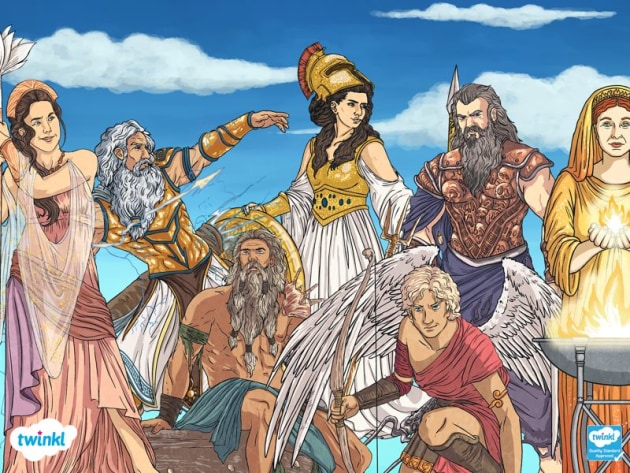
Greek mythology begins with a universe that looks very different from the world ruled by Zeus.
The earliest divine beings were not organized like the later Olympian gods.
Instead, the universe emerged through generations of primordial forces and divine beings.
Chaos
According to Hesiod's Theogony, the earliest entity was Chaos.
Chaos was not necessarily "confusion" in the modern sense.
The Greek term can refer to a primordial gap or yawning space.
From this primordial state came other beings.
Gaia
One of the most important was Gaia, the Earth.
Gaia became the foundation of the divine generations that followed.
She produced Uranus, the Sky, who became her partner.
Together they produced the Titans.
The Titans
The Titans were an earlier generation of powerful gods.
Among them were:
Cronus;
Rhea;
Oceanus;
Tethys;
Hyperion;
Theia;
Iapetus;
Mnemosyne;
Themis;
Phoebe;
Coeus;
Crius.
Cronus eventually overthrew Uranus.
But Cronus feared that his own children would overthrow him.
Cronus Swallows His Children
Cronus swallowed several of his children immediately after they were born.
Rhea managed to save Zeus.
She hid Zeus and gave Cronus a stone wrapped in cloth instead.
Cronus swallowed the stone believing it was his son.
Zeus grew up in secret.
Zeus Returns
Eventually Zeus confronted Cronus.
He forced his father to release his swallowed siblings.
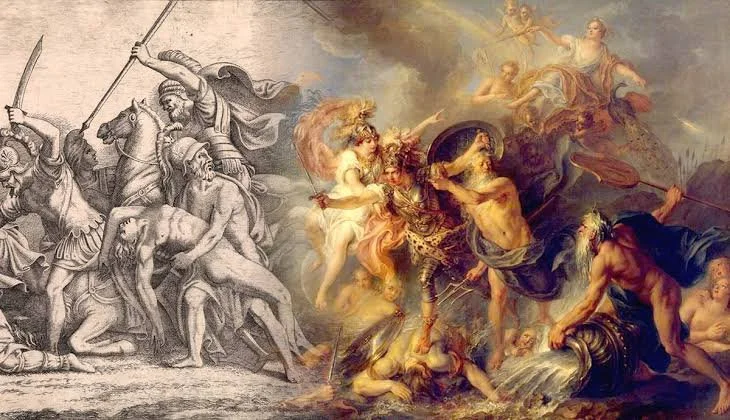
The gods then joined Zeus against the Titans.
This conflict became known as the Titanomachy.
The Olympians Win
Zeus and his allies eventually defeated the Titans.
The victorious gods divided the universe.
Zeus received the sky.
Poseidon received the sea.
Hades received the Underworld.
The Earth remained a shared domain rather than being divided in exactly the same way.
Humanity
Greek mythology contains several different traditions concerning the creation of humans.
One famous tradition associates humanity with Prometheus, who shaped or assisted humans and gave them fire.
Other traditions involve successive ages of humanity.
This demonstrates that Greek mythology was not one single standardized storybook.
Different poets and communities preserved different versions.
Conclusion
The Greek creation myth is essentially a story about generations of divine power.
Primordial beings give way to Titans.
The Titans are replaced by Olympians.
And the Olympians establish the divine order familiar from later Greek mythology.