Introduction
The title Hidden Slavic Athinganoi Musicians in Crete Hinterlands combines several historically complex categories: Slavic migration, the medieval term "Athinganoi," and the history of itinerant musicians.
The subject requires considerable caution.
"Athinganoi" is a Byzantine-era term whose precise social meaning has been debated. It has sometimes been connected historically with groups later associated with Roma, but equating every medieval use of the term directly with modern Romani communities is problematic.
Likewise, evidence for a specifically Slavic group of "Athinganoi musicians" hidden in the Cretan hinterland is not firmly established.
Slavic Movements in the Balkans
Slavic-speaking populations expanded into parts of the Balkans during late antiquity and the early medieval period.
Their movements affected mainland Greece and other regions.
Crete, however, had a different historical trajectory because of its geographical position and the strength of Byzantine and later Islamic political structures.
Medieval Crete
Crete remained an important island throughout Byzantine history.
Its ports connected it with the Aegean, eastern Mediterranean, and North Africa.
The island's population included agricultural communities, merchants, soldiers, clergy, and craftsmen.
Cultural influences could therefore arrive through maritime networks.
The Athinganoi
The Byzantine term Athinganoi appears in medieval sources and has generated significant scholarly debate.
The term should not be treated as a simple equivalent for one modern ethnic group.
Historical labels can change meaning.
They may describe religious communities, occupational groups, outsiders, or populations perceived as socially distinct.
Music and Mobility
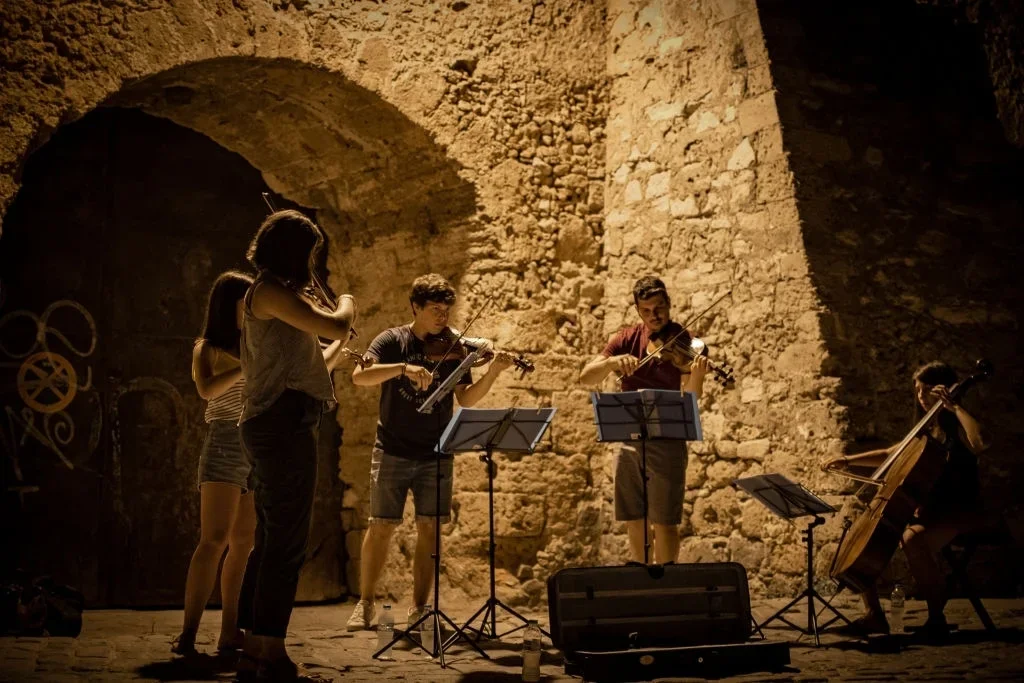
Musicians often traveled.
Performers could work at:
religious celebrations,
weddings,
markets,
courts,
festivals,
military camps,
and village gatherings.
Music could therefore provide a pathway for cultural exchange.
The Cretan Hinterland
Crete's mountainous interior historically contained villages separated by difficult terrain.
Travel between communities required knowledge of mountain paths.
Musicians and itinerant workers could move between settlements.
However, the existence of traveling musicians does not by itself establish an ethnic identity.
Slavic-Cretan Connections
Slavic influence on Crete is a subject requiring careful examination.
The island experienced repeated waves of migration and political transformation.
Names, language, archaeological material, and historical documents can sometimes reveal outside influences.
But identifying a specific hidden Slavic community requires stronger evidence.
Music as Historical Evidence
Music is often poorly preserved archaeologically.
Unlike pottery or stone architecture, musical traditions can disappear without physical remains.
Researchers therefore rely on:
manuscripts,
instruments,
iconography,
terminology,
oral traditions,
and comparative ethnomusicology.
Conclusion
The Hidden Slavic Athinganoi Musicians in Crete Hinterlands should be regarded as a speculative historical theme rather than a confirmed hidden population.
The Byzantine term Athinganoi is historically real, and Slavic movements across the Balkans are well documented.
Itinerant musicians were also common in many premodern societies.
What remains uncertain is whether these elements converged into a specific Slavic Athinganoi musical community in rural Crete.
The topic nevertheless demonstrates how difficult it can be to reconstruct the lives of mobile people whose activities were rarely recorded by elite historical writers.