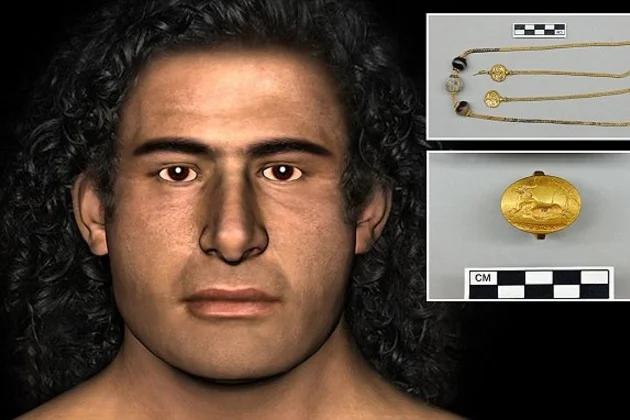
Archeologists say they have discovered the ‘real’ ‘Lord of the Rings’, after a 3,500 old ancient warrior’s skeleton was unearthed amid a treasure trove of ancient artifacts in Greece. The grave was discovered in the spring of 2015 by Jack L. Davis and Sharon R. Stocker, a husband-and-wife team at the University of Cincinnatiwho have been excavating at Pylos for 25 years. What he and Dr. Stocker had stumbled on was a very rare shaft grave, 5 feet deep, 4 feet wide and 8 long. Remarkably, the burial was intact apart from a one-ton stone, probably once the lid of the grave, which had fallen in and crushed the wooden coffin beneath. The coffin has long since decayed, but still remaining are the bones of a man about 30 to 35 years old and lying on his back. Placed to his left were weapons, including a long bronze sword with an ivory hilt clad in gold and a gold-hilted dagger. On his right side were four gold rings with fine Minoan carvings and some 50 Minoan seal stones carved with imagery of goddesses and bull jumpers.
An ivory plaque carved with a griffin, a mythical animal that protected goddesses and kings, lay between the warrior’s legs. The grave contained gold, silver and bronze cups.
The top of the warrior’s shaft grave lies at ground level, seemingly so easy to find that it is quite surprising the tomb lay intact for 35 centuries.
Archaeologists expressed astonishment at the richness of the find and its potential for shedding light on the emergence of the Mycenaean civilization, the lost world of Agamemnon, Nestor, Odysseus and other heroes described in the epics of Homer. The warrior’s grave belongs to a time and place that give it special significance. He was buried around 1500 B.C., next to the site on Pylos on which, many years later, arose the palace of Nestor, a large administrative center that was destroyed in 1180 B.C., about the same time as Homer’s Troy. The palace was part of the Mycenaean civilization; from its ashes, classical Greek culture arose several centuries later. The palaces found at Mycene, Pylos and elsewhere on the Greek mainland have a common inspiration: All borrowed heavily from the Minoan civilization that arose on the large island of Crete, southeast of Pylos. The Minoans were culturally dominant to the Mycenaeans but were later overrun by them.