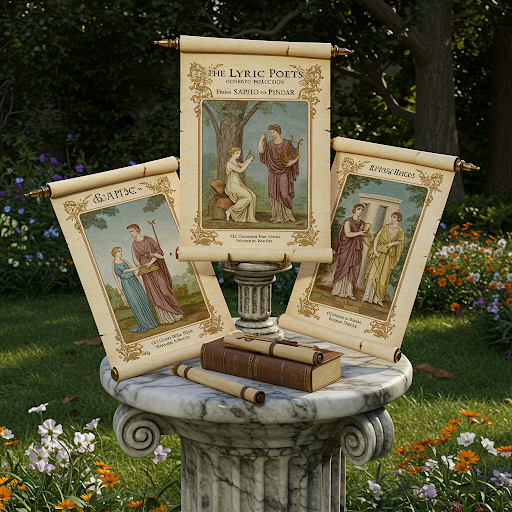
Lyric poetry, a cornerstone of ancient Greek literature, offers an intimate glimpse into personal emotions, social customs, and public celebrations. Distinguished from epic poetry by its focus on individual expression, lyric poetry flourished from the 7th to the 5th centuries BCE. Poets like Sappho and Pindar exemplified this genre, shaping its evolution and leaving a legacy that continues to resonate today.
Sappho: The Poetess of Love and Longing
Sappho of Lesbos (circa 630–570 BCE) stands as one of antiquity’s most revered lyric poets. Renowned for her passionate explorations of love, desire, and personal reflection, Sappho’s poetry was often performed with the accompaniment of a lyre, a defining characteristic of the genre. Her verses, though surviving only in fragments, reveal a profound sensitivity to human emotions and relationships.
One of her most famous works, the Ode to Aphrodite, exemplifies her plea for divine intervention in matters of the heart. Sappho's portrayal of longing and vulnerability transcends time, making her a symbol of personal and poetic expression. Her influence extended far beyond her lifetime, inspiring countless poets and thinkers across cultures.
Alcaeus: The Voice of Politics and Exile
A contemporary of Sappho, Alcaeus of Lesbos (circa 620–560 BCE) infused his poetry with political fervor and personal struggle. His verses reflect the turbulence of his era, marked by political upheaval and personal exile. Alcaeus’ poems celebrated friendship and loyalty while condemning tyranny, offering a window into the political landscape of ancient Greece.
Anacreon: The Poet of Wine and Revelry
Anacreon (circa 570–485 BCE) carved out a niche with his light-hearted poetry centered on themes of wine, love, and festivity. His works embodied the spirit of conviviality, capturing the pleasures of life with a playful elegance. Anacreon's poetry became synonymous with hedonism, influencing the tradition of "Anacreontic" verse that endured through the ages.
Pindar: The Laureate of Victory
Pindar (circa 518–438 BCE) elevated lyric poetry to new heights through his epinician odes, composed to celebrate victories in athletic competitions such as the Olympic Games. His poems are renowned for their grand style, blending mythology, moral reflection, and praise for athletic prowess. Pindar’s intricate use of language and structure set a benchmark for lyrical excellence, reflecting both the personal achievements of the victors and the cultural values of ancient Greece.
One of his most famous lines, “Become what you are,” encapsulates his belief in the pursuit of excellence and the fulfillment of one's potential. Pindar’s work not only honored athletic triumphs but also connected human endeavors with divine will, underscoring the spiritual dimensions of achievement.
Legacy and Influence
The lyric poets of ancient Greece profoundly shaped the literary landscape, offering a more personal and emotive counterpoint to the grand narratives of epic poetry. Their exploration of love, politics, revelry, and glory captured the breadth of human experience, leaving a legacy that endured through Roman times and into the modern era.
The works of Sappho, Alcaeus, Anacreon, and Pindar remain pillars of poetic expression. Their verses continue to inspire readers and poets alike, serving as timeless reminders of the power of words to articulate the joys and sorrows of the human condition.
Conclusion
From Sappho’s tender musings on love to Pindar’s exaltation of athletic glory, Greek lyric poetry stands as a testament to the richness of personal expression in antiquity. These poets not only shaped Greek literature but also laid the groundwork for future poetic traditions, ensuring their voices echo through the ages.