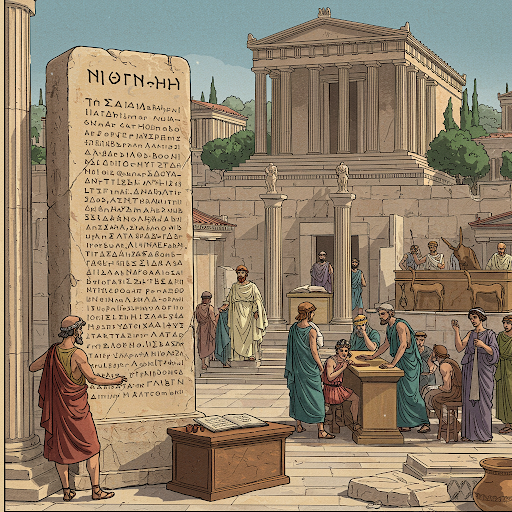
The development of law codes in ancient Greece played a crucial role in shaping political institutions, social structures, and the evolution of justice. Among the most influential legal reforms were those of Solon of Athens, whose changes laid the foundation for democracy. However, legal evolution did not stop with Solon—other city-states and later lawmakers continued to refine and implement new laws that influenced Greek society for centuries.
Solon’s Reforms: A Turning Point for Athenian Law
In the early 6th century BCE, Athens was in a state of social and economic turmoil. The Draconian laws, established earlier in the century, were notorious for their extreme harshness—most offenses, even minor ones, were punishable by death. Debt slavery was widespread, and economic inequality fueled tensions between the aristocracy and common citizens. To address these crises, Solon, a statesman and lawgiver, was appointed Archon (chief magistrate) in 594 BCE and tasked with reforming Athenian law.
Key Legal Reforms of Solon:
Abolition of Debt Slavery – Solon canceled existing debts and freed citizens who had been enslaved due to unpaid debts (Seisachtheia, or “shaking off burdens”). This provided economic relief and prevented further exploitation of the poor.
New Class System Based on Wealth, Not Birth – Solon divided Athenian society into four economic classes, with political participation based on wealth rather than aristocratic lineage. This allowed for greater upward mobility and a more inclusive political system.
Creation of the Heliaia (People’s Court) – He introduced a system where ordinary citizens could appeal legal decisions and participate in jury trials, establishing a more equitable judicial process.
Encouragement of Economic Growth – Solon promoted trade and industry by encouraging the cultivation of olives and restricting grain exports, ensuring local food security.
Standardization of Laws – He rewrote and published Athenian laws on wooden tablets, making them accessible to all citizens rather than a privileged few.
Impact of Solon’s Reforms:
Solon’s reforms did not establish democracy but created a more balanced society by reducing aristocratic dominance and allowing greater participation from non-nobles. His laws served as the foundation for later democratic developments under Cleisthenes (508 BCE) and Pericles (5th century BCE). However, Solon’s changes did not completely eliminate inequality—factional conflicts persisted, leading to the brief rule of the tyrant Pisistratus before democratic reforms fully took hold.
Legal Developments After Solon
Cleisthenes and Democratic Reforms (508 BCE)
While Solon laid the groundwork, Cleisthenes is credited with introducing key democratic structures:
Reorganization of Tribes – He replaced traditional family-based tribes with ten geographically based tribes, breaking the power of aristocratic families.
Expansion of the Assembly (Ekklesia) – All male citizens could vote on important policies, further democratizing governance.
Ostracism – Citizens could vote to exile any politician deemed too powerful, preventing tyranny.
These reforms made Athenian democracy more inclusive and reduced the influence of elite families in government.
Law Codes in Other Greek City-States
Spartan Law: The Reforms of Lycurgus
Unlike Athens, Sparta was known for its rigid and militaristic legal system, attributed to Lycurgus (possibly a legendary figure). Spartan laws emphasized:
Equality among male citizens (homoioi) – Land and wealth were redistributed to maintain a strong warrior class.
Military Training (Agoge) – Boys were raised in state-controlled training programs to become soldiers.
Iron Currency – Gold and silver were banned to discourage corruption and wealth accumulation.
Spartan law created a highly disciplined and stable society but came at the cost of personal freedoms.
Gortyn Code (Crete, 5th Century BCE)
One of the best-preserved Greek legal texts, the Gortyn Code was engraved on a stone wall in Crete and outlined laws regarding:
Marriage, divorce, and inheritance
Slavery and property rights
Punishments for various crimes
This code provided a rare glimpse into legal protections for women and slaves in ancient Greece.
Conclusion: The Lasting Legacy of Greek Law
Greek legal reforms, particularly those of Solon, Cleisthenes, and Lycurgus, shaped governance and justice systems for centuries. While Athens moved toward democracy, Sparta remained an oligarchic military state, and other city-states developed their own legal traditions. These early law codes influenced Roman law and later Western legal systems, proving that the pursuit of justice and fair governance has always been a fundamental human concern.