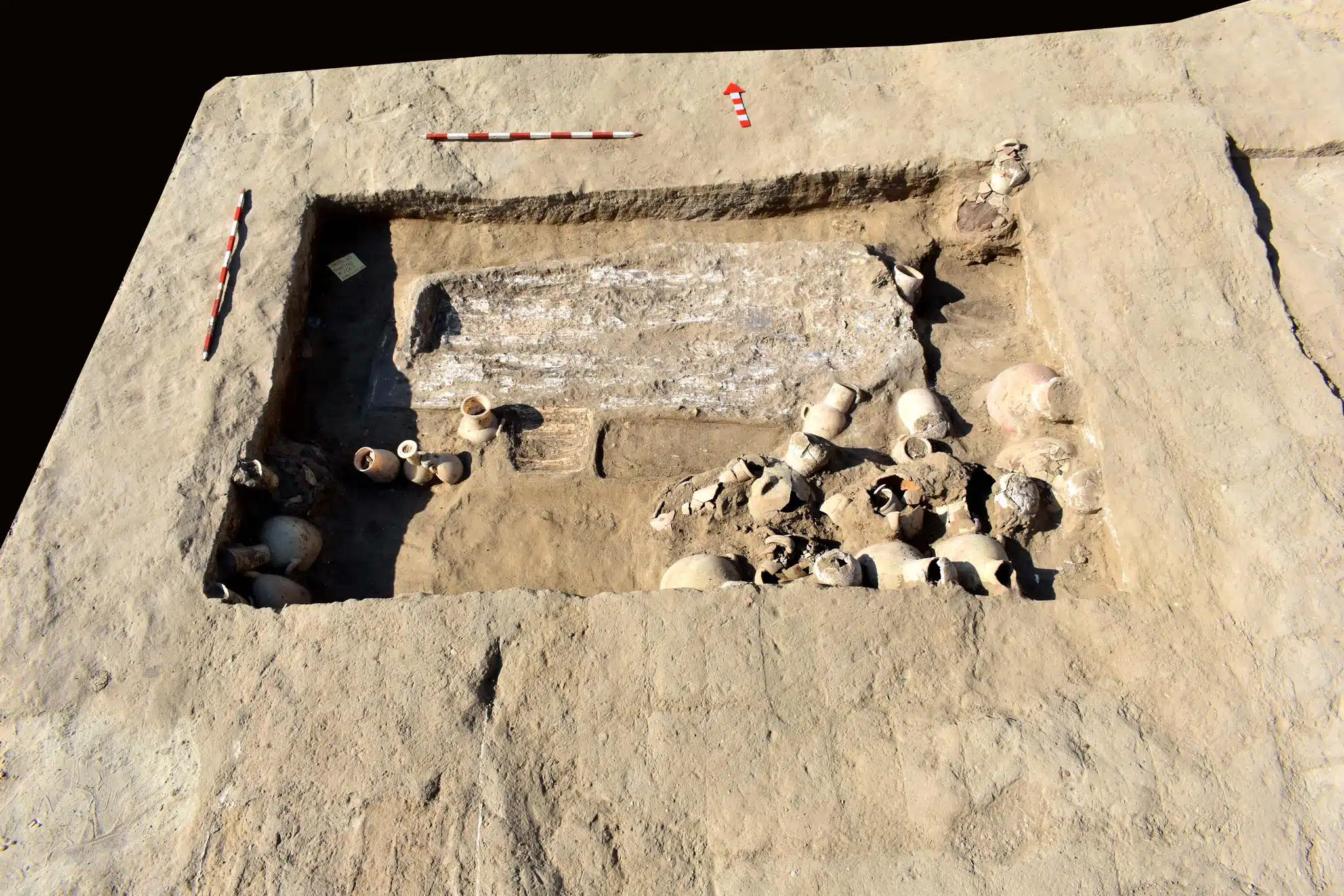
A Remarkable Discovery in Egypt’s Ismailia Governorate
Archaeologists have made a groundbreaking discovery at Tell Ruwad Iskandar, a significant historical site located in Egypt’s Ismailia Governorate. The excavation, led by an Egyptian archaeological team under the Supreme Council of Antiquities, unearthed an extensive burial site featuring Egyptian, Greek, and Roman graves, along with a collection of artifacts that offer profound insights into Egypt’s military, cultural, and religious history. Among the most notable finds is a gold ring inscribed with the cartouche of Ramses III, shedding light on the high-status individuals who were once buried in the area.
This discovery not only deepens our understanding of ancient burial customs but also highlights the enduring influence of multiple civilizations in Egypt. The findings suggest that Tell Ruwad Iskandar was a vital military and administrative hub, actively occupied across different periods.
Tell Ruwad Iskandar: A Strategic Military Site
The excavation site, Maskhouta, is located near Egypt’s eastern borders, an area known for its historical significance as a military outpost. According to Dr. Mohammed Ismail Khaled, Secretary-General of the Supreme Council of Antiquities, Tell Ruwad Iskandar played a crucial role in defending Egypt’s frontiers. The discovery of varied burial types and structures suggests that the area served as an active fortress, administrative center, and settlement for centuries.
The presence of fortifications and graves spanning different time periods indicates that Egyptians, Greeks, and Romans all recognized the strategic importance of this location, using it for military operations and as a burial ground for high-ranking officials and soldiers.
Tomb of an Egyptian Military Commander: A Window Into Egypt’s Past
One of the most spectacular finds at the site is the tomb of a high-ranking Egyptian military commander dating back to the reign of King Ramses III of the 20th Dynasty. The tomb, constructed from mudbrick, features a main burial chamber and three additional rooms, with walls coated in white plaster—a technique used to preserve the structure.
Artifacts Highlighting the Commander’s Status
Inside the tomb, archaeologists discovered a wealth of military and ceremonial artifacts, indicating the commander’s prestigious position and ties to the royal court. Among these treasures were:
Bronze arrowheads – Suggesting the commander’s involvement in military campaigns.
A scepter – A symbol of power and authority.
Alabaster vessels inscribed with the cartouche of King Horemheb, a famed warrior-pharaoh of the 18th Dynasty, hinting at a connection to earlier military traditions.
A gold ring inscribed with the cartouche of Ramses III – Indicating a direct link to the ruling pharaoh.
Personal Belongings and Luxury Items
In addition to military relics, several luxury artifacts were found, reflecting the commander’s elite status:
Beads and colorful stones – Likely used in decorative jewelry.
An ivory box – Possibly for storing valuable possessions or cosmetics.
These discoveries suggest that the commander was not only a powerful warrior but also a member of Egypt’s high-ranking aristocracy.
Greek and Roman Graves: Evidence of Cultural Fusion
Alongside the Egyptian tombs, archaeologists uncovered collective graves from the Greek and Roman periods, containing human skeletal remains. These burials exhibit a mixture of Egyptian and foreign influences, suggesting that diverse populations coexisted in the region during Hellenistic and Roman rule.
The presence of these graves indicates that Tell Ruwad Iskandar remained an important burial site for soldiers, merchants, and officials even after Egypt fell under Greek and later Roman control.
Late-Period Graves and Religious Artifacts
Further excavation revealed individual Late-Period burials, featuring amulets and religious artifacts linked to protective deities. Among the most fascinating finds were:
Amulets dedicated to Taweret – The goddess of fertility and childbirth, often invoked for protection.
Amulets of Bes – A dwarf-like deity associated with warding off evil spirits and misfortune.
These artifacts reflect the strong spiritual beliefs of the individuals buried at the site, demonstrating how religious practices persisted across different civilizations in Egypt.
The Significance of the Discovery
The excavation at Tell Ruwad Iskandar provides an unparalleled glimpse into Egypt’s complex history, showcasing the interactions between Egyptians, Greeks, and Romans. This discovery highlights:
Egypt’s military history – Through the burial of a high-ranking commander and the presence of weapons and military relics.
Cultural exchange – Demonstrated by the Greek and Roman burial practices integrated with traditional Egyptian customs.
Religious beliefs – Evident in the amulets and sacred artifacts found within the graves.
The Supreme Council of Antiquities has confirmed that further research will be conducted on the artifacts and skeletal remains to gain deeper insights into the individuals buried at the site. With excavation work set to continue, more groundbreaking discoveries are expected in the near future.
Conclusion: A Landmark Archaeological Discovery
The discovery of ancient Egyptian, Greek, and Roman graves at Tell Ruwad Iskandar is a major breakthrough in archaeological research. It not only confirms the region’s military and administrative significance but also sheds light on the cultural and religious influences that shaped Egypt over centuries. With further excavations planned, this site may yet reveal more secrets of the past, providing invaluable knowledge for historians and archaeologists worldwide.
Stay tuned for more updates on this incredible archaeological discovery as experts continue to unravel the mysteries buried beneath Egypt’s sands!