The floors of prehistoric houses can reveal much more than the physical layout of domestic buildings. Beneath their worn surfaces, tiny fragments of ash, plant fibers, animal remains, soil aggregates, and other materials may preserve evidence of how people lived, worked, and maintained their homes. In Neolithic villages, where settled agriculture and increasingly permanent dwellings became important in many regions, the repeated repair and replacement of floors can provide insight into household routines and the changing life of a building. Micromorphology is especially useful for investigating these processes because it allows archaeologists to examine the microscopic structure of archaeological sediments and identify traces that may be invisible during ordinary excavation.
Micromorphology involves the study of undisturbed sediment samples under a microscope. Researchers collect small blocks of sediment from archaeological layers, preserve their original structure, and prepare thin sections that can be examined using transmitted light and other analytical methods. These sections may reveal the arrangement of mineral grains, organic particles, ash, microscopic charcoal, and other components. Because the samples retain relationships between different materials, researchers can investigate how a floor was constructed, how it was used, and how it changed over time.
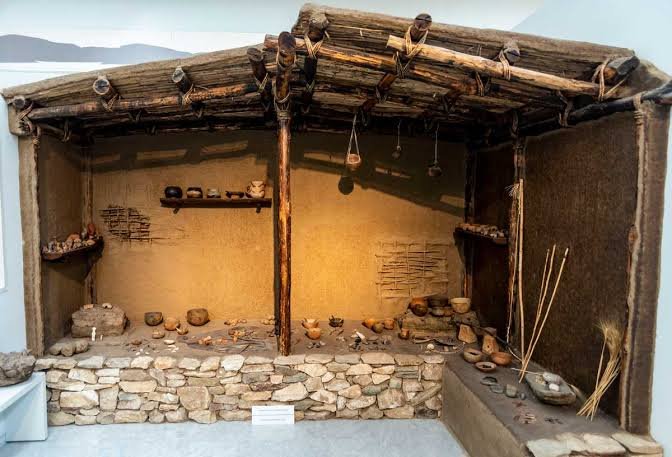
Neolithic floors were not necessarily permanent surfaces left untouched throughout the life of a house. Depending on the region, building materials, and household practices, floors might have been made from compacted earth, clay, plaster, stone, or mixtures of different materials. Residents could have swept away debris, added fresh clay, repaired damaged areas, or covered older surfaces with new layers. Repeated maintenance could gradually create a sequence of thin deposits that records the history of the dwelling. These layers may appear similar during excavation but contain important differences when examined microscopically.
The replacement of a floor could occur for several reasons. Daily movement might wear down the surface, while moisture could cause cracking, softening, or erosion. Fires, flooding, animal activity, and the accumulation of waste might also encourage residents to renew a floor. In some cases, rebuilding may have accompanied a wider renovation of the house, including changes to walls, entrances, hearths, or internal divisions. The decision to replace a floor was therefore not necessarily a response to damage alone. It could also reflect changing household needs or the desire to reorganize domestic space.
Micromorphology can help distinguish between a deliberately constructed floor and a naturally accumulated surface. A prepared floor may contain compacted particles, carefully arranged materials, or a relatively uniform layer that differs from the underlying soil. Repeated trampling can alter the orientation and distribution of particles, creating microscopic features consistent with regular movement across the surface. By contrast, naturally deposited sediment may display different structures, depending on water movement, wind deposition, or other environmental processes. The distinction is important because a layer that looks flat in an excavation trench may have formed without deliberate construction.
The microscopic remains of daily activities can also reveal how different parts of a house were used. Ash and charcoal may indicate the movement of material from a hearth, while plant fibers and phytoliths may be associated with bedding, food processing, or other plant-related activities. Small bone fragments, shell particles, and organic residues may provide clues about food preparation or waste disposal. However, these materials can be moved between areas through sweeping, foot traffic, animals, and the reuse of household debris. A microscopic trace should therefore be interpreted alongside the floor's location and its relationship to other features.
Repeated sweeping can produce a particularly interesting archaeological signature. Residents may have removed visible rubbish from a floor while leaving behind fine particles that became incorporated into the surface. Over time, the accumulation of microscopic debris could reveal areas where certain activities took place more frequently. A floor near a doorway might contain sediment carried in from outside, while a space beside a hearth could preserve residues associated with cooking and fuel. Nevertheless, sweeping can also move material into corners or outdoor areas, meaning that the final location of a particle may not be the place where it was originally produced.
Hearths and other fixed features can help establish the sequence of floor replacements. If a new floor covers an earlier hearth or extends around a rebuilt installation, it may indicate a change in the arrangement of the interior. Researchers can compare the microscopic composition of floor layers near a hearth with samples taken from other areas of the house. Differences in ash, charcoal, or heat-altered sediment may help identify where fire-related materials accumulated. However, the presence of ash does not always mean that a fire burned directly on that particular floor. Ash may have been carried in from an outdoor hearth or deposited during cleaning.
The history of a house can sometimes be reconstructed through the relationships between floor layers and walls. A floor that extends beneath a wall may predate the wall's construction, while a floor that meets a wall neatly may have been laid after the wall was built. Repairs can produce overlapping surfaces, and new floors may cover earlier architectural features that had become redundant. These relationships help archaeologists establish the sequence of modifications within a building. Microscopic evidence can refine this sequence by revealing whether a layer represents deliberate resurfacing, natural accumulation, or a mixture of both.
Environmental conditions also influence the preservation of floor deposits. Moisture can dissolve or redistribute certain materials, while microorganisms may break down organic remains. In dry environments, some delicate residues may survive for long periods, whereas other settings may preserve them poorly. Repeated heating can alter organic material and sediment structure, while flooding may introduce new particles into an occupied building. Micromorphology allows researchers to examine these processes in detail and assess whether the observed layers reflect human activity, natural change, or both.
The concept of a house-life is useful because a building's history extended beyond its initial construction. A dwelling might have been occupied by one household for many years, modified as family needs changed, and eventually abandoned or rebuilt. In some villages, buildings were repeatedly reconstructed in the same place, creating deep sequences of occupation layers. The replacement of floors can be one of the clearest records of these changes, particularly when successive surfaces preserve traces of maintenance and activity. Yet the number of floor layers does not directly reveal the number of generations that lived in a house, since resurfacing could occur frequently or only after long intervals.
Comparing floors across a village can reveal whether households followed similar practices. Some buildings may contain numerous thin floor layers, while others preserve only a few major surfaces. These differences could reflect variations in occupation duration, building function, access to materials, or household maintenance routines. If several houses show comparable methods of floor preparation, researchers may investigate whether they shared construction traditions or participated in common building practices. However, differences in preservation and excavation methods must also be considered before drawing conclusions about household behavior.
Micromorphology provides a way to study Neolithic domestic life at a very fine scale. By examining the structure of floor deposits, archaeologists can investigate how residents prepared surfaces, removed debris, responded to damage, and reorganized their living spaces. These microscopic traces rarely identify a specific activity with complete certainty, but they become much more informative when combined with architectural evidence, artifacts, environmental analysis, and careful stratigraphic recording. Through the study of successive floors, a building can be understood not as a static structure but as a space repeatedly shaped by the routines and decisions of the people who lived within it.