Introduction
The Amazons are among the most fascinating warrior figures of Greek mythology.
Ancient Greek writers described them as formidable women warriors who lived beyond the ordinary Greek world.
They appear in stories involving heroes such as Heracles, Theseus, and Bellerophon.
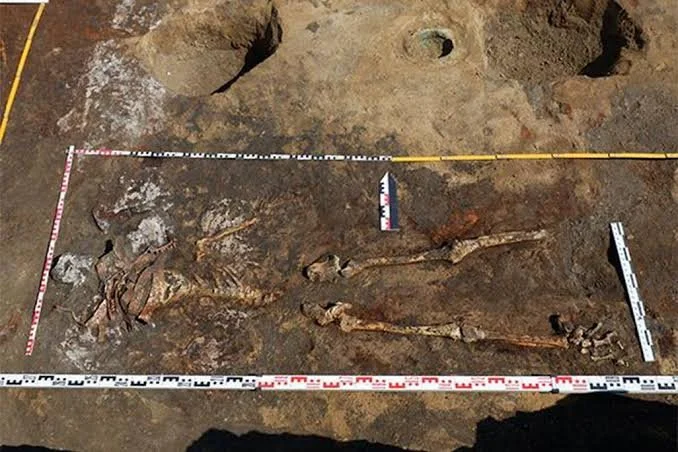
The title Secret Amazon Warrior Graves Near Thermopylae suggests the possibility of undiscovered burials belonging to Amazon warriors near one of the most famous landscapes in Greek history.
This claim must be treated cautiously.
There is no established archaeological discovery demonstrating a group of Amazon graves at Thermopylae.
However, archaeological discoveries across the broader Eurasian world have shown that some ancient women were buried with weapons and other objects traditionally associated with warfare. That evidence has made the relationship between Amazon mythology and real ancient warrior women an important subject of scholarship.
The Amazons in Greek Mythology
Greek literature portrays Amazons as powerful female warriors.
They are often located geographically toward the edges of the Greek world.
Their opponents include some of the greatest heroes of Greek mythology.
The Amazons therefore functioned as an imaginative counterpart to Greek society.
They represented a world in which conventional gender roles were dramatically reversed.
Amazons and Bellerophon
Interestingly, the Amazon tradition also appears in the mythology of Bellerophon.
After confronting the Chimaera in Lycia, Bellerophon was traditionally sent against the Solymi and the Amazons.
This places the Amazon stories within the same wider mythological world as the Chimaera and Pegasus traditions.
Thermopylae and Strategic Geography
Thermopylae is famous for its narrow passage between mountains and the sea.
The landscape became historically important because it provided a natural bottleneck through which armies had to pass.
Its strategic importance continued for centuries.
This makes the region an attractive setting for stories about warriors and military encounters.
But mythological geography and historical geography should not automatically be equated.
Could Female Warriors Have Existed?
Archaeology has demonstrated that women participated in warfare in some ancient societies.
Burials containing weapons, horse equipment, armor-related objects, and other martial goods have been discovered in various parts of Eurasia.
These discoveries have encouraged researchers to reconsider older assumptions about gender and warfare.
However, finding a woman buried with weapons does not automatically prove that she belonged to the legendary Amazons.
Myth and Reality
The most interesting question may therefore not be whether Amazons literally existed exactly as Greek poets described them.
Instead, researchers can ask whether Greek stories were influenced by encounters with societies in which women could participate in warfare.
The ancient Greeks interacted with many peoples beyond Greece.
Travel, trade, colonization, warfare, and storytelling created opportunities for cultural information to circulate.
Foreign warrior traditions could therefore be transformed into mythology.
Why Thermopylae?
The specific association with Thermopylae remains speculative.
The region's archaeological record contains evidence of long-term human activity, but a hypothetical Amazon cemetery would require direct archaeological evidence.
Researchers would need to establish:
the date of the burials,
biological sex and age,
geographic origin,
burial customs,
associated weapons,
cultural affiliation,
and relationship to local populations.
Even then, identifying the individuals as "Amazons" would remain a cultural interpretation unless supported by exceptional evidence.
Burial Archaeology
A genuine cemetery would provide far more information than the presence of weapons alone.
Human remains could potentially reveal diet, health, ancestry, injuries, and patterns of physical activity.
Weapons could reveal social status and military practices.
Horse equipment could indicate mounted warfare.
Together, these forms of evidence could reconstruct aspects of a person's life.
The Amazon as a Cultural Memory
The Amazon myth remained powerful because it challenged expectations.
Greek literature often placed Amazon warriors outside the boundaries of familiar Greek society.
Their stories allowed ancient writers to explore questions about gender, warfare, civilization, foreignness, and power.
In this sense, the Amazon was both a mythological character and a cultural concept.
Conclusion
The Secret Amazon Warrior Graves Near Thermopylae should not be presented as an established archaeological discovery.
No confirmed evidence demonstrates that legendary Amazon warriors were buried there.
Nevertheless, the possibility of discovering ancient female warrior burials in Greece would be archaeologically important, while discoveries elsewhere have already demonstrated that women could occupy martial roles in some ancient societies.
The enduring fascination of the Amazons lies precisely at this boundary between mythology and history: their stories may contain echoes of real encounters with unfamiliar warrior cultures, but separating historical reality from centuries of literary imagination requires careful archaeological evidence.