Introduction
Satyrs are among the most recognizable figures of ancient Greek mythology.
Usually depicted as male nature spirits associated with wine, music, dancing, forests, and Dionysian worship, they occupy a fascinating position between humans and the wild.
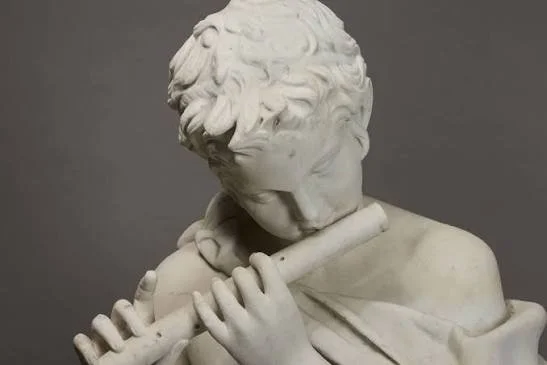
The title Rare Satyr Flute Carvings from the Pieria Slopes suggests the discovery of carvings depicting satyrs playing flutes in the landscape of Pieria.
Pieria, in northern Greece, is strongly connected with Mount Olympus, the Muses, and ancient poetic traditions.
There is no established archaeological evidence for a specific collection matching this exact description.
However, the combination of satyrs, music, and the Pierian landscape is deeply compatible with ancient Greek artistic and religious themes.
Satyrs and Music
Satyrs frequently appear in scenes involving music and celebration.
They are associated especially with Dionysus and his followers.
Their world includes wine, dance, theatrical performance, ecstatic ritual, and the abandonment of ordinary social restraints.
Musical instruments were an important part of this imagery.
The Flute
The Greek aulos, often loosely described as a flute, was a reed instrument with a distinctive sound.
It was used in religious ceremonies, theater, processions, entertainment, and other contexts.
Ancient depictions often show musicians playing double pipes.
The distinction between modern flute terminology and ancient Greek instruments is important because modern names do not always accurately represent ancient technology.
Pieria and the Muses
Pieria was associated with the Muses.
The region's proximity to Mount Olympus contributed to its poetic and sacred identity.
Poetry, music, divine inspiration, and mountain landscapes were therefore deeply connected in ancient Greek imagination.
A satyr musical scene would fit naturally within this symbolic world.
Satyrs in Ancient Art
Satyrs appear extensively in Greek vase painting.
They are often shown dancing, playing instruments, drinking, pursuing nymphs, or accompanying Dionysus.
Their appearance could be humorous, frightening, erotic, or celebratory.
The satyr was not simply a monster.
He represented a version of nature unconstrained by conventional social rules.
What Would a Carving Tell Us?
If genuine ancient carvings of musical satyrs were found, archaeologists would examine their context.
A carving in a sanctuary would have a different significance from one on a domestic building.
A funerary context could indicate another interpretation.
A theatrical context might suggest performance-related symbolism.
The archaeological location is therefore as important as the image itself.
The Problem of "Rare"
Satyr imagery itself is not exceptionally rare in ancient Greek art.
What would be unusual would be a newly discovered, securely dated carving associated with a previously unknown local sanctuary or ritual context.
That distinction helps prevent archaeological exaggeration.
Conclusion
The Rare Satyr Flute Carvings from the Pieria Slopes should be treated as a hypothetical or imaginative archaeological theme rather than a documented discovery.
Yet the underlying cultural connections are strong.
Pieria's relationship with the Muses, ancient Greek music, Dionysian traditions, and satyr imagery provides a rich framework for exploring how music and mythology interacted in ancient Greek society.