Introduction
The ancient city of Phigaleia, located in the rugged landscape of southwestern Arcadia in the Peloponnese, belongs to a region where Greek mythology, religion, and dramatic natural geography have long been intertwined.
Arcadia was famous in ancient Greek imagination as a land of mountains, forests, springs, caves, shepherds, hunters, and powerful deities. It was also a region associated with Hermes, Pan, Artemis, and numerous local religious traditions.
The title Secret Hermes Caduceus Carvings in Phigaleia Ruins evokes the possibility of mysterious archaeological symbols hidden among the remains of the ancient city.
There is, however, no established archaeological evidence demonstrating a specific collection of secret caduceus carvings at Phigaleia. The subject is therefore best approached as a combination of documented Hermes symbolism, the archaeology of Phigaleia, and the possibility that later observers could interpret ambiguous carvings through the lens of mythology.
Phigaleia and Ancient Arcadia
Phigaleia occupied an important position within the mountainous landscape of Arcadia.
The city's surroundings were relatively isolated compared with major urban centers such as Athens or Corinth. This geographical character contributed to the preservation of distinctive local religious traditions.
Arcadian religious life frequently emphasized nature and landscape.
Mountains, springs, caves, forests, and remote sanctuaries were not simply geographical features. They could become sacred spaces associated with gods, heroes, nymphs, and local legends.
This provides an important context for understanding why symbols associated with Hermes might be connected with Phigaleia in later interpretations.
Hermes and the Caduceus
Hermes was one of the most versatile gods in Greek mythology.
He served as messenger of the gods, protector of travelers, guide of souls, patron of merchants, and deity associated with communication, movement, boundaries, and exchange.
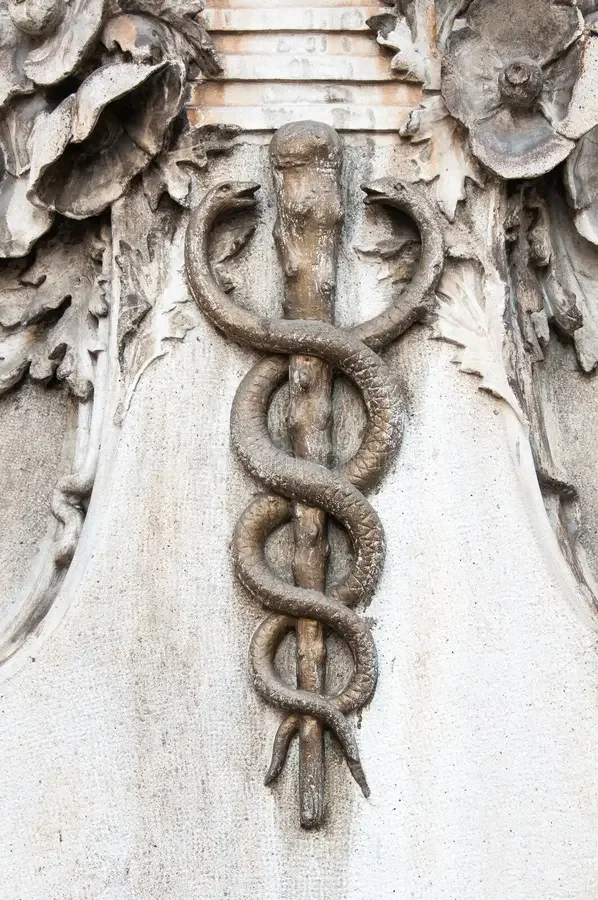
His traditional attributes included winged sandals, a traveler’s hat, and the kerykeion, commonly called the caduceus.
The caduceus was fundamentally a herald's staff.
In ancient Greek contexts, it represented Hermes' authority as a messenger and herald.
Its later history is complicated because the symbol eventually became associated with medicine in modern Western culture, even though the ancient Greek association of the caduceus was primarily with Hermes and heraldic authority.
Why a Caduceus Would Matter Archaeologically
A genuine ancient carving depicting the caduceus could potentially provide information about local religious identity.
Archaeologists would not simply identify two intertwined lines and declare them to be Hermes' staff.
They would examine the carving's context.
Questions would include:
Where was the carving located?
Was it associated with a sanctuary?
What other symbols appeared nearby?
What was the archaeological layer?
What type of stone or architectural surface was involved?
Did the style correspond with known Greek representations of Hermes?
Could the image have had a completely different function?
These questions are essential because ancient geometric designs can sometimes resemble recognizable mythological symbols without actually representing them.
Hermes in a Mountainous Landscape
Hermes was particularly appropriate to places involving movement and boundaries.
Travelers crossing mountain passes could invoke Hermes as a divine protector.
Merchants moving between communities could also associate him with safe travel and exchange.
Arcadia's difficult terrain therefore provides an interesting cultural setting for Hermes worship.
A symbol connected with the god could have carried several meanings simultaneously: protection, movement, communication, commerce, and transition.
The Problem of the "Secret Carving"
The word "secret" is particularly attractive in archaeological storytelling, but it can be misleading.
Ancient carvings do not necessarily become mysterious because they were intentionally hidden.
They may simply have been overlooked, weathered, reused in later construction, or difficult to interpret.
Ancient buildings were frequently modified.
Stones could be incorporated into walls, floors, roads, or later structures. A carving that originally had an obvious religious context could therefore become detached from its original meaning.
Mythology and Archaeological Interpretation
The most interesting aspect of such a hypothetical discovery would not necessarily be the symbol itself.
It would be the relationship between mythology and physical space.
If a genuine Hermes-related carving were identified at Phigaleia, researchers could ask whether the image belonged to a sanctuary, civic building, roadside religious location, or private structure.
The discovery could help reconstruct the religious landscape of ancient Arcadia.
Conclusion
There is no established evidence for a hidden collection of Hermes caduceus carvings at Phigaleia.
Nevertheless, the concept provides an engaging way to explore the relationship between Hermes, Arcadian landscapes, ancient religious symbolism, and archaeological interpretation.
The real mystery of Phigaleia lies not necessarily in undiscovered supernatural symbols, but in the many fragments of ancient life that survive in the archaeological landscape and still require careful interpretation.