Introduction
Few figures capture the independence and complexity of Greek heroic mythology as effectively as Atalanta.
A legendary huntress associated with Arcadia, Atalanta appears in traditions involving wilderness, hunting, athletic competition, heroic expeditions, and the famous Calydonian Boar Hunt.
Ancient sources portray her as an exceptional female hunter and athlete. Some traditions also connect her with specific Arcadian landscapes, including springs and wilderness areas.
The title The Hidden Curse of Atalanta's Hunt in Arcadia Woods suggests a mysterious supernatural curse associated with her hunting activities.
There is no single ancient tradition universally recognized as "the curse of Atalanta's hunt." Instead, the title can be explored through several connected themes: Artemis, forbidden hunting, divine anger, the dangers of the wilderness, and the later fate of Atalanta and her husband.
Atalanta, the Huntress
Atalanta's mythology is unusual because she occupies a role that ancient Greek storytelling often assigned primarily to male heroes.
She is described as a skilled hunter, runner, and warrior.
Her connection with wilderness was established from childhood in some traditions.
One story states that her father exposed her because he wanted a male child. She was subsequently nourished by a she-bear and raised by hunters.
This narrative symbolically places Atalanta between civilization and wilderness.
She is born into human society but raised in the natural world.
Artemis and the Wilderness
Atalanta's relationship with hunting is closely connected to the religious world of Artemis.
Artemis was associated with wild animals, hunting, forests, young people, and the boundaries between civilization and wilderness.
For ancient audiences, hunting was not simply recreation.
It could have religious and social significance.
The hunt represented a controlled encounter with nature and danger.
Breaking the rules of the hunt, disrespecting sacred animals, or violating divine boundaries could therefore have serious mythological consequences.
The Calydonian Boar Hunt
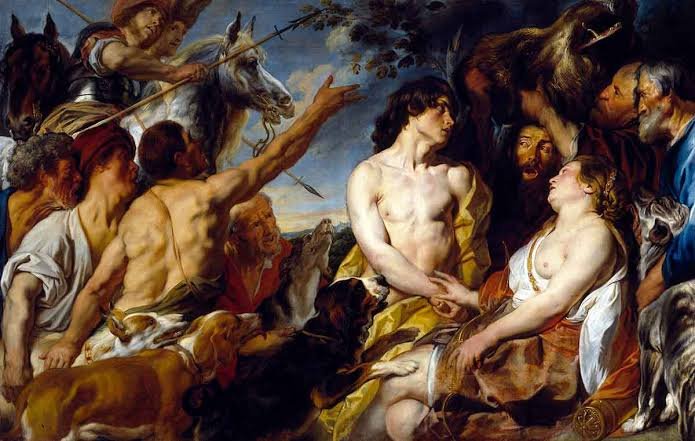
Atalanta is especially famous for participating in the Calydonian Boar Hunt.
According to ancient traditions, King Oeneus neglected to honor Artemis properly, and the goddess sent a monstrous boar to devastate the land.
Heroes from different parts of Greece gathered to hunt it.
Atalanta participated and was the first to wound the animal in some versions of the story. Pausanias preserves traditions in which she receives recognition for her role in the hunt.
The story demonstrates how hunting mythology could become intertwined with divine punishment.
The "Curse" as a Mythological Pattern
Although a single canonical "Atalanta curse" does not exist, Greek mythology repeatedly uses the concept of divine consequences.
A god is offended.
A sacred rule is broken.
A natural disaster or monster appears.
Heroes attempt to restore order.
This pattern is particularly visible in stories involving Artemis.
The title's "curse" can therefore be interpreted as a broader symbolic theme rather than a specific historical curse recorded on an ancient inscription.
Atalanta and the Golden Apples
Another major episode concerns Atalanta's footrace with her suitors.
She had promised to marry only a man capable of defeating her in a race.
Hippomenes, or Melanion in some traditions, used golden apples provided through divine assistance to distract her during the race.
She stopped to collect them and consequently lost.
This episode shifts Atalanta's story from the wilderness into the social world of marriage and competition.
The Later Transformation
Some later traditions describe Atalanta and her husband as being transformed into lions after offending the gods.
The details differ between ancient sources.
This transformation has sometimes been interpreted as another form of divine punishment or as a mythological explanation for the placement of lions in the symbolic world of the gods.
It is important, however, not to combine every version of Atalanta's mythology into one supposedly continuous historical narrative.
Greek mythology was transmitted through multiple authors and local traditions.
Arcadian Woods and Sacred Geography
Arcadia's forests provide a fitting setting for Atalanta's mythology.
Ancient Arcadia was characterized by rugged mountains, wooded valleys, caves, springs, and remote sanctuaries.
The wilderness was simultaneously beautiful and dangerous.
For ancient communities, forests could provide timber, game, medicinal plants, pasture, and hunting grounds, but they could also be spaces outside normal civic control.
Stories about Atalanta therefore reflect an important cultural tension: the admiration of wilderness and the fear of its unpredictability.
Conclusion
The Hidden Curse of Atalanta's Hunt in Arcadia Woods is best understood as a mythological exploration rather than a documented supernatural event.
Atalanta's stories contain genuine ancient traditions involving hunting, Artemis, divine punishment, athletic competition, and transformation.
The most compelling "curse" is perhaps the larger warning embedded within Greek mythology itself: the wilderness can reward skill and courage, but humans who ignore divine boundaries may face consequences.