Introduction
Kea, also known as Tzia, is one of the northern Cycladic islands and has a long archaeological history extending from prehistoric settlements to the Classical and Hellenistic periods. Its location near the Attic coast made it an important participant in maritime and cultural networks linking the Cyclades with mainland Greece.
Gold objects found in religious contexts can provide valuable information about ancient craftsmanship, ritual practices, and social relationships. Thin sheets of gold, sometimes called gold leaves or gold foil, were used in jewelry, decorative applications, and other forms of personal or ceremonial display.
The possibility of Archaic gold leaves in temple debris on Kea raises questions about the island's religious life and artistic connections. However, the specific discovery requires archaeological documentation before it can be treated as an established assemblage.
Kea During the Archaic Period
The Archaic period, generally dated from the eighth to the early fifth century BCE, witnessed major changes in Greek political organization, religious architecture, artistic production, and maritime exchange.
Kea's position near Attica placed it within a network of island and mainland communities.
The island contained settlements and sanctuaries that reflected both local traditions and wider Greek cultural developments.
Religious sites were important centers of communal activity. They could attract offerings from local residents, visitors, and individuals participating in regional exchange.
Gold in Ancient Greek Religious Life
Gold was valued for its rarity, appearance, and resistance to corrosion. It was used in jewelry, decorative objects, ceremonial equipment, and offerings.
In religious settings, gold objects could be dedicated to deities as expressions of gratitude, devotion, or social prestige.
A valuable offering might represent an individual's wealth or commemorate an important event. Some objects were also associated with healing, protection, or personal vows.
The interpretation of gold finds depends on their archaeological context and relationship with other offerings.
What Are Gold Leaves?
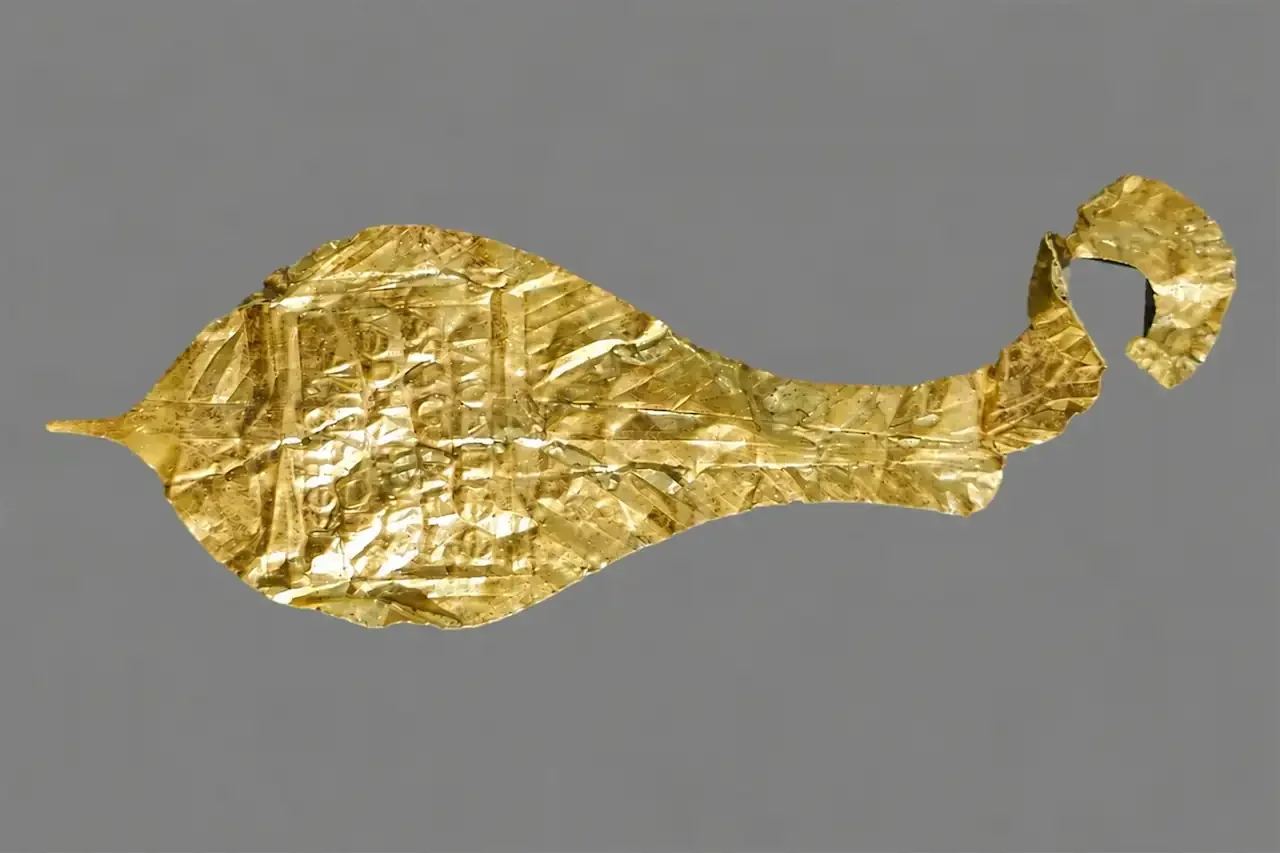
Gold leaves are extremely thin sheets of hammered gold.
Ancient craftspeople could produce them by repeatedly hammering metal until it became very thin and flexible.
The sheets could be shaped, folded, attached to other materials, or incorporated into decorative objects.
Gold foil was sometimes applied to wooden, ivory, ceramic, or other surfaces. Because the supporting material may decay, small gold fragments can survive as the only remaining evidence of an elaborate object.
The precise function of a fragment can be difficult to establish unless its original context is preserved.
Temple Debris and the Archaeological Record
The term "temple debris" can refer to material accumulated through building collapse, renovation, destruction, or later reuse.
A temple might contain fragments of architectural decoration, pottery, metal objects, and votive offerings.
Gold leaves found in such deposits could have belonged to offerings, decorative elements, or objects used during religious ceremonies.
However, their presence in debris does not necessarily prove that they were deliberately deposited there. They may have been displaced from earlier layers or introduced during later activity.
Stratigraphic recording is essential for understanding how the material entered the deposit.
Goldworking Techniques
Ancient goldworkers used several methods to shape and decorate metal.
Hammering produced thin sheets, while cutting and engraving created specific outlines and surface details.
Gold could also be attached to other materials through mechanical fastening or specialized joining techniques.
Microscopic examination can reveal tool marks and manufacturing methods. Chemical analysis may provide information about the gold's composition and the presence of other metals.
These findings can help researchers compare objects with examples from other Archaic Greek sites.
Religious Networks Across the Cyclades
The Cyclades were connected through maritime exchange and shared religious traditions.
Sanctuaries could receive offerings from individuals traveling between islands or from communities maintaining relationships with distant cult centers.
The style of an object might reflect artistic influences from Attica, the eastern Aegean, or other parts of the Greek world.
Nevertheless, similar decorative techniques do not necessarily prove that an object was imported. Local craftspeople could reproduce widely circulating styles.
Establishing an object's origin requires material analysis alongside stylistic comparison.
Dating the Gold Leaves
Gold itself cannot generally be dated through radiocarbon analysis. Its chronology must be established through archaeological context and comparison with securely dated objects.
Associated pottery, coins, inscriptions, and architectural phases can help establish when the material was deposited.
Researchers must also distinguish the date of manufacture from the date of deposition. A gold object could have been preserved and used for generations before being dedicated or discarded.
If fragments are recovered from disturbed temple debris, their precise chronology may remain uncertain.
Conservation and Research
Gold is relatively resistant to corrosion, but extremely thin fragments can be fragile and easily distorted.
Conservators must handle them carefully, especially when they remain attached to soil, plaster, or other materials.
High-resolution imaging and microscopic analysis can reveal manufacturing details without unnecessary physical manipulation.
A complete record should include the fragment's dimensions, weight, composition, surface condition, and exact archaeological context.
Conclusion
Archaic gold leaves associated with temple debris on Kea would provide a valuable opportunity to study religious offerings, metalworking, and artistic exchange in the Cyclades.
Their significance would depend on identifying their original function and establishing a reliable date. The specific claim of such a gold-leaf assemblage on Kea requires verification through excavation records and conservation documentation.
More broadly, the study of thin gold fragments demonstrates how small surviving objects can preserve evidence of elaborate ancient craftsmanship and the religious practices of island communities.