Introduction
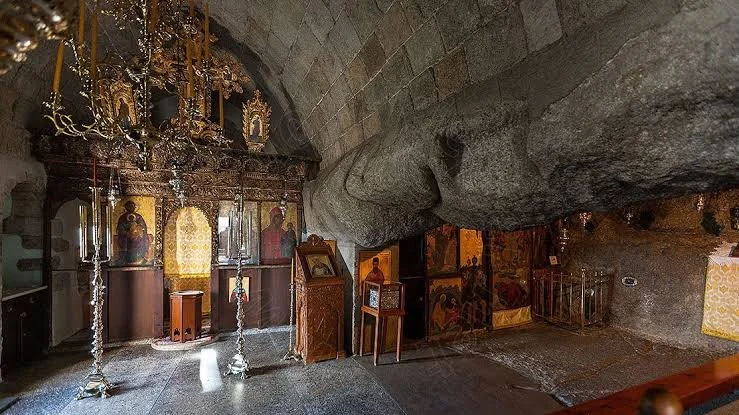
Patmos is widely recognized for its religious heritage and its association with early Christian tradition. The island's most prominent landmark, the Monastery of Saint John the Theologian, dominates the settlement of Chora and reflects centuries of religious, architectural, and cultural development.
The discovery of Hellenistic oil lamps in monastery outbuildings would raise interesting questions about the relationship between ancient occupation and later religious construction. Such objects could reveal how the landscape was used before the establishment of the medieval monastery.
However, the specific claim of Hellenistic lamps from particular outbuildings requires archaeological documentation. The presence of ancient artifacts within a later building does not automatically prove that the structure itself dates to the Hellenistic period.
Patmos Before the Monastery
Patmos belongs to the Dodecanese island group in the southeastern Aegean. Its location placed it within maritime networks connecting the Cyclades, Asia Minor, and other eastern Mediterranean regions.
The island was inhabited in antiquity, although its settlement history developed differently from that of larger regional centers.
Ancient occupation could have included agricultural communities, coastal activity, and religious practices. Archaeological evidence from different periods is necessary to reconstruct how Patmos was used before its medieval religious importance emerged.
The Hellenistic Period
The Hellenistic period began after the death of Alexander the Great in 323 BCE and continued until the Roman conquest of the major eastern Mediterranean kingdoms.
During this period, cities and smaller settlements participated in extensive commercial and cultural networks.
Greek artistic traditions spread across a large geographical area, while regional communities continued to develop local practices.
Everyday objects, including pottery, coins, tools, and lamps, provide evidence of these connections. Their distribution helps researchers investigate patterns of trade and domestic life.
Oil Lamps in the Ancient World
Oil lamps were essential household objects in the ancient Mediterranean. They provided light in homes, workshops, religious spaces, and public buildings.
Most lamps used vegetable oil as fuel, with a wick positioned near a nozzle. Their designs varied considerably, ranging from simple handmade forms to carefully molded objects.
During the Hellenistic period, lamps often developed more standardized shapes. Some were decorated with relief patterns, handles, or distinctive nozzle designs.
The shape, manufacturing technique, and decorative features can help archaeologists identify a lamp's approximate date and possible production region.
Lighting and Everyday Activities
Artificial lighting extended the hours during which people could work, prepare food, read, and perform household tasks.
In homes, lamps were placed on shelves, tables, or other surfaces. Their soot deposits and fuel residues can sometimes reveal how they were used.
Lamps also appeared in religious and funerary contexts. They could be deposited as offerings or used during ceremonies and commemorative activities.
The discovery context is therefore essential. A lamp found in a household room has a different likely function from one recovered from a burial or sanctuary.
Monastery Outbuildings and Earlier Layers
Monastic complexes often include more than the main church and residential buildings. Storage rooms, workshops, kitchens, agricultural facilities, and defensive structures may form part of the wider architectural environment.
Such buildings can be constructed over earlier occupation layers or incorporate materials from older structures.
A Hellenistic lamp recovered from an outbuilding could have entered the deposit through several processes. It might have been found during construction, transported with soil, or deposited during a later period of reuse.
Its presence would establish ancient activity in the area only if the archaeological context supported that conclusion.
Patmos and Maritime Exchange
The island's location made it part of regional maritime movement throughout antiquity.
Oil lamps and other household objects could circulate through commercial networks, while locally produced vessels might reflect regional manufacturing traditions.
Petrographic and chemical analysis can help determine whether a lamp was made locally or imported from another production center.
Comparing its shape and decoration with examples from nearby islands and coastal settlements can provide further information about cultural connections.
Archaeological Dating and Interpretation
A Hellenistic attribution should be based on recognized typological features and, where possible, secure archaeological context.
Researchers examine the lamp's fabric, manufacturing marks, shape, nozzle, handle, and decoration.
Associated pottery, coins, and building phases can help narrow its date. Scientific analysis may also reveal traces of fuel or residues preserved within the object.
If a lamp was recovered from disturbed soil, its date may be estimated stylistically, but its relationship to the monastery building would remain uncertain.
Preservation and Cultural Heritage
Patmos' religious architecture is an important part of its cultural heritage. Archaeological research around monastery buildings must therefore respect the structural integrity and continuing religious use of the complex.
Artifacts should be documented and conserved professionally. Their provenance, storage history, and relationship to the building should be recorded.
Careful study of such objects can help reveal the island's earlier history without diminishing the significance of its later religious traditions.
Conclusion
Hellenistic oil lamps associated with Patmos' monastery outbuildings would provide an intriguing link between the island's ancient occupation and its later religious landscape.
Their forms and manufacturing techniques could reveal everyday lighting practices, regional trade, and connections with other Aegean communities. Nevertheless, the specific claim of Hellenistic lamps from particular monastery outbuildings requires confirmation through excavation records and secure provenance.
The broader subject demonstrates how small domestic artifacts can illuminate the long and layered history of an island whose best-known monuments belong to a much later period.