Introduction
Symi, located in the southeastern Aegean near the coast of southwestern Anatolia, has a long maritime history shaped by its position between major island and mainland routes. Its rugged coastline, small bays, and surrounding reefs create a complex underwater landscape.
The Doric order was one of the principal architectural systems of ancient Greek monumental construction. Its columns supported temples and other public buildings, leaving recognizable architectural elements that archaeologists can identify in surviving ruins.
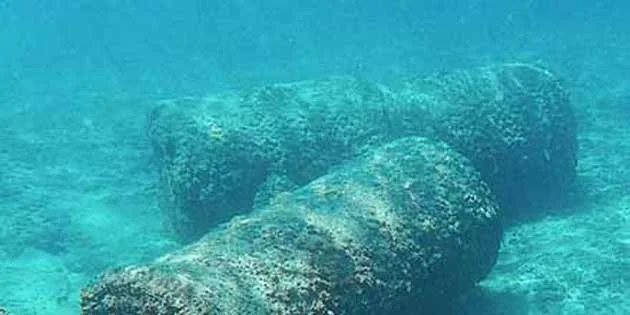
The possibility of submerged Doric columns near Symi's reefs raises questions about ancient coastal architecture, shipwrecks, and the movement of building materials. However, the presence of underwater stone blocks does not automatically establish that they belonged to a Doric structure.
Symi and Its Ancient Maritime Setting
Symi lies close to Rhodes and the southwestern Anatolian coast. Its surrounding waters formed part of a busy maritime environment connecting islands, ports, and settlements.
The island's bays offered potential shelter for small vessels, while its rocky coast required careful navigation.
Ancient maritime routes carried agricultural goods, pottery, metals, timber, and construction materials. Larger commercial and political centers depended on smaller islands for transport, supplies, and intermediate stopping points.
Symi's location makes it a worthwhile area for investigating underwater archaeological remains, particularly those connected with coastal trade and maritime activity.
The Doric Architectural Order
The Doric order developed in ancient Greek architecture and became widely used during the Archaic and Classical periods.
Doric columns typically featured sturdy proportions, a shaft marked by vertical fluting, and a simple capital consisting of a rounded echinus and square abacus.
Unlike some other architectural systems, the traditional Doric column did not normally include a separate base. Its shaft rested directly on the stylobate, the upper platform of the building's stepped foundation.
The Doric order was used in temples and other monumental structures across mainland Greece, the Aegean, and Greek settlements beyond the mainland.
How Columns Were Constructed
Ancient monumental columns were often assembled from separate stone drums. Each section was carefully shaped and positioned above the previous one.
The drums could contain central holes or joining features designed to align the sections and secure the column.
Fluting was commonly cut into the shaft, either during preparation or after the drums had been assembled, depending on the construction method.
The dimensions, curvature, and surface details of surviving drums can help researchers identify their architectural order and approximate date.
Why Architectural Elements Might Be Underwater
Several processes could explain the presence of ancient stonework beneath the sea.
A coastal building might have been submerged through relative sea-level change, tectonic movement, or shoreline erosion. Architectural blocks could also have entered the water following the collapse of a structure.
Another possibility is that stones were transported by ship and lost during a maritime accident. Some blocks may have been deliberately discarded or reused in later harbor construction.
These possibilities must be distinguished through archaeological context. A group of regularly shaped column drums arranged near one another would require a different interpretation from scattered blocks lying across a reef.
Identifying Doric Columns on the Seabed
Underwater identification requires detailed recording of the stone objects and their surroundings.
Researchers examine the shape of the blocks, the presence of fluting, the dimensions of the shafts, and any surviving architectural joints.
Stone analysis can help identify the geological source of the material. If the blocks match a known ancient quarry, this may provide evidence about their production and transport.
However, an architectural fragment may have been reused in a later structure. Its original date and final underwater deposition may therefore be separated by centuries.
Symi and Regional Building Networks
The southeastern Aegean contained numerous ancient settlements and sanctuaries that required stone for construction.
Building materials could be transported between islands and mainland centers, particularly where local stone was unsuitable for monumental architecture.
A submerged group of architectural blocks near Symi could therefore reflect regional transport or the remains of a coastal building.
Establishing a connection to a specific temple or settlement would require comparisons with documented architecture and geological source analysis.
Underwater Archaeological Methods
Modern underwater archaeology combines diving surveys with photogrammetry, sonar, and other recording techniques.
Photogrammetry creates detailed three-dimensional models from overlapping photographs. These models can preserve the position, dimensions, and surface characteristics of architectural remains.
Sonar can help locate larger underwater anomalies, especially in areas where visibility is poor.
Researchers may also examine sediment layers and associated artifacts to determine whether a deposit represents a building collapse, shipwreck, or later disturbance.
Protection of Submerged Heritage
Underwater archaeological remains are vulnerable to storms, currents, fishing equipment, anchoring, and unauthorized recovery.
Removing a column drum without recording its position destroys important contextual information. Even apparently isolated objects may belong to a larger archaeological landscape.
Responsible investigation should prioritize documentation and conservation. Any excavation or recovery should be conducted under appropriate archaeological supervision and legal authorization.
Conclusion
Submerged Doric columns near Symi's reefs would offer an important opportunity to investigate ancient architecture and maritime transportation in the southeastern Aegean. Their study could reveal where building materials originated, how they were transported, and how coastal structures changed over time.
Nevertheless, the specific existence of submerged Doric columns near Symi requires confirmation through underwater survey and architectural analysis. The wider subject demonstrates how underwater archaeology can reconnect scattered stone remains with the ancient buildings and maritime networks that produced them.