Introduction
Karpathos is a long, mountainous island in the southeastern Aegean, positioned between Crete and Rhodes. Its geography created natural routes connecting coastal settlements with inland communities, while its surrounding waters linked it to important maritime networks.
During the Bronze Age, seals were valuable objects used for personal identification, administrative control, and the authentication of goods or documents. Their engraved designs also reflected artistic traditions and social identities.
The possibility of Bronze Age seals from Karpathos' headlands offers an interesting subject for investigating the island's participation in Aegean exchange networks. However, specific finds must be distinguished from broader evidence of Bronze Age activity in the region.
Karpathos in the Bronze Age Aegean
Karpathos occupied a strategic position between Crete, Rhodes, and the southwestern Anatolian coast.
This location placed it within a maritime environment that supported the movement of people, pottery, metals, and other goods.
During the Bronze Age, Crete became a major center of Minoan civilization, while mainland Greece later developed powerful Mycenaean centers. The islands between these regions participated in cultural and economic exchanges that varied across different periods.
Karpathos' archaeological landscape is therefore important for studying how smaller communities interacted with larger centers.
What Were Bronze Age Seals?
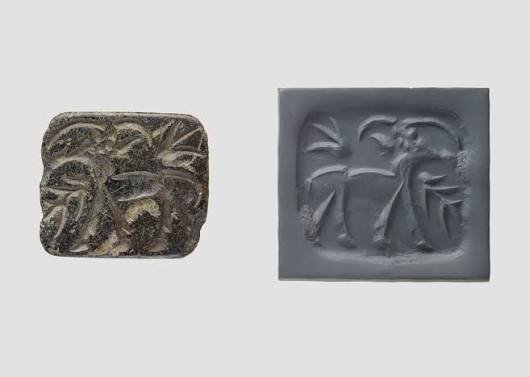
Seals were objects engraved with designs that could be impressed into clay or another soft material.
They were made from different materials, including stone, ivory, bone, and other durable substances. Some were shaped as cylinders, while others took the form of stamp seals or more elaborate objects.
A seal could identify an individual, household, workshop, or administrative authority. Its impression might be used to secure a container, mark a transaction, or demonstrate that an object had not been opened.
The exact function depended on the society and administrative system in which it was used.
Designs and Symbolism
Bronze Age seals often carried images of animals, humans, plants, geometric patterns, and religious or ceremonial symbols.
Minoan seals are especially known for their detailed representations of animals, ritual scenes, and natural motifs.
The small size of many seals required exceptional engraving skill. Craftspeople used specialized tools to produce precise designs on hard surfaces.
Comparing these images can help researchers identify artistic traditions and possible connections between regions.
However, similar motifs do not always indicate that objects came from the same workshop. Designs could spread through imitation, exchange, and the movement of artisans.
Why Headlands Matter
Headlands are elevated coastal projections that extend into the sea. Their position can provide broad views of maritime approaches and nearby anchorages.
In antiquity, such locations could be useful for settlement, observation, or access to coastal routes.
A seal discovered on a headland might have belonged to a nearby household, workshop, administrative center, or burial context. Its location alone cannot establish why it was deposited there.
The archaeological relationship between the seal and its surrounding materials is therefore essential.
Seals and Administrative Practices
In complex Bronze Age societies, seals played an important role in controlling goods and recording transactions.
Clay sealings could preserve impressions made by a seal. These objects sometimes survived even when the original containers, wooden doors, or other materials had disappeared.
Sealings can reveal administrative practices because their impressions show how objects were marked and controlled.
If Bronze Age seals were recovered from a Karpathian settlement, associated clay sealings could help determine whether they were used locally or had arrived through exchange.
Trade and Cultural Connections
The distribution of Bronze Age seals across the Aegean reflects the movement of artistic ideas and administrative technologies.
Crete, the Cyclades, mainland Greece, and the eastern Mediterranean shared some visual conventions while maintaining distinctive local traditions.
Karpathos' geographical position makes it a potentially important location for studying these interactions.
A seal found on the island could have been locally manufactured, imported, or carried by someone traveling through the region. Material analysis and stylistic comparison would be necessary to distinguish these possibilities.
Scientific Analysis and Dating
Researchers can study seals through microscopy, three-dimensional imaging, and material analysis.
Engraving marks may reveal how an object was produced, while geological examination can sometimes identify the source of the stone.
Dating is often based on archaeological context and comparison with securely dated examples. A seal's style may suggest a period, but stylistic dating should be supported by associated evidence whenever possible.
An object recovered from disturbed soil or without a documented findspot cannot provide the same chronological certainty as one found in a sealed excavation layer.
Preservation and Research Challenges
Small seals are vulnerable to loss, damage, and unauthorized collection. Their detailed engravings may also become worn through handling.
Proper archaeological documentation includes recording dimensions, material, weight, surface condition, and the exact find context.
Digital imaging can preserve fine details and allow specialists to compare designs across collections.
Any interpretation should also consider whether the object was used in everyday administration, personal display, religious activity, or burial practice.
Conclusion
Bronze Age seals from Karpathos' headlands would offer valuable evidence for understanding administration, artistic exchange, and social identity in the southeastern Aegean.
Their study could help clarify how the island participated in wider networks connecting Crete, the Cyclades, Rhodes, and the eastern Mediterranean. However, the specific claim of a documented assemblage from Karpathos' headlands requires verification through reliable excavation records.
The broader archaeological significance of seals lies in their ability to connect small personal objects with the economic and social systems of Bronze Age communities.