Introduction
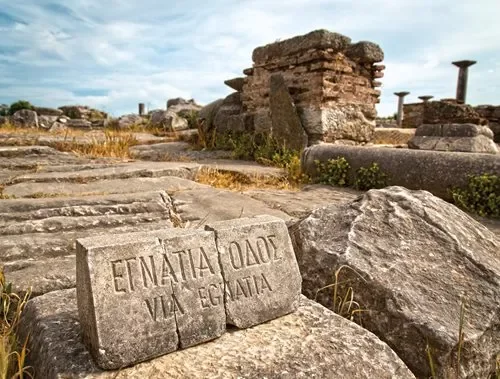
Ancient Olympia was one of the most important religious and athletic centers of the Greek world. Its sanctuary of Zeus attracted visitors from across the Mediterranean, while its sporting facilities hosted the celebrated Olympic Games.
The archaeological landscape includes temples, treasuries, administrative buildings, athletic installations, and other structures developed over many centuries.
The possibility of Roman villa mosaics beneath or near the Olympia palaestra raises questions about private residences, elite life, and the changing use of land around the sanctuary during Roman rule.
However, the specific claim of villa mosaics beneath the palaestra requires archaeological verification. The existence of Roman-period buildings at Olympia does not automatically establish that particular mosaic floors belonged to a villa.
Olympia Before Roman Rule
Olympia developed as a major sanctuary during the Archaic and Classical periods.
Its religious significance centered on the worship of Zeus, while athletic competitions attracted participants and spectators from different Greek communities.
The sanctuary contained monumental architecture, sporting facilities, and spaces used for religious ceremonies.
The palaestra was an important part of this complex.
The Function of the Palaestra
A palaestra was a facility used for physical training, particularly wrestling and other forms of athletic preparation.
At Olympia, the palaestra formed part of the wider athletic landscape.
Its rooms and open spaces supported training activities and the preparation of athletes.
The building's architectural organization reflected the importance of physical education and athletic competition in Greek society.
It should be distinguished from private residential architecture, even when later structures developed nearby.
Roman Olympia
Roman rule brought changes to the sanctuary.
The Olympic Games continued, although their organization and political environment evolved.
Roman officials and wealthy visitors developed connections with Olympia.
Buildings were repaired, modified, and sometimes repurposed.
The sanctuary remained a place of religious and athletic significance, but its architectural landscape increasingly reflected the influence of Roman patronage.
Roman Villas in Greece
Roman villas were substantial residences associated with wealthy individuals and landowners.
They could include courtyards, dining rooms, reception spaces, bathing facilities, gardens, and service areas.
Some villas were located in rural landscapes, where they combined residential comfort with agricultural production.
Others were situated near towns or major cultural centers.
Their architecture and decoration expressed the wealth and social position of their owners.
Mosaic Floors
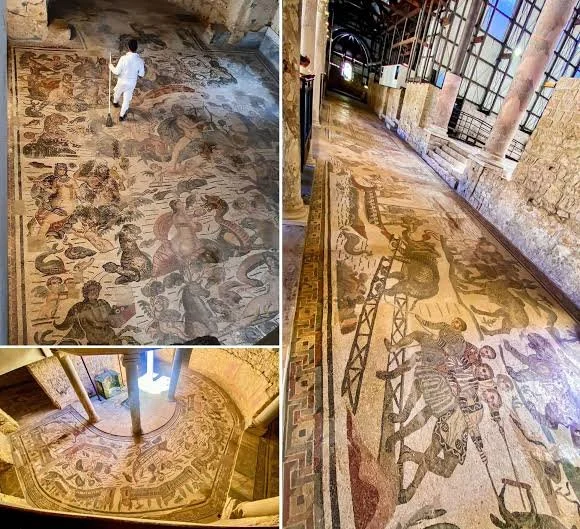
Mosaics were an important feature of Roman decorative architecture.
They were made by arranging small pieces of stone, ceramic, or glass into patterns and images.
These pieces are commonly known as tesserae.
Mosaic floors could display geometric designs, plants, animals, mythological scenes, or representations of daily life.
The complexity of a mosaic depended on the available materials, workshop traditions, and the resources of the building's owner.
The Question of a Villa Beneath the Palaestra
The phrase beneath Olympia palaestra could describe remains physically located below the known athletic building or in its immediate surrounding area.
These possibilities must be distinguished.
A mosaic floor beneath a later structure might belong to an earlier building that was subsequently demolished or covered.
A mosaic discovered nearby might belong to a separate residential complex.
Neither situation automatically establishes the presence of a Roman villa.
Researchers would need to examine foundations, room arrangements, floor plans, and associated objects.
Dating and Attribution
Mosaics can sometimes be dated through stylistic comparison.
Researchers examine tessera size, color, composition, decorative patterns, and the treatment of figures.
However, stylistic dating should be supported by archaeological context.
Pottery, coins, building materials, and stratigraphic relationships can provide additional chronological evidence.
The building's function must also be established independently.
A mosaic floor could belong to a residence, bath complex, reception building, or another structure.
Scientific Analysis and Reconstruction
Modern imaging techniques can help document mosaic surfaces.
Photogrammetry creates detailed three-dimensional records, while digital mapping allows researchers to reconstruct missing areas.
Material analysis can identify the stone and glass used in the tesserae.
These techniques can also help determine whether different sections of a floor were produced during the same construction phase.
Digital reconstruction should clearly distinguish surviving material from hypothetical additions.
The Changing Landscape of Olympia
Olympia experienced repeated periods of construction, repair, abandonment, and reuse.
Later buildings sometimes incorporated earlier architectural elements.
Earthquakes, flooding, and changes in settlement patterns also affected the site.
A Roman mosaic discovered beneath a later structure could therefore provide evidence of an earlier phase in the sanctuary's development.
Its interpretation would depend on understanding the sequence of construction and reuse.
Conservation
Mosaics are vulnerable when exposed after centuries underground.
Changes in temperature and humidity can affect their bedding materials and cause individual tesserae to loosen.
Salt crystallization and biological growth can also damage surfaces.
Conservation requires careful environmental management and stabilization.
Where removal is not necessary, preserving a mosaic in its original archaeological context is generally preferable.
Conclusion
Roman villa mosaics associated with the Olympia palaestra would offer valuable insight into the relationship between private architecture and the sanctuary's public landscape.
They could reveal how Roman-period residents and visitors used decorative spaces and how wealthy individuals expressed status through architecture.
Nevertheless, the specific identification of villa mosaics beneath the palaestra requires secure archaeological evidence. Their location, date, and architectural context must be established before they can be attributed to a Roman residence.