Introduction
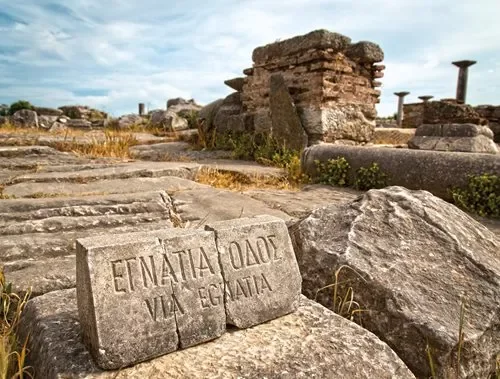
The Via Egnatia was one of the most important roads of the Roman Empire in the eastern Mediterranean. Built across the Balkans, it connected the Adriatic region with the Aegean and ultimately with routes leading toward Byzantium.
The road supported military movement, administration, trade, communication, and travel. Its branches and connecting routes helped link settlements that were not directly situated along the main highway.
Roman mile markers, commonly known as milestones, provide valuable evidence for the organization and maintenance of these transportation networks.
The study of mile markers along branches of the Via Egnatia offers an opportunity to reconstruct how Roman infrastructure extended beyond the main road.
The Via Egnatia
The Via Egnatia was constructed during the second century BCE, following the Roman conquest of Macedonia.
It crossed the Balkan Peninsula from the Adriatic coast toward the eastern Aegean.
Its route connected important settlements and military centers, including areas associated with Dyrrhachium, Thessalonica, and other regional hubs.
The road became a major communication corridor between Italy and the eastern provinces.
Why Roman Roads Mattered
Roman roads served several interconnected purposes.
Military forces used them to move troops and equipment.
Officials relied on them for administration and communication.
Merchants used the routes to transport agricultural products, manufactured goods, and other commodities.
Travelers also depended on roads to reach cities, sanctuaries, ports, and settlements.
The road network therefore helped connect distant parts of the empire.
Understanding Roman Mile Markers
A Roman milestone was a stone marker placed along a road to indicate distance or commemorate construction and repair work.
Many were cylindrical or rectangular stone pillars.
Inscriptions could include the name or titles of an emperor, the distance from a reference point, and information about road construction or restoration.
Not every milestone contained the same information.
Some were relatively simple, while others carried elaborate imperial inscriptions.
The Roman Mile
Roman distances were commonly measured in mille passus, meaning one thousand double paces.
A Roman mile was approximately 1.48 kilometers.
Milestones helped travelers and officials understand distances along a route.
They also provided a visible demonstration of imperial authority.
An inscription naming an emperor could associate road maintenance with the ruler's public image and political legitimacy.
Branch Roads and Local Connections
The Via Egnatia was part of a wider network rather than an isolated highway.
Secondary roads connected it with inland settlements, agricultural districts, ports, military installations, and religious centers.
These branches were essential because most communities were not located directly beside the main road.
A branch route could be shorter and more practical for local travel, even if it carried less traffic than the imperial highway.
Dating Milestones
Milestone inscriptions are valuable chronological evidence.
An emperor's name or official title can help establish the period in which a marker was erected or restored.
However, milestones were sometimes reused.
A stone might have been moved from its original position or incorporated into a later building.
Researchers therefore examine inscriptions alongside archaeological context and the physical location of the marker.
Inscriptions and Imperial Authority
Milestones were not merely practical signs.
They communicated Roman power through public inscriptions.
When an emperor repaired or extended a road, a milestone could record that achievement.
The practice reinforced the idea that imperial authority maintained the infrastructure connecting the provinces.
Inscriptions can therefore provide information about political history as well as transportation.
Archaeological Investigation
Researchers studying a possible Via Egnatia branch begin by identifying the route through historical maps, landscape analysis, and known settlements.
They examine surviving road surfaces, bridges, cuttings, drainage structures, and retaining walls.
Milestones are especially valuable when found close to their original positions.
Their inscriptions can be compared with other markers to establish the route's chronology and administrative organization.
Geographic information systems can help reconstruct road alignments and analyze how ancient routes related to terrain.
Reuse and Preservation
Many Roman milestones were reused during later periods.
They could become building blocks, boundary markers, or structural components in churches, houses, and defensive walls.
Reuse can make it difficult to identify their original locations.
Weathering, agricultural activity, and modern construction also threaten surviving examples.
Proper documentation should record inscriptions, dimensions, stone type, and the circumstances of discovery.
The Via Egnatia in the Later Roman World
The importance of the Via Egnatia continued after the division of the Roman Empire.
The road remained significant under the Eastern Roman, or Byzantine, Empire.
Settlements along its route continued to depend on communication and transportation.
Although the condition and organization of the road changed over time, its geographical importance endured.
The route helped connect the Balkans with Constantinople and the eastern Mediterranean.
Conclusion
Roman mile markers along branches of the Via Egnatia provide an important way to investigate the expansion and maintenance of Roman transportation infrastructure.
Their inscriptions can reveal distances, imperial building programs, administrative priorities, and the relationship between major roads and local settlements.
The study of these markers also helps reconstruct how secondary routes connected communities to the wider imperial network.
Individual markers must nevertheless be examined in their archaeological context. Their original positions, inscriptions, and dates are essential for distinguishing genuine Via Egnatia branches from later roads or reused Roman stones.