Introduction and Historical Background
Metal production was one of the major technological developments of the Bronze Age. The ability to extract and work copper transformed the manufacture of tools, weapons, ornaments, and ceremonial objects. Copper metallurgy also encouraged the development of specialized labor, long-distance exchange, and relationships between communities and mineral resources.
Chalkidiki, in northern Greece, is a region known for its mineral resources and complex geological landscape. Its mountains and mineralized zones have attracted attention because of their potential significance for ancient mining and metalworking.
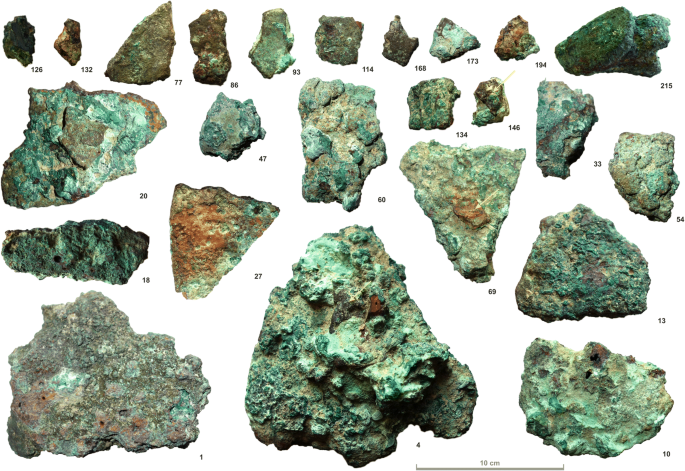
Copper slag is particularly important in archaeological research because it represents waste material produced during metallurgical processes. The study of possible Bronze Age copper slags near Chalkidiki mining areas could therefore contribute to understanding early metal production in northern Greece. Nevertheless, the specific date and origin of any proposed slag assemblage must be established through scientific analysis and archaeological context.
Copper Resources and Bronze Age Technology
Copper was one of the earliest metals widely used by prehistoric communities. During the Bronze Age, it was frequently combined with tin to produce bronze, an alloy that could offer advantages in hardness and working properties.
The production of copper required several stages. Communities first had to identify and obtain copper-bearing ores. These ores were then crushed, prepared, and heated under controlled conditions to separate usable metal from unwanted material.
The process required knowledge of fuel, furnace construction, temperature, airflow, and the chemical behavior of minerals. Metallurgical production therefore involved specialized technical skills that were not necessarily available in every settlement.
Understanding Copper Slag
Slag is a by-product formed during metal extraction and processing. It can contain glassy material, mineral inclusions, metal droplets, and compounds produced through high-temperature reactions.
The appearance of slag varies according to the ore, furnace conditions, fuel, and metallurgical technique. Some forms are dense and heavy, while others may contain bubbles or display a porous structure.
The presence of slag can indicate metallurgical activity, but not all slag has the same origin. Archaeologists must distinguish between smelting slag, refining waste, furnace lining, and other materials produced during high-temperature activities.
The identification of copper slag requires mineralogical and chemical examination. Visual inspection alone is insufficient to establish the precise metallurgical process.
Mining and Metallurgical Landscapes in Chalkidiki
Mining landscapes include more than extraction sites. They may also contain processing areas, workshops, furnaces, storage facilities, settlements, and routes used to transport ore and finished products.
The relationship between a mineral deposit and a nearby settlement is particularly important. If archaeological evidence demonstrates that ore was extracted and processed locally, researchers may be able to reconstruct the organization of production and the distribution of metal products.
Chalkidiki's geological resources make it a significant region for studying the relationship between natural resources and human activity. However, the existence of modern mining activity or mineral deposits does not by itself demonstrate prehistoric exploitation. Archaeological dating and technological evidence are necessary to establish the chronology of mining.
Archaeological Evidence of Metallurgical Production
Evidence of ancient metalworking may include furnaces, tuyères, crucibles, molds, ore fragments, slag deposits, and metal objects. These materials provide different kinds of information about the production process.
Furnace remains can reveal the construction and operation of smelting installations. Crucibles may indicate the melting or refining of metal, while molds can provide evidence of object manufacture.
The spatial distribution of metallurgical remains may help distinguish between household-scale production and more organized workshop activity. Large concentrations of slag could suggest repeated or intensive processing, although their interpretation depends on the size, chronology, and context of the deposit.
Scientific Examination of Copper Slags
Scientific analysis is essential for understanding the composition and origin of metallurgical waste. Optical microscopy can reveal the internal structure of slag, while scanning electron microscopy may identify mineral phases and metal inclusions.
X-ray fluorescence can help determine the elemental composition of samples. Other analytical techniques may provide information about mineral phases, oxidation conditions, and the technological processes involved.
Lead isotope analysis is sometimes used in studies of metal provenance. It can help compare ores and metal objects, but the results must be interpreted carefully because different deposits may have overlapping isotopic signatures.
Radiocarbon dating may be possible when suitable organic materials are securely associated with a metallurgical context. The slag itself generally cannot be dated directly through conventional radiocarbon methods.
Economic and Social Significance
Metallurgy influenced the organization of ancient communities because it required access to raw materials, fuel, technical knowledge, and labor. Mining and metal production could encourage exchange between settlements and create specialized occupations.
The production of metal objects also had social importance. Tools and weapons supported practical activities, while ornaments and ceremonial objects could communicate status, identity, and authority.
If Bronze Age metallurgical activity is confirmed in Chalkidiki, it would contribute to broader discussions about technological development and resource use in prehistoric northern Greece.
Conclusion
Copper slag is a valuable source of archaeological information because it can reveal the technical processes involved in ancient metal production. The proposed study of Bronze Age copper slags near Chalkidiki mines could help clarify the relationship between mineral resources, prehistoric settlements, and metallurgical knowledge.
To establish the significance of such material, researchers must verify its archaeological context, date, and chemical composition. Properly documented evidence could contribute to understanding the development of metallurgy and the economic organization of Bronze Age communities in the region.