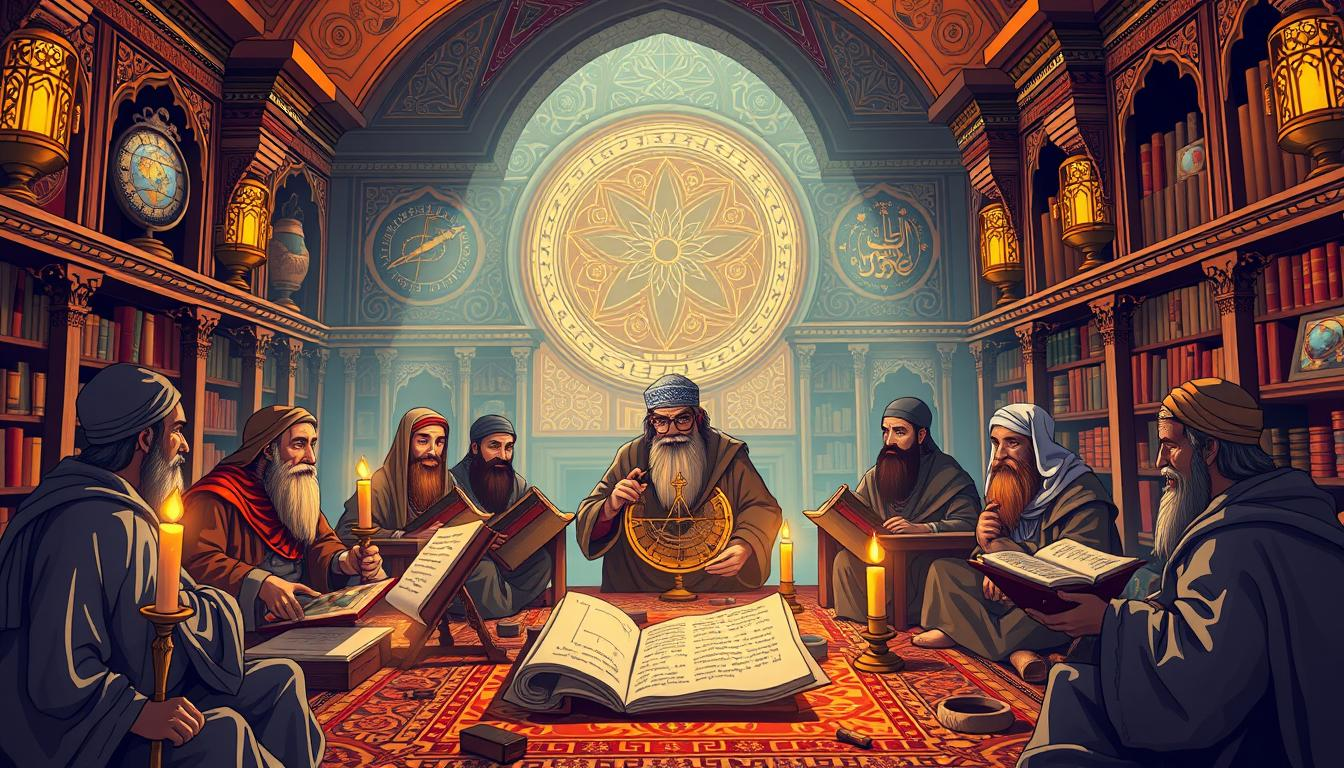
The Great Chain of Knowledge: Greek Science and Its Impact on the Islamic Golden Age
The preservation and expansion of human knowledge is rarely a straight line; it is a relay race. When the Western Roman Empire collapsed and Europe entered a period of intellectual contraction, the torch of Greek scientific inquiry was passed to the East. During the Islamic Golden Age (8th–13th centuries), scholars in Baghdad, Cairo, and Córdoba didn't just archive Greek science—they interrogated, corrected, and radically expanded it, creating the foundation for the modern scientific method.
1. The Translation Movement: Baghdad’s House of Wisdom
The catalyst for this intellectual explosion was the Translation Movement, centered in the Bayt al-Hikma (House of Wisdom) in Baghdad. Under the Abbasid Caliphs, particularly Al-Ma'mun, a state-sponsored effort was launched to translate every available Greek manuscript into Arabic.
The Subjects: Works by Aristotle (Logic), Euclid (Geometry), Ptolemy (Astronomy), and Galen (Medicine) were hunted down across the Mediterranean and Middle East.
The Scholars: This was a multicultural effort. Syriac Christians, Jews, and Muslims worked together. Hunayn ibn Ishaq, a Nestorian Christian, became the most famous translator, known for his precision in rendering complex Greek medical terms into Arabic.
2. Medicine: From Galen to Ibn Sina
Islamic physicians inherited the Greek system of "Humorism" from Galen and Hippocrates, which held that health was a balance of four bodily fluids. However, they moved beyond Greek theory toward clinical observation.
Ibn Sina (Avicenna): His monumental work, The Canon of Medicine, synthesized the medical knowledge of the Greeks with his own clinical findings. He introduced the idea of quarantine to limit the spread of contagious diseases and was the first to describe the contagious nature of tuberculosis.
Al-Razi (Rhazes): Often called the "Galen of the Arabs," he was the first to distinguish smallpox from measles, a feat of diagnostic precision that was missing in Greek texts. He famously challenged Galen’s theories when they didn't match his experimental observations.
3. Mathematics: The Birth of Algebra
The Greeks were masters of geometry, but they lacked a robust system for calculation. Islamic mathematicians took Greek geometric principles and fused them with Indian numerical systems (the concept of zero and "Arabic" numerals).
Al-Khwarizmi: He utilized the geometry of Euclid to solve practical problems in inheritance and land measurement. His book Al-Jabr (the root of the word Algebra) moved beyond the Greek focus on "shapes" to a new system of "equations."
Refining Geometry: Scholars like Al-Biruni used Greek trigonometry to calculate the radius of the Earth with a margin of error of less than 1%, centuries before European explorers realized the true scale of the planet.
4. Astronomy: Correcting the Ptolemaic Model
The Islamic world inherited the Ptolemaic System—the Greek geocentric model where the Earth sits at the center of the universe. While they respected Ptolemy, Islamic astronomers noticed that his mathematical models didn't perfectly match the movement of the stars.
The Maragha Observatory: Astronomers like Nasir al-Din al-Tusi developed the "Tusi Couple," a mathematical device that resolved flaws in Ptolemy’s planetary orbits.
The Copernican Link: Centuries later, Nicolaus Copernicus used these same Islamic mathematical models to help prove his heliocentric (sun-centered) theory. Without the Islamic refinement of Greek astronomy, the Scientific Revolution in Europe might have stalled.
5. Optics: The First Scientific Method
Greek science often relied on "extramission theory"—the idea that the eye sends out rays to "touch" objects. Ibn al-Haytham (Alhazen), working in Cairo, used Greek geometry to prove the Greeks were wrong.
Intromission Theory: He proved that light reflects off objects and enters the eye.
The Camera Obscura: By experimenting with light through a pinhole, he created the first "dark chamber." His Book of Optics is considered the first true example of the Scientific Method, as he insisted that every theory must be verified through repeatable physical experiments, not just philosophical reasoning.
Conclusion: The Return to Europe
The influence of Greek science on the Islamic world came full circle during the 12th and 13th centuries. As Europeans began to re-establish trade and contact with the Islamic world in Spain and Sicily, they "rediscovered" their own Greek heritage—not in the original Greek, but in Arabic translations accompanied by brilliant Islamic commentaries.
Figures like Ibn Rushd (Averroes) became the primary teachers of Aristotle to the West. The Islamic Golden Age didn't just save Greek science from being forgotten; it polished, tested, and upgraded it, ensuring that when the Renaissance finally arrived, it was built on a foundation of rigorous evidence and mathematical precision.