The Professionals: The Role of Greek Mercenaries in Ancient Warfare
While the image of the citizen-soldier—the farmer who picks up a shield to defend his city—is central to Greek identity, the reality of ancient warfare was often dominated by the mercenary. From the golden sands of Egypt to the heart of the Persian Empire, Greek mercenaries were the most sought-after "special forces" of the ancient world. They turned war from a civic duty into a high-stakes profession, fundamentally changing the geopolitics of the Mediterranean and Near East.
1. The "Hoplite for Hire": Why Greeks?
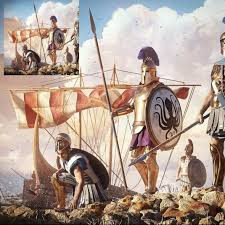
The Greek hoplite was the world's premier heavy infantryman. Their effectiveness came not just from their equipment, but from the phalanx formation—a wall of bronze and oak that was nearly impenetrable to the lighter, more mobile infantries of the East.
The Economic Push
Greece was often "land-hungry" and politically volatile. For a younger son with no inheritance or a political exile with no home, mercenary work offered:
High Pay: Mercenaries were often paid in gold or silver coin, a rarity in the early Greek economy.
Social Mobility: A successful mercenary could return home with enough wealth to buy land and enter the elite class.
Adventure and Survival: For many, it was simply a more viable career than subsistence farming.
2. The Ten Thousand: A Turning Point in History
The most famous account of Greek mercenaries is found in Xenophon’s Anabasis. In 401 BCE, a Persian prince named Cyrus the Younger hired over 10,000 Greek mercenaries (the "Ten Thousand") to seize the throne from his brother, Artaxerxes II.
The March to the Sea
After Cyrus was killed at the Battle of Cunaxa, the Greeks were stranded in the heart of Mesopotamia with no leaders and no map. Their journey back to the Black Sea—fighting through hostile tribes and winter snows—proved a vital point to the world: a disciplined Greek force could march through the heart of the Persian Empire and survive. This realization directly paved the way for the later conquests of Agesilaus II and, eventually, Alexander the Great.
3. Serving the Pharaohs: Greeks in Egypt
Long before the Classical Age, Greek mercenaries were the backbone of the Egyptian military. The Pharaohs of the 26th Dynasty (the Saite Period) relied so heavily on Greek "bronze men" that they granted them their own city: Naucratis.
The King's Guard: Greek mercenaries served as the personal bodyguards to the Pharaohs, viewed as more loyal than local troops because they had no stake in Egyptian palace politics.
Cultural Exchange: These soldiers were the first "tourists." We still find Greek graffiti carved into the legs of the giant statues at Abu Simbel, left by bored mercenaries on campaign in the 6th century BCE.
4. The Professionalization of War
The rise of the mercenary led to a "tech race" in ancient warfare. Because they were professionals, they had the time and incentive to innovate in ways citizen-soldiers could not.
Specialization: Mercenaries weren't just hoplites. The world saw the rise of specialist "light" troops, like the Cretan Archers or the Rhodian Slingers, who provided essential support that traditional city-state armies lacked.
Peltasts and Tactics: The mercenary general Iphicrates revolutionized warfare by equipping his troops with lighter shields and longer spears, allowing them to outmaneuver and harass traditional heavy phalanxes.
5. The Moral Dilemma: Soldiers of Fortune vs. Citizens
The use of mercenaries was a double-edged sword for the Greek polis.
Dependence: Wealthy cities like Athens or Carthage eventually became so dependent on mercenaries that their own citizens forgot how to fight.
Loyalty: As the philosopher Plato and the historian Polybius noted, mercenaries were loyal to the coin, not the cause. If a higher bidder appeared, or if the pay dried up, the army disappeared.
Conclusion: The Precursors to Empire
Greek mercenaries were the primary vehicle for the "Hellenization" of the East long before Alexander the Great was born. They spread the Greek language, military tactics, and coinage to every corner of the known world. They proved that the Greek way of war was a commodity as valuable as wine or oil, and in doing so, they shifted the center of power from the individual city-state to the massive, professional armies of the Hellenistic kings.