The Parthenon Marbles: A 200-Year-Old Tug of War
The debate over the Parthenon Marbles (often called the Elgin Marbles) is perhaps the most famous and complex cultural heritage dispute in the world. It pits the British Museum in London against the Acropolis Museum in Athens, raising profound questions about history, law, and who "owns" the past.
1. The History: How They Left Athens
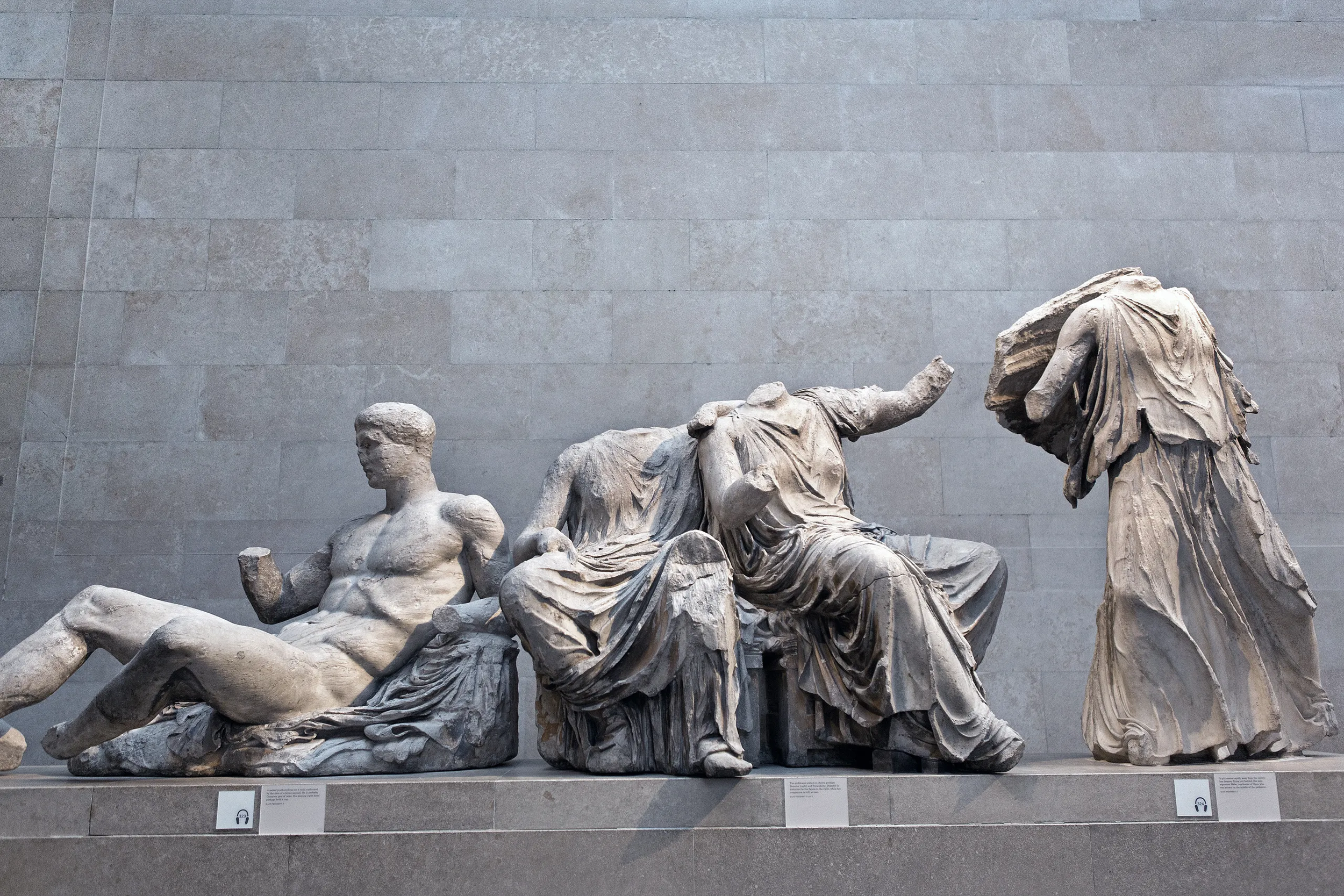
The marbles are a collection of Classical Greek sculptures—friezes, metopes, and pediment figures—that originally decorated the Parthenon on the Athenian Acropolis. They were created under the supervision of the master sculptor Phidias between 447 and 432 BCE.
Between 1801 and 1812, Thomas Bruce, the 7th Earl of Elgin, who was the British Ambassador to the Ottoman Empire (which then ruled Greece), removed roughly half of the surviving sculptures. Elgin claimed he had a firman (official decree) from the Ottoman authorities allowing him to take them. He eventually sold them to the British government, which placed them in the British Museum in 1816.
2. The Case for Returning to Greece (Restitution)
The Greek government, supported by many international activists and celebrities, argues that the marbles are an inseparable part of a single monument and a national symbol.
Unity of the Monument: Proponents argue that the marbles are not standalone "art pieces" but architectural elements. Keeping half in London and half in Athens "mutilates" the artistic integrity of Phidias’s work.
Questionable Legality: Greece contends that the Ottoman Empire was an occupying power and had no moral or legal right to give away Greek heritage. Furthermore, the original firman Elgin claimed to have has never been found; only an Italian translation exists, and its wording is ambiguous.
The New Acropolis Museum: For decades, the British Museum argued that Greece had no suitable place to house the marbles. This argument was neutralized in 2009 with the opening of the state-of-the-art Acropolis Museum, which features a dedicated gallery for the Parthenon frieze, currently filled with plaster casts of the pieces held in London.
3. The Case for Staying in London (Retention)
The British Museum and its supporters argue that the marbles are part of a shared global heritage and that their presence in London provides a unique educational service.
The "Universal Museum" Concept: The British Museum argues that it is a world-class institution where the marbles can be seen in the context of other civilizations (Egyptian, Assyrian, Roman), allowing visitors to understand the global "cross-pollination" of art.
Legal Acquisition: The museum maintains that Elgin acquired the sculptures legally under the laws of the time and that the British Parliament cleared him of any wrongdoing in 1816.
Preservation History: Supporters argue that by removing the marbles when he did, Elgin saved them from further decay, pollution, and the risk of being ground down for lime or damaged in the Greek War of Independence.
4. The Changing Tide: Recent Developments
In recent years, the pressure on the British Museum has reached an all-time high. Several factors have shifted the momentum:
International Precedent: Many museums (such as the Smithsonian and various German institutions) have begun returning "colonial-era" artifacts, such as the Benin Bronzes, to their countries of origin.
UNESCO’s Stance: In 2021, UNESCO’s Intergovernmental Committee stated for the first time that the dispute is not just between two museums, but an intergovernmental issue, urging the UK to "reconsider its position."
Public Opinion: Polls in the United Kingdom consistently show that a majority of the British public now supports returning the marbles to Greece.
5. Is a Compromise Possible?
Both sides have explored "hybrid" solutions to break the deadlock:
The "Parthenon Partnership": Recent reports suggest the British Museum and Greece have discussed a long-term loan agreement. Greece might send other ancient masterpieces to London in exchange for the "rolling return" of the Parthenon sculptures.
Digital Reconstruction: Some suggest using high-resolution 3D robotic carving to create perfect replicas for London, allowing the originals to return to Athens.
The Core Question
The Parthenon Marbles controversy isn't just about rocks and marble; it’s about identity. For Greece, they are a missing limb of a national body. For the British Museum, they are the cornerstone of a global archive. As the world moves toward decolonizing museums, the fate of these sculptures remains the ultimate test case for the future of cultural property.
Do you think a museum's role is to preserve history where it can be seen by the most people, or to ensure that cultural artifacts remain in their place of origin?