The Great Expansion: The Three Pillars of the Greek Diaspora
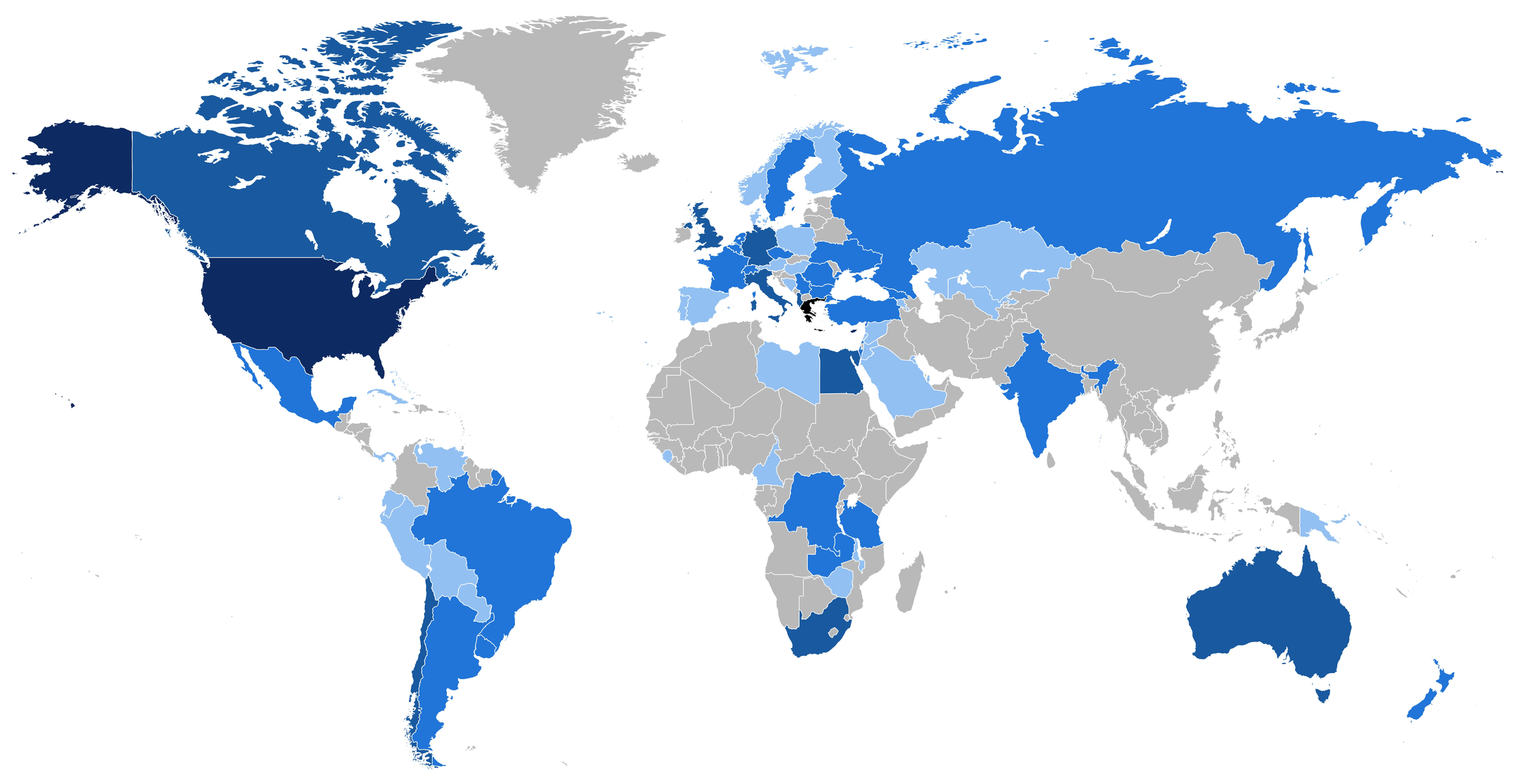
The story of Greece is not confined to the Balkan Peninsula. For nearly three millennia, the Greeks were a seafaring people whose identity was defined by the Diaspora—the "scattering" of communities across the Mediterranean and beyond. By the time of the Roman Empire, there were often more Greeks living outside of Greece than within it.
Three regions stand out as the primary anchors of this expansion: Magna Graecia (Southern Italy), Asia Minor (Modern-day Turkey), and Egypt.
1. Magna Graecia: The "Greater Greece" of Italy
Starting in the 8th century BCE, Greeks from Euboea, Corinth, and Sparta began establishing colonies in Southern Italy and Sicily. They found the soil so fertile and the cities so wealthy that the region became known as Magna Graecia.
The Cultural Powerhouses: Cities like Syracuse, Tarentum, and Neapolis (Naples) were larger and wealthier than most cities in mainland Greece. Syracuse, in particular, was a rival to Athens in terms of military might and architectural splendor.
The Intellectual Hub: Southern Italy was the home of Pythagoras and his mathematical school in Croton, as well as the philosopher Parmenides.
The Roman Legacy: When Rome expanded southward, it didn't just conquer these cities; it absorbed their culture. Most of what we consider "Roman" art, religion, and literature was actually the result of Romans encountering the sophisticated Greeks of Southern Italy.
2. Asia Minor: The Heart of Ionian Intellectualism
The western coast of Asia Minor (modern-day Turkey) was perhaps the most "Greek" place outside of Greece itself. It was here, in the region of Ionia, that Western philosophy and science were born.
The Birth of Philosophy: In cities like Miletus and Ephesus, thinkers like Thales and Heraclitus began asking questions about the nature of the universe without relying on mythology.
The Hellenistic Metropolises: After the conquests of Alexander the Great, Asia Minor became the center of the Greek world. The city of Pergamon boasted a library that rivaled Alexandria’s, and the Temple of Artemis at Ephesus was one of the Seven Wonders of the Ancient World.
The Long Sunset: Greek communities remained the dominant cultural force in Asia Minor through the Byzantine Empire and into the early 20th century. This 3,000-year history only came to a tragic end with the "Population Exchange" of 1923.
3. Egypt: The Center of the Hellenistic Universe
Greek influence in Egypt began with mercenaries and traders, but it reached its zenith after Alexander the Great conquered the region in 332 BCE and established the Ptolemaic Dynasty.
Alexandria: This city was the "New York of the Ancient World." It was a planned Greek city on Egyptian soil that served as the global center for trade, science, and literature.
The Fusion of Cultures: Unlike the colonies in Italy, the Greeks in Egypt engaged in a complex cultural dance with the locals. The Ptolemies portrayed themselves as Greek Kings to their Greek subjects and as Divine Pharaohs to the Egyptians. This led to the creation of hybrid deities like Serapis.
The Jewish Diaspora: Alexandria was also home to the largest Greek-speaking Jewish community in the world. It was here that the Hebrew Bible was translated into the Greek Septuagint, a pivotal moment for the eventual spread of Christianity.
4. The Diaspora as a "Cultural Bridge"
The Greek Diaspora was never just about migration; it was about the creation of a Common Mediterranean Culture (Koine).
Trade: Greek merchants linked the tin mines of Britain to the spice routes of India.
Architecture: Whether you were in Marseilles, Benghazi, or Sevastopol, you would find the same Doric columns and open-air theaters.
The Survival of Knowledge: When mainland Greece fell into decline or was invaded, it was often the Diaspora communities—in Baghdad, Constantinople, or Sicily—that preserved the manuscripts and scientific traditions that would eventually fuel the Renaissance.
Conclusion: A Nation Without Borders
The Greek Diaspora proves that a civilization is not defined by a specific plot of land, but by a shared language, set of values, and intellectual tradition. By spreading across Italy, Asia Minor, and Egypt, the Greeks ensured that their "inquiry" into the world became a permanent feature of human history.
Which of these three regions do you find most interesting—the philosophical cities of Asia Minor, the wealthy colonies of Italy, or the scientific hub of Egypt?