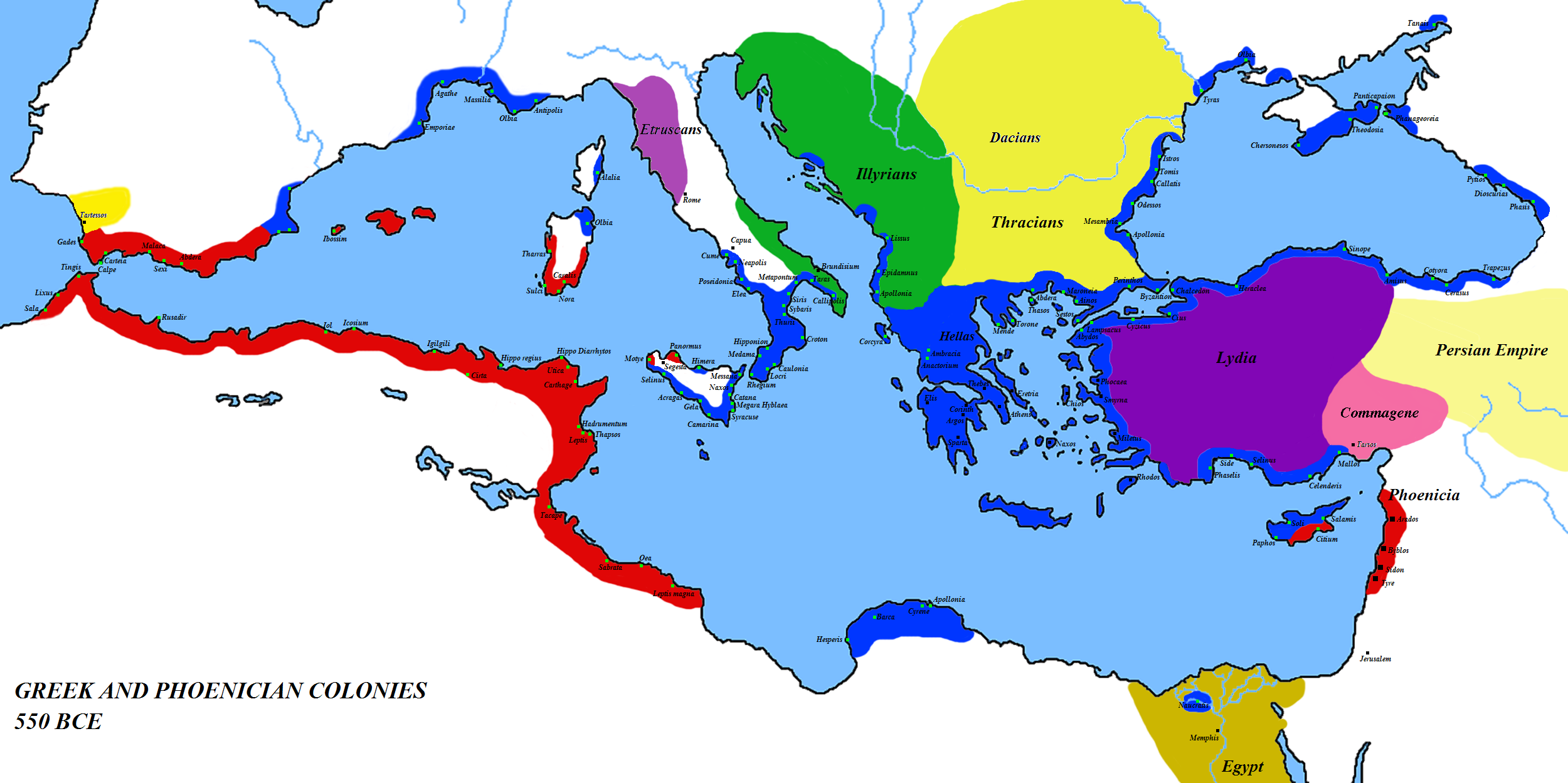
While the word "colonization" today often carries connotations of imperial conquest, the Greek version—apoikia (literally "a home away from home")—was a more organic expansion. Driven by land hunger, political strife, and a desire for new trade routes, Greek city-states sent out expeditions that eventually turned the Mediterranean and the Black Sea into a "Greek Lake."
As the philosopher Plato famously remarked, the Greeks settled around the sea "like frogs around a pond."
1. The Drivers: Why Leave Home?
Between roughly 750 and 550 BCE, hundreds of new Greek settlements were founded. This wasn't a centralized empire-building project but a series of independent ventures.
Stenochoria (Land Hunger): Greece is mountainous with limited arable land. As the population grew, the "Mother City" (Metropolis) would experience food shortages, forcing them to send out a segment of their population to find new soil.
Political Exile: In the high-stakes world of the polis, losing a political struggle often meant you and your supporters had to leave or face execution.
Trade and Resources: Greeks needed reliable access to metals (iron and copper), grain (from the Black Sea and Egypt), and timber.
2. The Process: The Oikistes and the Sacred Fire
Founding a colony was a highly ritualized event. A group of settlers, led by a designated leader called the Oikistes, would first consult the Oracle at Delphi to seek Apollo’s blessing for their destination.
The Sacred Fire: The settlers would carry a flame from the eternal hearth of their Metropolis to light the hearth of the new city. This symbolised the "umbilical cord" between the new settlement and the old, though politically, the colony was an independent state from day one.
Urban Planning: Because these were "start-up" cities, they often featured more orderly, grid-like layouts (Hippodamian plans) than the chaotic, ancient streets of Athens or Corinth.
3. Key Regions of Expansion
The Greek diaspora established three primary pillars of influence:
Magna Graecia (Southern Italy and Sicily): This was the "New World" for the Greeks. Cities like Syracuse and Tarentum became wealthier and more populous than mainland cities.
The Black Sea (Euxine Pontus): Founded primarily by the city of Miletus, these colonies (like Byzantium and Olbia) served as the "breadbasket" of Greece, shipping massive amounts of grain back to the mainland.
North Africa and Gaul: Cities like Cyrene (Libya) and Massalia (modern-day Marseille, France) introduced Greek viticulture and olive oil production to Western Europe.
4. The "Hellenization" of the Mediterranean
The impact of these colonies went far beyond simple trade. They acted as "cultural transformers" for the indigenous peoples they encountered.
The Alphabet: The Greeks brought their phonetic alphabet to Italy, where the Etruscans and later the Romans adapted it into the Latin alphabet we use today.
Monetary Economy: The spread of Greek coinage standardized trade across the Mediterranean, facilitating the first truly "global" economy.
Architecture and Art: From the temples of Paestum in Italy to the theaters of Asia Minor, Greek aesthetic standards became the prestige language of the ancient world.
5. A Network, Not an Empire
Unlike the Roman Empire, which was a top-down hierarchy, the Greek world was a decentralized network of independent cities. They were held together not by a single king, but by a shared language, shared gods, and the Panhellenic games.
This expansion ensured that when the Greek mainland eventually fell to Macedon and later Rome, the "Greek Way of Life" was already so deeply rooted in the soil of Italy, France, and Egypt that it could never truly be erased.