The story of Antigone is the final chapter in the tragic saga of the House of Oedipus. It is a profound exploration of the conflict between "Divine Law" (personal conscience and religious duty) and "Human Law" (the decrees of the state), a theme that remains central to Western legal and ethical philosophy.
1. The Context: The War of the Two Brothers
Following the exile and death of Oedipus, his two sons, Eteocles and Polynices, agreed to share the throne of Thebes by alternating years. However, Eteocles refused to step down after his term, leading Polynices to raise an army from Argos to take the city by force—the famous conflict known as the Seven Against Thebes.
The war ended in a gruesome stalemate: the two brothers killed each other in single combat outside the city gates. Their uncle, Creon, then assumed the throne.
2. Creon’s Decree
To restore order to the war-torn city, Creon issued a stern legal edict:
Eteocles, who died defending the city, was to be buried with full military honors.
Polynices, viewed as a traitor who brought a foreign army against his own people, was to be left unburied on the battlefield.
In Greek culture, leaving a body unburied was the ultimate punishment; it meant the soul would be unable to cross the River Styx and would wander the earth in misery forever. Creon declared that anyone who attempted to bury Polynices would be executed.
3. The Act of Defiance
Antigone, the sister of the fallen brothers, could not accept the desecration of her sibling. She believed that the laws of the gods regarding the dead were eternal and superseded any temporary law made by a king.
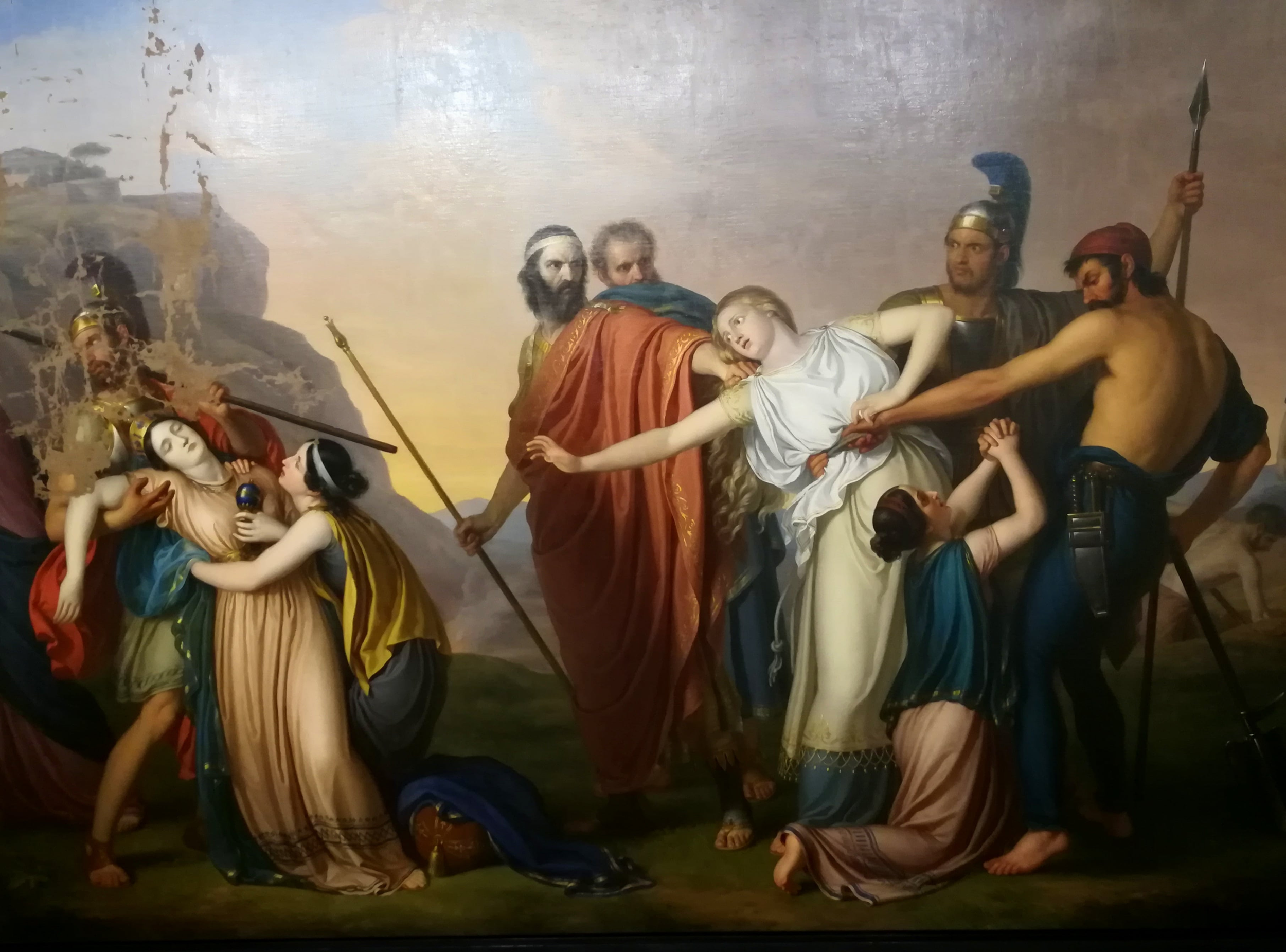
Despite the warnings of her more timid sister, Ismene, Antigone went to the battlefield and performed the symbolic funeral rites, sprinkling dust over Polynices' body. She was captured by Creon’s guards and brought before the King.
4. The Philosophical Clash
The core of the myth is the dialogue between Antigone and Creon, representing two irreconcilable worldviews:
Antigone’s Argument: She argued that Creon’s decree was a violation of the "unwritten and unfailing laws of heaven." She chose loyalty to her family and the divine over her own life.
Creon’s Argument: He argued that a leader must be obeyed for the sake of the state. If laws are ignored for personal reasons, the result is Anarchy, which he viewed as the greatest evil facing a city.
5. The Tragic Conclusion
Creon sentenced Antigone to be sealed alive in a stone tomb. This decision triggered a chain reaction of death:
Haemon, Creon’s son and Antigone’s fiancé, pleaded for her life. When Creon refused, Haemon committed suicide in the tomb with Antigone (who had already hung herself).
Eurydice, Creon's wife, killed herself upon hearing of her son’s death.
Creon was left alive but broken, a "living corpse" who realized too late that his stubbornness had destroyed his family and his peace.
The myth of Antigone continues to be performed and adapted globally, often serving as a symbol of civil disobedience against unjust regimes.