The encounter with Polyphemus is one of the most famous episodes in Homer’s Odyssey. It serves as a masterclass in the Greek concept of Xenia (the sacred law of hospitality) and demonstrates the transition of Odysseus from a simple warrior to a cunning "man of many ways."
1. The Nature of the Cyclopes
The Cyclopes were a race of primordial giants, each with a single large, circular eye in the center of their forehead. Unlike the civilized Greeks, they were depicted as lawless and solitary:
Anti-Social: They had no government, no agriculture, and no laws.
Contempt for the Gods: Polyphemus famously claimed that the Cyclopes were stronger than the Olympian gods and felt no need to honor them.
The Cave: Polyphemus lived in a massive cavern on an island (often identified as Sicily), where he tended his flock of giant sheep and made cheese.
2. The Violation of Xenia
When Odysseus and twelve of his men entered Polyphemus's cave, they expected to be treated as guests. In Greek culture, a host was obligated to provide food and safety.
Polyphemus did the opposite. Upon finding the men, he mocked their request for hospitality, snatched up two of Odysseus's companions, and ate them raw. He then sealed the cave with a massive boulder that only a giant could move, effectively turning the cave into a larder for his future meals.
3. The "No One" Stratagem
Odysseus realized that killing the giant in his sleep was impossible, as the men would remain trapped behind the boulder. Instead, he formulated a multi-stage plan based on deception:
The Wine: Odysseus offered Polyphemus some potent, undiluted wine he had brought from the ship. The giant, unused to alcohol, drank until he fell into a drunken stupor.
The Name: Before the giant passed out, he asked Odysseus for his name. Odysseus replied, "My name is Nobody" (Outis in Greek).
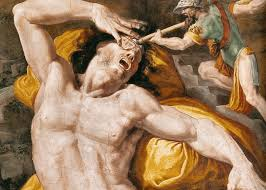
The Blinding: While the giant slept, Odysseus and his men took a sharpened olive-wood stake, heated it in the fire, and drove it into Polyphemus's single eye.
4. The Great Escape
Polyphemus roared in pain, calling out to the other Cyclopes on the island for help. When they gathered outside the cave and asked who was hurting him, Polyphemus shouted, "Nobody is killing me!" Thinking their friend was simply suffering from a divine illness or madness, the other giants went home.
The next morning, to escape the cave, Odysseus tied his men to the bellies of Polyphemus's sheep. As the blinded giant felt the tops of the sheep to ensure no one was riding them out, the men slipped past him unnoticed.
5. The Fatal Boast and the Curse
As Odysseus sailed away, his pride got the better of him. He shouted his true name to Polyphemus, wanting the world to know who had defeated the giant.
This was a catastrophic mistake. Polyphemus was the son of Poseidon, the god of the sea. Hearing his son’s cry for vengeance, Poseidon heard the prayer of Polyphemus:
"Grant that Odysseus, sacker of cities... may never reach his home. But if he is destined to see his friends again... let him come late, in a bad state, having lost all his comrades."
This curse became the driving force of the Odyssey, ensuring that Odysseus wandered the seas for another ten years and lost every single one of his men before returning to Ithaca.