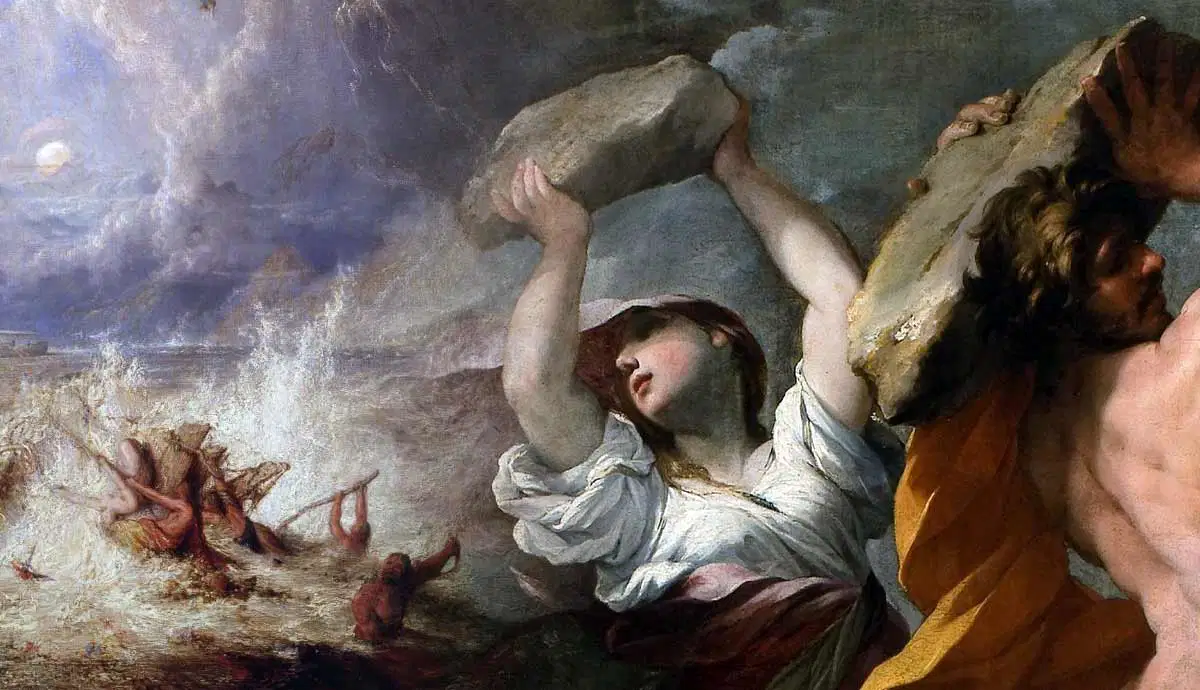
The myth of Deucalion and Pyrrha is the Greek equivalent of the universal "Great Flood" motif. It marks the transition between the age of the primordial Bronze men and the birth of modern humanity, framed as a story of survival, piety, and a bizarre, stony rebirth.
1. The Wrath of Zeus
By the end of the Bronze Age, humanity had become wicked and irreverent. The final straw for Zeus was a visit to the house of Lycaon, the King of Arcadia, who attempted to serve the king of the gods a meal of human flesh to test his divinity.
Disgusted, Zeus decided to wipe out the human race entirely. While he initially considered using thunderbolts, he feared the fire might rise high enough to consume the heavens. Instead, he chose to flood the earth with the help of Poseidon, calling forth a deluge that submerged everything but the highest mountain peaks.
2. The Ark of Prometheus
Just as in other flood myths, one pair was spared due to their virtue. Deucalion was the son of the Titan Prometheus, and his wife Pyrrha was the daughter of Epimetheus and Pandora.
Prometheus, possessing the gift of foresight, warned his son of the coming disaster. Under his father's instructions, Deucalion built a large wooden chest (a larnax). The couple stocked it with provisions and floated upon the rising waters for nine days and nights.
3. The Rebirth of Humanity
When the rains ceased, the chest came to rest on the peaks of Mount Parnassus. As the waters receded, Deucalion and Pyrrha stepped out into a silent, desolate world. Desperate for companionship and guidance, they visited the Oracle of Themis.
The Oracle gave them a cryptic and seemingly horrifying command:
"Depart from my temple, cover your heads, and throw the bones of your mother behind you."
Pyrrha was initially terrified, as disturbing the bones of one's mother was a great sacrilege. However, Deucalion, inheriting his father's wit, realized that the "Mother" was Gaia (Mother Earth) and her "bones" were the stones of the earth.
4. The Stone People
Following the Oracle's instructions, the couple walked across the land, throwing stones over their shoulders:
The stones thrown by Deucalion softened and transformed into men.
The stones thrown by Pyrrha softened and transformed into women.
This new race of humans was known as the "Stone People," a name intended to explain why humans are capable of enduring hard labor and suffering. From this new generation came their son, Hellen, the legendary ancestor of the "Hellenes" (the Greeks).
The legend of Deucalion and Pyrrha underscores the Greek belief that humanity is literally tied to the earth, possessing a "stony" resilience that allows them to survive divine upheaval.