The myth of Persephone and Hades is one of the most significant "etiological" myths in Greek culture—meaning it was created to explain a natural phenomenon: the changing of the seasons. It also provides a rare glimpse into the structure and rules of the Underworld.
1. The Abduction (The Theft of Spring)
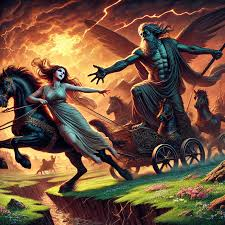
Persephone (originally named Kore, or "The Maiden") was the daughter of Demeter, the goddess of the harvest, and Zeus. One day, while she was gathering flowers in a meadow, the earth suddenly split open. Hades, the King of the Dead, emerged in his golden chariot and carried her away to the Underworld to be his queen.
Demeter, devastated by the loss of her daughter, abandoned her duties. As she wandered the earth in mourning, the soil became barren, the crops withered, and a perpetual winter fell over the world. Humanity faced starvation, forcing Zeus to intervene.
2. The Pomegranate Seeds (The Law of the Underworld)
Zeus sent Hermes to the Underworld to order Hades to release Persephone. Hades seemingly complied, but before she left, he offered her a gift: several seeds of a pomegranate.
In the ancient Greek world, there was a sacred law of the Underworld: anyone who consumed the food of the dead was bound to that realm forever. By eating even a few small seeds, Persephone unknowingly tied her fate to Hades.
3. The Divine Compromise
Because Persephone had eaten the seeds, a compromise was reached to prevent the total destruction of the earth:
One-Third of the Year: Persephone would live in the Underworld as Queen with Hades.
Two-Thirds of the Year: She would return to the upper world to be with her mother, Demeter.
4. The Origin of the Seasons
This arrangement became the mythological heartbeat of the Greek year:
Spring and Summer: When Persephone returns to the earth, Demeter is overjoyed. The flowers bloom, the trees bear fruit, and the earth becomes lush and green.
Autumn and Winter: When Persephone must descend back to the Underworld, Demeter’s grief returns. She withdraws her life-giving power from the soil, causing the leaves to fall and the ground to go dormant.
5. The Two Faces of Persephone
Unlike many other victims of abduction in myth, Persephone’s character evolved. She is rarely depicted as a helpless prisoner in later stories.
The Dread Goddess: In the Underworld, she was known as the "Iron Queen," a formidable and often cold ruler who managed the shades of the dead alongside Hades.
The Bringer of Life: On earth, she remained the symbol of renewal and the "Maiden" of the grain.
The myth was the foundation of the Eleusinian Mysteries, the most secret and sacred religious rites of ancient Greece, which promised initiates a better afterlife based on the story of Persephone’s return.