When most people think of ancient Greek religion, they picture the majestic, colonnaded silhouette of the Parthenon in Athens or the Temple of Apollo at Delphi. We naturally assume these grand buildings were the center of spiritual life—the ancient equivalent of a church, mosque, or cathedral.
But this is a complete misconception.
In ancient Greece, the temple was not a house of worship for the people; it was a secure, luxury vault built to house the cult statue of a god. Human ritual, community gatherings, and the core act of Greek worship did not take place inside the stone walls. They happened outside, under the open sky, centered entirely around a single, indispensable structure: the altar (bomos).
Without a temple, a Greek could still easily practice their religion. Without an altar, worship was impossible.
1. Spatial Layout: The True Center of Gravity
The architectural layout of a Greek sanctuary (temenos) reveals a deliberate sacred geography. The boundary of the sanctuary was explicitly marked by stones, creating a zone completely isolated from the pollution of everyday civic life.
Within this sacred space, the altar was almost always built outside, directly in front of the temple's eastern entrance.
 [ SANCUTARY BOUNDARY ] ──► [ THE ALTAR (Public/Outdoor Ritual) ] ──► [ THE TEMPLE (The God's Vault) ]
    (Sacred Temenos)             (Eastern Courtyard Axis)                (Cult Statue Inside)
This east-west alignment was critical. When a priest stood at the altar to perform a sacrifice, they faced west toward the temple. As the massive wooden doors of the temple swung open at dawn, the morning sun would slice past the altar, illuminate the smoke of the burning sacrifice, and shine directly onto the eyes of the gold-and-ivory cult statue waiting inside.
The god looked out from the dark interior to watch the humans tending the sacrificial flames in the bright courtyard. The altar was the literal interface—the point of contact—between the human city and the divine mind.
2. Anatomy of the Altar: Form Follows Function
While temples followed a relatively strict, universally recognized architectural blueprint, altars varied wildly in scale, material, and design depending on the age of the sanctuary and the specific deity being honored.
The Evolution of Altar Architecture
The Ash Altar: The most archaic altars weren't made of stone at all. They were monumental, organic mounds formed by the accumulated, un-cleared ash, charred bones, and fat of centuries of sacrifices. The famous Altar of Zeus at Olympia was a towering, 22-foot-high stepped mound of pure sacrificial ash that visitors had to climb to leave their offerings.
The Monolithic Block: The most common variety was a rectangular or circular block carved from local limestone or marble. It featured an upper surface with a slight depression to hold the sacrificial fire, flanked by decorative metal or stone volutes (scroll-like barriers) to keep the wood and bones from falling off the sides.
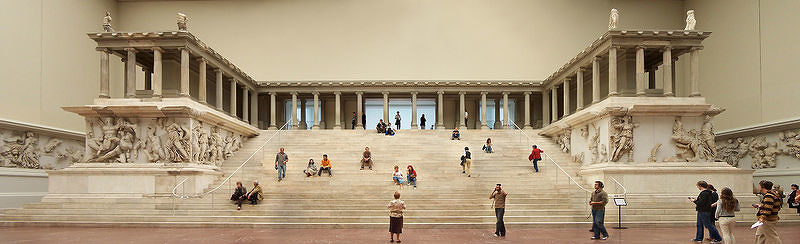
The Monumental Stage: During the Hellenistic period, altars swelled into massive, self-contained architectural wonders that dwarfed the temples next to them. The breathtaking Pergamon Altar (built around 170 BCE) was a massive U-shaped terrace surrounded by a colonnade and a world-famous frieze of battling giants, designed to accommodate hundreds of sacrificial animals simultaneously.
3. The Altar as an Economic and Biological Processor
An altar was not just a static platform for prayer; it was a highly functional, messy, and hard-working biological processor. The core of Greek worship was animal sacrifice (thysia), a complex ritual that elegantly fused religious devotion with community dining.
The altar had to be designed to handle intense heat, heavy butchery, and significant amounts of blood.
1.The Blood Libation:Step 1: Dedicating the Life Force.
The animal's throat was cut over the altar. The blood was carefully caught in bowls and splashed directly against the sides of the stone structure. This act of painting the altar with blood was the primary way of feeding the chthonic elements of the deity and marking the stones as hyper-sacred.
2.The God's Portion:Step 2: Burning the Bones and Fat.
The animal was butchered on or right next to the altar. Because the gods only required the essence of the animal, the thigh bones wrapped in thick sheets of glistening fat (meria) were placed onto the roaring firewood at the center of the altar, often sprinkled with barley and incense.
3.The Human Feast:Step 3: Roasting the Meat.
As the smoke from the bones drifted up to satisfy the god, the inner organs (splanchne) were skewered on long spits and roasted directly over the altar's embers, eaten immediately by the priests and elites to seal the communion. The remaining meat was boiled and distributed to the public.
4. The Altar as a Legal Sanctuary: The Right of Asylum
Because the altar was the physical point where a god's presence intersected with the earth, the stones themselves possessed a powerful aura of absolute inviolability (asylia). This transformed the altar into one of the most important legal and political safety valves in the ancient world.
If a runaway slave, a political dissident, a defeated general, or a convicted criminal managed to outrun their pursuers, enter a sanctuary, and sit upon the altar, they were instantly untouchable.
[ AGGRESSOR ] ──► Attempts to drag fugitive off Altar ──► Harming the God's Property ──► GENERATIONAL CURSE
To violently drag a suppliant off an altar was viewed as an act of direct, open warfare against the deity itself. It inflicted deep spiritual pollution (miasma) upon the aggressor and their city.
Historical accounts are filled with instances where armies or tyrants starved out a political rival by surrounding an altar, refusing to let them eat or drink, waiting for them to die naturally or step away—because physically ripping their fingers off the sacred stone would invite a terrifying, generational curse down upon the state.
5. Architectural Inversion: High Altars vs. Low Pits
As we explored when looking at the shadows of Greek religion, the shape of the altar changed completely based on the vertical direction of the god being invoked.
Altar Type Target Pantheon
Design Elements
Ritual ActionBomos (High Altar) Ouranic (Sky Gods like Zeus, Apollo, Athena)Elevated stone block rising toward the sun; open-air courtyard placement.Smoke, incense, and fat directed upward into the sky.
Bothros / Megaron (Low Pit)
Chthonic (Underworld Gods like Hades, Hecate, The Dead)A hole dug straight into the dirt or a hollow, ringed stone pipe open to the soil. Liquids (blood, milk, wine) poured directly downward into the earth.
Ultimately, the temple was a beautiful monument to a god's pride and a city's wealth, but the altar was where the actual work of religion occurred. It was the messy, smoke-filled, blood-stained hearth of the ancient community—the exact spot where humans bargained with the cosmos for their survival, one sacrifice at a time.