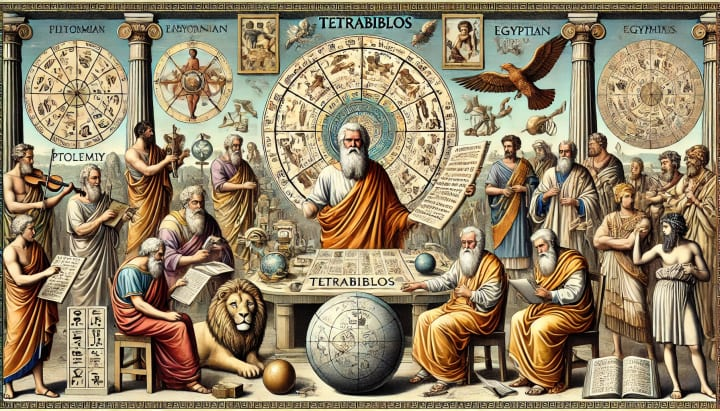
To a modern observer, astronomy and astrology live on completely opposite sides of the intellectual tracks. One is a rigorous, mathematical science, while the other is a popular pseudoscience.
But in the ancient Greek world, this separation did not exist. The Greeks used a single concept to describe both fields: Mathematike. Measuring the physical orbit of a planet and interpreting its cosmic influence on a human soul were viewed as two sides of the exact same coin.
Astrology was not a superstition lingering on the fringes of Greek thought; it was a highly sophisticated, mathematically intense system that profoundly reshaped classical philosophy, theology, and the understanding of destiny.
1. The Eastern Importation: Merging Science and Myth
During the Classical Period (5th–4th centuries BCE), traditional Greek religion paid relatively little attention to the planets. The stars were markers of the seasons used by farmers and sailors, while the gods lived on Mount Olympus or beneath the earth.
Everything changed following the conquests of Alexander the Great. As the Greek world collided with the ancient empires of Babylon and Egypt, a massive wave of astronomical data flooded the Aegean.
 [ BABYLONIAN OBSERVED DATA ] + [ GREEK GEOMETRICAL MATH ] ──► HOROSCOPIC ASTROLOGY
    (Centuries of Omen Lists)        (The 360-Degree Zodiac)          (Personalized Destiny)
The Babylonians had spent centuries tracking the repetitive movements of celestial bodies, viewing them as ominous, collective signs for the king and the state. The Greeks took this raw data and applied their obsessed-over genius for geometry and logic.
By the 2nd century BCE, Hellenistic mathematicians transformed these vague celestial omens into a precise, individual science: Horoscopic Astrology. They mapped the sky into a 360-degree mathematical circle divided into twelve zodiac signs, tracking the exact degree of the horizon rising at the precise moment of an individual's birth (the horoskopos or "hour-watcher").
2. Cosmic Hardwiring: Renaming the Wanderer Stars
As the Greeks adopted the planets into their worldview, they did something monumentally significant: they permanently linked the "wandering stars" (planētes) to the identities of the Olympian gods.
The physical characteristics of the light emitting from a planet dictated its theological assignment, setting a symbolic shorthand that remains unchanged to this day:
Ancient Greek Planet
Here is the breakdown of the planetary designations, their literal meanings, and their associated Olympian identities:
Phainon ("The Shining One")
Olympian: Cronus (Saturn)
Persona: Characterized by a slow-moving, dim light, it was associated with the weight of time, boundaries, old age, and melancholy.
Phaethon ("The Radiant One")
Olympian: Zeus (Jupiter)
Persona: A bright, steady, and majestic white light, it represented the virtues of justice, abundance, and imperial authority.
Pyroeis ("The Fiery One")
Olympian: Ares (Mars)
Persona: Defined by a distinctly aggressive red hue, it was linked to the chaotic forces of conflict, blood, physical energy, and war.
Phosphoros / Hesperos ("Light-Bringer" / "Evening")
Olympian: Aphrodite (Venus)
Persona: Appearing as a brilliant, beautiful beacon at dawn or dusk, it was the celestial embodiment of harmony, luxury, and desire.
Stilbon ("The Gleaming One")
Olympian: Hermes (Mercury)
Persona: Defined by a fast-moving, flickering, and erratic path close to the sun, it was associated with intellectual agility, commerce, and the swift transmission of messages.
3. The Stoic Universe: Cosmic Sympathy and Heimarmene
Astrology’s meteoric rise across the Greek world was supercharged by Stoic philosophy. The Stoics did not view the universe as a chaotic collection of random events; they viewed it as a single, living, rational organism woven together by an all-pervading divine breath called Pneuma.
Because everything was part of one cosmic body, the Stoics argued for Sympatheia (Cosmic Sympathy). If you pull a string on one side of a musical instrument, the other strings vibrate. Similarly, the movements of the great planetary gods in the heavens naturally echoed in the small, micro-cosmic lives of humans on Earth.
This concept gave birth to an unyielding belief in Heimarmene (Absolute Astral Determinism). The cosmos was a flawless, divine clockwork machine—a reality beautifully captured by the discovery of the Antikythera Mechanism (above), a mechanical computer built to predict eclipses and planetary positions down to the day.
If the universe was a machine, then a person's fate was cast in stone at the moment of birth. True religious virtue, according to the Stoics, was not trying to change your fate through desperate prayers or sacrifices, but developing the mental fortitude (apatheia) to calmly accept whatever script the planets had written for you.
4. The Gnostic Escape: Breaking the Planetary Chains
While the Stoics embraced the clockwork destiny of the stars, other religious movements viewed the rise of astrology with absolute horror, transforming it into a spiritual prison break.
By the early centuries CE, Gnosticism and various mystery traditions looked up at the night sky and saw a cage. They argued that the seven visible planets were ruled by the Archons—tyrannical, lesser cosmic spirits who used astrology and fate to trap human souls inside material bodies, cutting them off from the true, transcendent God beyond the stars.
1.Shedding the Mortal Shell:The Separation.
Upon physical death, the human soul detaches from the body and begins a perilous vertical ascent through the atmospheric layers toward the heavens.
2.Confronting the Seven Archons:The Tollbooths.
The soul must ascend through seven consecutive celestial spheres, each guarded by one of the planetary rulers (from the Moon up to Saturn). At each gate, the Archon attempts to bind the soul using its birth horoscope and earthly sins.
3.Reciting the Secret Gnosis:The Passwords.
To pass each gate safely, the initiate has to recite highly secretive, protective passwords learned during life, proving they possess Gnosis (divine knowledge) that places them above planetary authority.
4.Reaching the Pleroma:The Return.
Having stripped away the energetic influence of all seven planets, the naked, pure soul bursts through the zodiac ring into the Pleroma—the realm of pure light, permanently escaping the cycle of fate.
5. The Astrological Legacy
By fusing the mathematical mechanics of astronomy with the deep psychological and existential questions of religion, the Greeks turned the night sky into a profound mirror of human life.
Whether one viewed the stars as a beautiful, harmonious expression of divine reason (like the Stoics) or a matrix of cosmic wardens to be outsmarted (like the Gnostics), astrology completely remapped the ancient mind—proving that for the Greeks, the heavens were never empty, but alive with a script that demanded to be read.