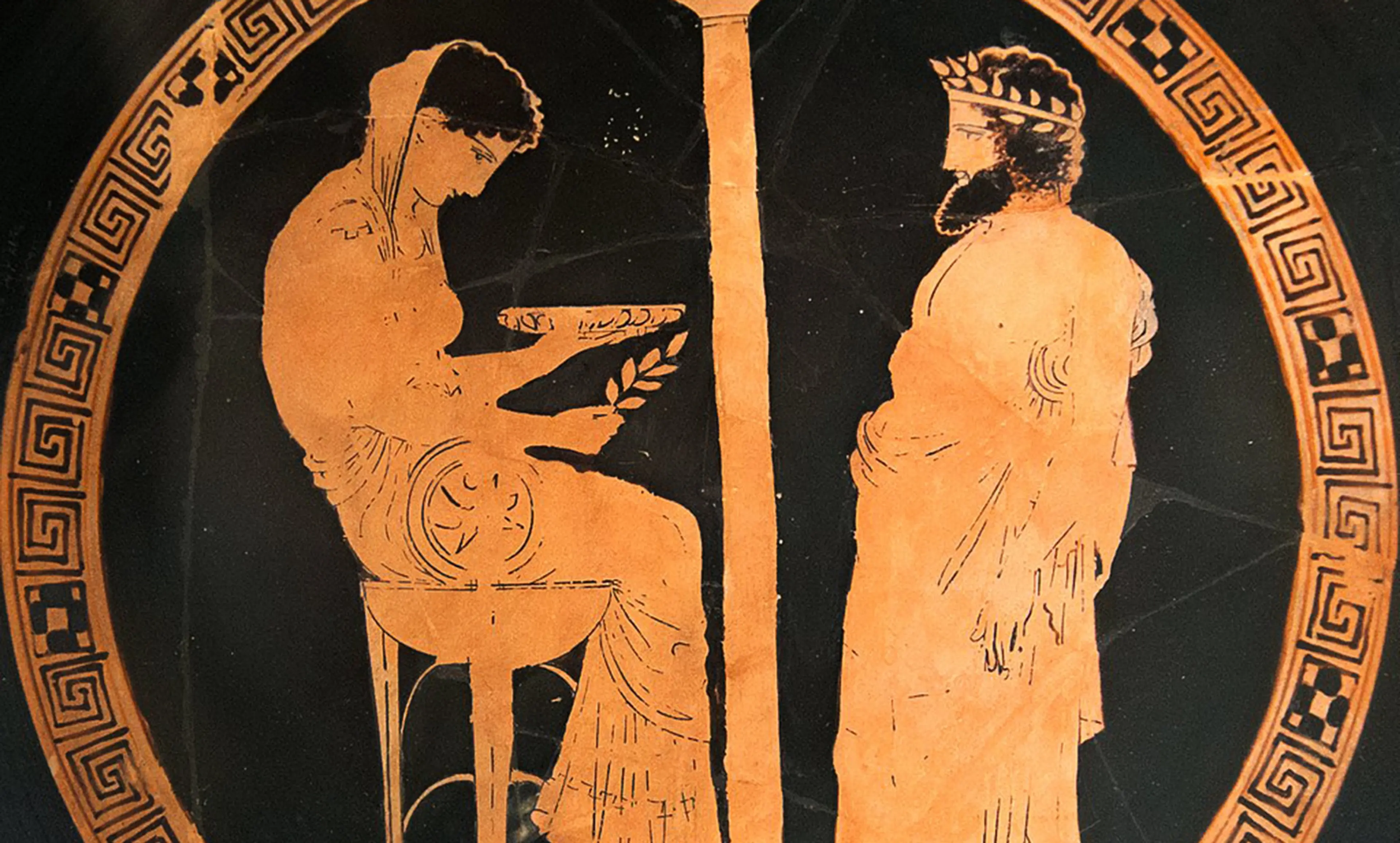
It is a common modern assumption that ancient Greek politics was a purely rational arena defined by democratic debates in Athens or military strategy in Sparta. In reality, the most powerful political entity in the Greek world wasn't a general or a king—it was a woman who sat on a bronze tripod in a dark, subterranean chamber at Delphi.
She was the Pythia, the high priestess of the Temple of Apollo, widely known as the Oracle of Delphi.
Far from being just a mystic telling personal fortunes, the Pythia functioned as the ultimate political consultant, supreme court judge, and geopolitical arbiter of the Mediterranean. For nearly a thousand years, no Greek city-state (polis) would go to war, found a colony, or rewrite its constitution without her stamp of divine approval.
1. The Geopolitical Hub of the Mediterranean
The sanctuary of Delphi was strategically built on the dramatic slopes of Mount Parnassus. The Greeks considered it the omphalos—the literal navel, or center, of the earth. Because Delphi was an independent, neutral sanctuary managed by a coalition of neighboring Greek tribes rather than a single powerful city, it acted as a safe, cross-border political zone.
Whenever a city-state faced a major political crisis, they sent official envoys called theoproboi to consult the Pythia. The sanctuary became the ancient world's premier intelligence agency.
Delphian priests traveled widely and questioned visitors from all over the Mediterranean, gathering vast amounts of data on geography, local political stability, resource shortages, and military movements. When the Pythia spoke, her pronouncements were backed by the most comprehensive geopolitical intelligence network of the time.
2. The Three Pillars of Oracular Influence
The Pythia’s political interventions generally fell into three critical areas of statecraft.
A. The Colonization Movement
Between the 8th and 6th centuries BCE, the Greek world exploded outward, establishing hundreds of new cities across the Black Sea, North Africa, Italy, and France. Executing this successfully required flawless logistics.
Before a city dispatched ships into unknown waters, the expedition leader (oikistes) had to consult the Pythia. She would provide specific geographical targets, claiming Apollo had directed them there.
The Political Function: If the colony failed, the local government wasn't blamed; it was simply a misinterpretation of Apollo's will. If it succeeded, the city's political legitimacy was permanently tied to Delphi.
B. Ratifying Constitutions and Laws
When cities transitioned away from tyrannies or dark-age monarchies toward new legal frameworks, lawgivers sought out the Oracle to give their human laws divine, unquestionable authority.
Sparta: The legendary Spartan lawgiver Lycurgus based the entirety of Sparta’s rigid social and military system—the Great Rhetra—directly on a mandate he claimed to receive from the Pythia.
Athens: When Cleisthenes invented Athenian democracy in 508 BCE, he reorganized the entire population into ten new tribes. He sent a list of one hundred heroic names to the Pythia, letting her choose the final ten "eponymous heroes" for the new democratic tribes, effectively baptizing democracy with divine consent.
C. War and Peace
No state went to war without asking the Pythia if the gods favored them. This gave the Oracle massive sway over military history. The most famous example is her double-edged advice to King Croesus of Lydia, who asked if he should invade Persia. The Pythia famously replied:
"If you cross the river Halys, you will destroy a great empire."
Croesus confidently marched to war, only to realize the empire he destroyed was his own. This strategic ambiguity protected the Oracle's reputation while forcing leaders to assume the ultimate risk of their decisions.
3. How the Political Mechanism Worked
The actual consultation process was a carefully staged, multi-tiered political ritual designed to build psychological tension and maintain institutional control.
[ CONSULTANT ] ──► Pays Fee & Offers Sacrifice ──► Enters Temple Underground (Adyton) ──► PYTHIA SPEAKS (Trance) ──► PRIESTS TRANSLATE (Ambiguous Verse)
The Preparation: The Pythia—a local woman selected from Delphi who committed to a lifelong vow of celibacy—purified herself in the nearby Castalian Spring and inhaled vapors (historically attributed to ethylene or hydrocarbon gases rising from fault lines beneath the temple).
The Pronouncement: Seated on her tripod over a chasm in the inner sanctum (adyton), she entered a trance-like state and uttered vocalizations in response to the political questions.
The Translation: The Delphic priests took her ecstatic utterances and translated them into elegant, highly structured, and intentionally ambiguous hexameter verse.
This calculated ambiguity was a masterstroke of political survival. By rendering responses that could be interpreted in multiple ways, the Oracle ensured she was never technically wrong, maintaining absolute diplomatic immunity regardless of which warring city-state came out on top.
4. The Oracle as a Source of Political Propaganda
Because her words carried unmatched weight, powerful Greek factions constantly tried to manipulate, bribe, or weaponize the Pythia for domestic political gain.
Historical Era
Political Event / Manipulation
The Resulting Action
The Archaic Period - The wealthy Alcmaeonid family of Athens funded the luxurious rebuilding of the Delphic temple after a fire.In return, whenever Sparta consulted the Oracle, the Pythia systematically told them: "First, free Athens from tyranny." This forced Sparta to march out and topple the Athenian tyrant Hippias.
The Persian Wars (480 BCE) Facing the massive invasion force of Xerxes, the Pythia issued deeply pessimistic, defeatist oracles to Athens, urging them to flee to the edges of the earth.Athenian leader Themistocles had to cleverly re-interpret her second oracle regarding a "wall of wood" to mean the Athenian navy, successfully rallying the population to fight at Salamis.
The Peloponnesian War Sparta actively courted Delphic favor against Athens.The Oracle openly declared that Apollo would help the Spartans, and would fight on their side whether called upon or not, shattering the religious morale of the Athenian empire.
5. The Decline of Delphic Power
The political authority of the Pythia began to wane as Greece lost its independence. When Philip II of Macedon and his son Alexander the Great rose to power in the 4th century BCE, they bypassed democratic negotiation and simply coerced the Oracle. Demosthenes, the famous Athenian orator, bitterly remarked that the Pythia had begun to "philippize"—meaning her divine tongue could be bought and directed by Macedonian gold.
Though she continued to speak for centuries under Roman rule, the rise of Christianity eventually sealed her fate. In 393 CE, the Christian Roman Emperor Theodosius I ordered the closure of all pagan sanctuaries, silencing the voice that had guided the political destiny of the Mediterranean for a millennium.