In the patriarchal world of ancient Greece, women were largely excluded from public life, denied political votes, and legally bound to the custody of male guardians. Yet, for three days every autumn, the entire civic apparatus of the Greek city-state came to a grinding halt so that women could take complete control.
This was the Thesmophoria, one of the oldest, most widespread, and most secretive religious festivals in the Greek world.
Dedicated to Demeter (the goddess of agriculture) and her daughter Persephone, the festival was a strict, women-only ritual. Men were absolutely forbidden from attending, watching, or even asking about what happened. Its primary objective was deeply vital to the survival of the state: securing both human and agricultural fertility for the coming year.
1. The Social Inversion: Women in Command
The Thesmophoria took place during the month of Pyanepsion (late October or early November), coinciding perfectly with the autumn sowing of barley and wheat.
During the three days of the festival, the ordinary social order of Greece was completely inverted:
The Male Evacuation: Men completely vacated the Thesmophorion (the sacred sanctuary grounds, often located on the Pnyx hill where the democratic assembly usually met).
Self-Governance: The women set up a makeshift camp, elected their own female officials (archousai), ran their own assemblies, and conducted all religious state business independently.
The Legal Protection: Husbands were legally required by the state to pay for their wives’ festival expenses and provide them with freedom of movement for the duration of the rites. Any man caught trying to spy on the hidden camp faced immediate, severe physical beating or legal execution.
2. The Three Days of the Festival
The festival unfolded in a strict chronological sequence over three distinct stages, mirroring Demeter's mythic grief and eventual joy over the loss and return of Persephone.
Day 1: Anodos (The Ascent or Way Up)
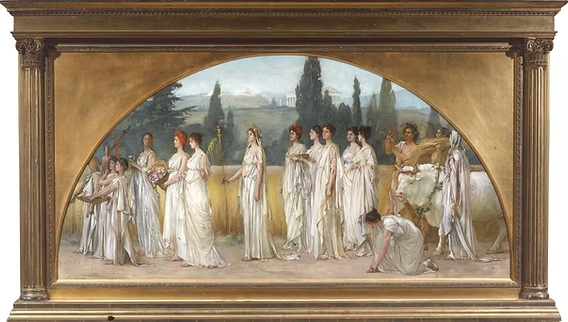
Women marched in procession out of the city, carrying heavy supplies up to the sanctuary hill. They established their camp, constructed temporary leaf-and-twig huts, and elected their leaders. They also slept on the bare ground on beds made of specific chthonic plants (like the chasteberry tree) that were believed to suppress sexual desire and promote ritual purity.
Day 2: Nesteia (The Fasting)
This was a day of intense communal grief, designed to mimic Demeter's mourning when Persephone was abducted into the Underworld. The women sat flat on the dirt, refusing all solid food. The atmosphere was intentionally grim, silent, and physically exhausting.
However, this solemnity was broken by Aischrologia—the ritual chanting of crude jokes, insults, and sexually explicit language. This wasn't merely locker-room humor; it was a sacred tool. In myth, a grieving Demeter was only coaxed out of her catastrophic depression when an old woman named Iambe made her laugh using vulgar jokes. By repeating this behavior, the women used laughter as a primal, life-affirming catalyst to jump-start the fertility of the earth.
Day 3: Kalligeneia (The Fair Birth)
The final day transformed into a vibrant celebration of rebirth, joy, and abundance. Torch-lit night dances were held, sacrifices were completed, and a grand feast was eaten to welcome the return of fertile forces to the soil and the human womb.
3. The Secret Chthonic Alchemy: The Rotting Piglets
The core ritual that made the Thesmophoria highly effective to the ancient mind occurred deep underground—and it involves one of the most unusual acts of chthonic magic in antiquity.
Months before the festival (likely during the summer festival of the Skirophoria), selected women known as the Bailers (antletriai) threw live piglets, cakes shaped like phalluses, and pine branches down into deep, dark underground chambers or fissures in the earth called megara.
Pigs were the ultimate sacrificial animal for Demeter due to their high reproductive rates (as seen in the votive figurine above). The mythic justification was that when Hades burst from the earth to abduct Persephone, a swineherd named Eubouleus and his entire flock of pigs were accidentally swallowed up into the chasm alongside her.
During the Anodos (Day 1) of the autumn festival, a highly specific procedure was carried out:
1.Retrieving the Remains:Descent into the Dark.
The Bailers, having purified themselves for three days, descended into the pitch-black underground megara. Clapping their hands loudly to drive away the sacred snakes that guarded the pits, they gathered the thoroughly rotted, liquefied remains of the piglets that had been decomposing for months.
2.Altar Dedication:The Sacred Transition.
The putrefied organic matter was hauled back up to the surface and carefully placed on Demeter's outdoor altars alongside grain offerings.
3.Mixing the Seed:Sowing the Magic.
Farmers and citizens systematically mixed pieces of this rotted, consecrated pig flesh directly into their seed-baskets.
To the ancient Greek mind, this was literal sympathetic magic. By taking life that had been deliberately buried, rotted, and reclaimed from the underworld, and mixing it directly with the autumn seed-grain, they guaranteed that the crops sown in the winter cold would successfully resurrect from the dirt in the spring.
4. Cosmic and Civic Significance
The Thesmophoria was far more than an agricultural insurance policy. Its name derives from thesmoi (the ancient unwritten laws or customs established by Demeter) and pherein (to bring). Demeter was worshipped here as Demeter Thesmophoros—the "Law-Bringer."
Without the secret actions of the women during these three days, the Greeks believed the earth would remain a barren desert, the human race would cease to reproduce, and the architecture of civilization itself would crumble.