The Greek Concept of the Cosmos and the Universe
The ancient Greek concept of the universe underwent one of the most profound intellectual evolutions in human history. The very word κόσμος (kosmos) originally meant "order," "harmony," or "adornment." When the Greeks applied it to the universe, they proposed a radical idea: the universe is not a chaotic realm governed by the arbitrary whims of gods, but an ordered, rational, and beautiful whole that could be understood through observation and geometry.
1. Mythological and Early Cosmological Views
Before the 6th century BCE, the Greeks viewed the universe through the lens of epic poetry, such as Homer's Iliad and Hesiod's Theogony.
The Structure: The Earth was conceived as a flat disk or shield at the center of existence, surrounded by Oceanus, an infinite, personified river.
The Firmament: The sky was viewed as a solid, metallic dome (often described as bronze or iron) supported by pillars, with the celestial bodies embedded in it.
The Underworld: The universe was organized along a vertical axis: Olympus (heaven) at the top, the Earth in the middle, and Hades or Tartarus (the underworld) lying as far below the Earth as the sky was above it.
2. The Ionian Revolution: Order out of Chaos
Beginning in the 6th century BCE, the Milesian philosophers of Ionia began seeking naturalistic explanations for the physical world, stripping away anthropomorphic myths.
Thales of Miletus: Suggested that the Earth was a flat disk floating on a vast cosmic ocean, with water acting as the primary, foundational element of all matter.
Anaximander: Challenged the idea of a flat earth, picturing a cylindrical or disk-like Earth suspended freely at the center of the cosmos. He envisioned celestial bodies as wheels or rings of fire, obscured by air and open only at small holes to let the light shine through (explaining the phases of the moon and eclipses).
3. The Geocentric Cosmos: Plato and Aristotle
In the Classical period, the concept of the universe shifted to a fully three-dimensional, geometrical sphere.
Shutterstock
Plato's Ideal Sphere: In his dialogue Timaeus, Plato argued that the universe is a single, living organism created by a divine artisan (demiurge). Because the sphere is the most perfect geometrical shape, the universe must be spherical and finite.
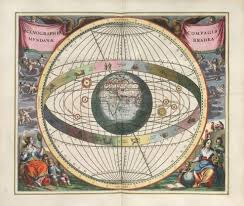
Aristotle's Crystalline Spheres: Aristotle expanded this idea into a detailed physical model. He placed the stationary Earth at the absolute center of the universe, surrounded by 55 concentric, crystalline spheres that carried the Sun, Moon, planets, and stars.
The Sublunar Realm: The region between the Earth and the Moon, composed of the four imperfect, changing elements (earth, water, air, and fire).
The Superlunary Realm: The realm from the Moon outward, composed of an incorruptible fifth element (Aether), which is eternal and unchanging.
4. Hellenistic Alternatives: Heliocentrism
As mathematical and astronomical observations became more precise, Greek astronomers attempted to explain irregularities in planetary paths.
Aristarchus of Samos: Proposed the earliest known heliocentric model in the 3rd century BCE. He placed the Sun and the fixed stars at the center of the universe, with the Earth and planets revolving around it. While mathematically elegant, it was largely rejected by his contemporaries, who favored the intuitive geocentric model.
Ptolemy's Mathematical Cosmos: In the 2nd century CE, the astronomer Claudius Ptolemy compiled the Hellenistic understanding of the cosmos in the Almagest. To account for the retrograde motion of planets while keeping the Earth stationary, he introduced complex mathematical mechanisms:
Deferents: Large circular orbits centered near the Earth.
Epicycles: Smaller, secondary circular orbits that the planets traced as they moved along their deferents.