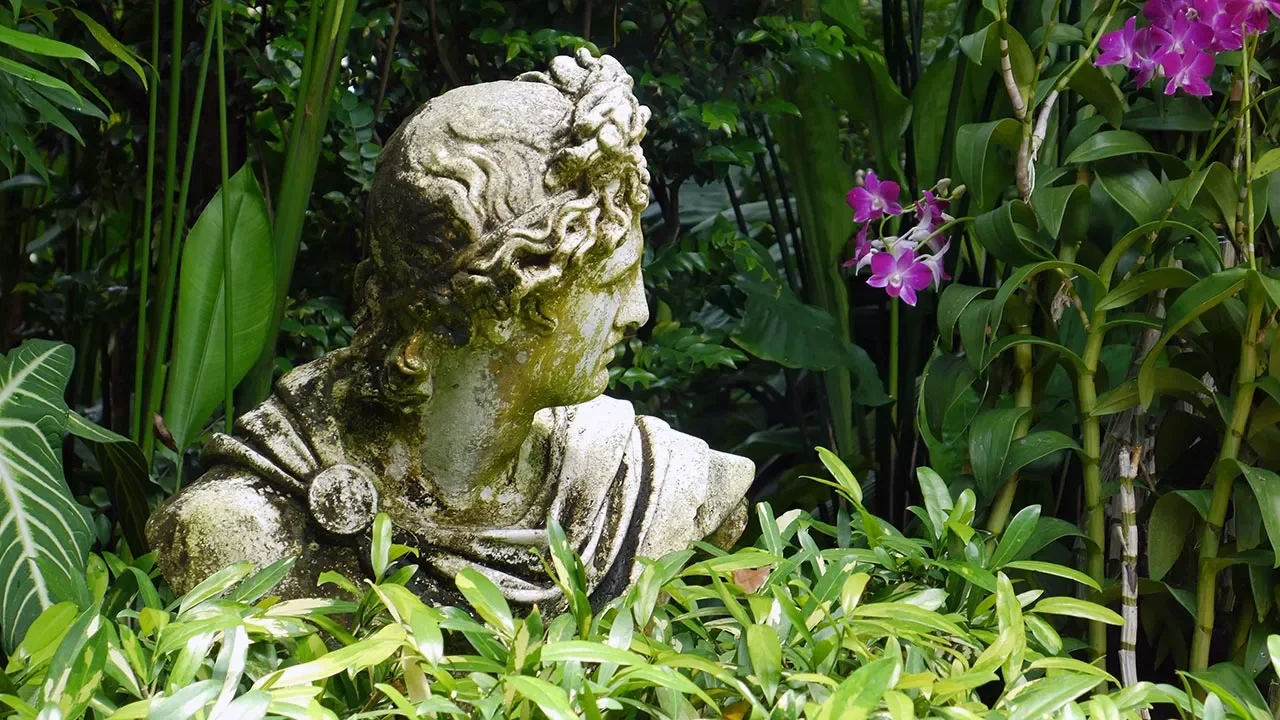
While popular imagination often paints ancient Greece as a stark landscape of gleaming white marble, historical reality was vibrantly green. Classical Greek garden design—known broadly within archaeological contexts as a component of urban and rural spatial planning—was a highly sophisticated integration of religious symbolism, architectural symmetry, and agricultural utility. Rather than designing purely for aesthetic leisure as the later Romans did, the Greeks viewed the garden as an intersection between humanity, nature, and the divine.
At the core of Greek landscape design was the temenos, or sacred precinct. Within these boundaries, designers established alstoi, which were sacred groves. These were not wild tangles of wilderness, but meticulously managed ecosystems. Designers selected trees based on mythic associations: the olive for Athena, the laurel for Apollo, and the deep-glinting cypress for Pluto. These spaces relied heavily on the concept of genius loci, meaning the inherent spirit of the place. Walkways were structured using strict mathematical ratios, frequently mirroring the golden ratio utilized in adjacent temple architecture, ensuring that the natural topography aligned with structural axes to frame the landscape as a living canvas.
Domestic gardens, or kepoi, served a more dualistic purpose. Situated within the interior peristyle, which was a courtyard surrounded by columns, of wealthy households, these spaces managed microclimates. The high courtyard walls provided shade, while central cisterns gathered rainwater to sustain a collection of aromatic and medicinal herbs. Greeks cultivated mint, thyme, sage, and the prized acanthus—the leaves of which famously inspired the capitals of Corinthian columns. Irrigation was a triumph of hydraulic engineering; utilizing terracotta piping and gravity-fed channels, designers directed urban wastewater overflow to nourish domestic flora.
Furthermore, public gardens evolved significantly during the Hellenistic period. The Academy of Plato and the Lyceum of Aristotle were fundamentally public pleasure grounds integrated with gymnasia. Here, plane trees were planted systematically along running tracks to provide shade for philosophers and athletes alike. The design priority shifted toward engineering shade and managing airflow, using the cooling transpirational properties of dense tree canopies to lower local ambient temperatures. This deliberate synthesis of botanical architecture, hydraulic resource management, and theological geometry proves that Greek gardens were far more than simple patches of earth—they were highly engineered, living monuments.