Ancient Greek Coins Were More Than Money—Every Symbol Was a Message
To a modern person, a coin may appear to be a simple financial object.
A number.
A national symbol.
A portrait.
A piece of metal exchanged for goods.
But in the ancient Greek world, coins could communicate far more.
A small silver coin could announce the identity of an entire city.
A goddess could represent divine protection.
An owl could symbolize wisdom and Athens.
A turtle could identify an island community.
A mythical creature could connect a population with its legendary past.
Ancient Greek coins were, in effect, miniature works of political communication.
The Birth of Coinage
Coinage developed in western Anatolia during the first millennium BCE and spread rapidly through the Greek world.
Greek city-states adopted coinage for economic purposes, but the images placed on coins were rarely random.
Each community selected symbols that could communicate its identity.
The result was a remarkable visual language.
A merchant did not necessarily need to read a long inscription to recognize the origin of a coin.
The image itself could communicate the message.
Athens and the Owl
Perhaps the most famous example is the Athenian silver tetradrachm.
One side traditionally featured the head of Athena, the city's patron goddess.
The other featured an owl.
The owl was closely associated with Athena.
It became one of the most recognizable symbols of Athens.
The coin also included additional imagery, such as an olive branch, reinforcing the connection between the city, its goddess, and its cultural identity.
These coins circulated widely.
The Athenian “owl” became recognizable far beyond Attica.
Why Put a God on a Coin?
Religion and politics were closely connected in ancient Greek communities.
A city might claim the protection of a particular deity.
Displaying that god or goddess on a coin could communicate:
Civic identity.
Divine protection.
Religious loyalty.
Political legitimacy.
The image transformed currency into a portable religious symbol.
Every transaction also circulated the identity of the issuing community.
Animals as Political Symbols
Greek cities frequently used animals.
These were often connected with:
Local myths.
Patron deities.
Geography.
Economic activity.
Examples could include:
Owls.
Dolphins.
Horses.
Lions.
Bulls.
Eagles.
The animal could function almost like an ancient logo.
The Turtle of Aegina
The island of Aegina became famous for its early coinage featuring a turtle.
The animal was appropriate for an island society strongly connected with maritime activity.
Aegina's coins became widely recognized in the ancient Greek world.
The turtle was therefore more than decoration.
It became a symbol of economic identity.
Pegasus and Corinth
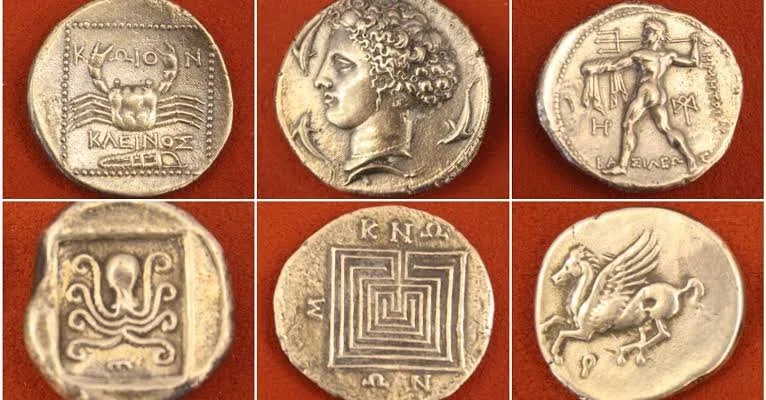
Corinth famously used Pegasus, the winged horse of Greek mythology.
The creature was associated with the city's legendary traditions and became an enduring symbol on Corinthian coinage.
A Corinthian coin could therefore carry mythology into the marketplace.
A mythical animal became part of economic life.
The Meaning of the Human Portrait
Early Greek coinage often emphasized gods, symbols, and mythological imagery rather than realistic portraits of living rulers.
This changed significantly in the Hellenistic period.
After the conquests of Alexander the Great, royal portraiture became increasingly important.
Coins could now communicate dynastic power.
A ruler's face could circulate throughout an empire.
This was an extraordinary political tool.
A king did not need to physically visit every city.
His image could.
Alexander the Great and the Power of Coinage
Alexander's coinage often employed divine and heroic imagery associated with Greek religion and mythology.
After his death, successor kingdoms increasingly developed their own monetary iconography.
Portraiture became particularly important.
Coins became tools of legitimacy.
A ruler could connect himself with:
Gods.
Heroes.
Alexander's legacy.
Military victories.
The coin was therefore a miniature political monument.
Victory and the Goddess Nike
The figure of Nike, the personification of victory, appeared in various forms of Greek art and coinage.
Her presence could communicate military success.
A victorious ruler or city could associate itself with divine favor.
The message was simple:
We have won.
But the coin could carry that message across enormous distances.
The Olive Branch
Plants also carried meaning.
The olive was particularly important in Greek culture.
Olive trees were associated with:
Agriculture.
Wealth.
Peace.
Athena.
The appearance of an olive branch could therefore carry multiple meanings simultaneously.
Why Greek Coins Are Historical Documents
Coins often survive when other forms of evidence disappear.
A coin can preserve:
Names of rulers.
City identities.
Religious imagery.
Political titles.
Artistic styles.
Economic relationships.
Archaeologists can use coin discoveries to study trade and chronology.
A coin found at a distant site may demonstrate commercial or political contact.
Propaganda in Your Pocket
Ancient rulers understood the power of repeated images.
A statue remained in one place.
A coin traveled.
It passed from merchant to soldier.
From city to port.
From one kingdom to another.
Every exchange spread an image.
In this sense, Greek coins were among the ancient world's most efficient forms of mass communication.
They were propaganda small enough to fit in the palm of your hand.
And thousands of years later, they still carry their messages.