How Ancient Greek Physicians Turned Medicine From Religious Ritual Into a System of Observation
Long before modern hospitals, antibiotics, anesthesia, X-rays, and sterile surgical theaters, Greek physicians were attempting to understand disease through observation and practical treatment.
Ancient Greek medicine was not modern medicine. Many of its theories were incorrect, and religious healing remained enormously important. Yet Greek physicians made a lasting contribution by increasingly asking a revolutionary question:
What if illness has natural causes that can be studied?
That question helped create one of the intellectual foundations of Western medical history.
Medicine Before the Greek Physicians
Healing existed long before Greek civilization.
Egyptian, Mesopotamian, and other ancient societies possessed sophisticated medical traditions.
Greek physicians inherited knowledge from these cultures and developed their own approaches.
Religion remained important.
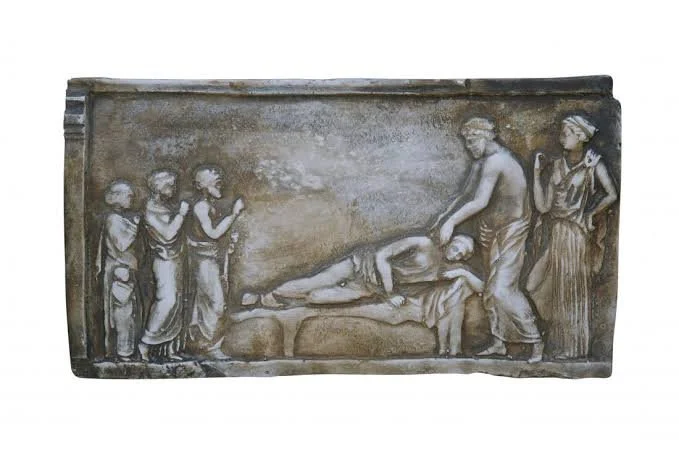
Healing sanctuaries dedicated to Asclepius, the god of medicine, attracted people seeking cures.
Patients might sleep in a sacred space and hope for a healing dream.
But alongside religious medicine developed another tradition based increasingly on observation.
The Hippocratic Tradition
The name most associated with ancient Greek medicine is Hippocrates.
The historical Hippocrates was a physician associated with the island of Kos and lived around the fifth and fourth centuries BCE.
However, the collection known as the Hippocratic Corpus was produced by multiple authors over time.
This distinction matters.
Not every medical work traditionally attributed to Hippocrates was necessarily written by him.
The broader Hippocratic tradition nevertheless emphasized careful observation.
Disease as a Natural Process
One of the most important developments in Greek medical thought was the rejection of purely supernatural explanations for some diseases.
Physicians increasingly considered:
Diet.
Environment.
Climate.
Water.
Lifestyle.
Physical injury.
as possible causes of illness.
This did not eliminate religious explanations.
Ancient Greek society continued to combine religious and natural approaches.
But the naturalistic tradition was extremely influential.
The Four Humors
Greek physicians developed the famous theory of the four humors:
Blood.
Phlegm.
Yellow bile.
Black bile.
Health was thought to depend on their balance.
Disease could occur when the humors became unbalanced.
Modern medicine has rejected this theory.
But historically, it was enormously important because it provided physicians with a systematic framework for thinking about disease.
Diagnosis Through Observation
Greek physicians paid attention to symptoms.
They observed:
Fever.
Pulse.
Urine.
Skin.
Breathing.
Appetite.
Sleep.
Pain.
The physician was expected to observe the patient's condition over time.
This emphasis on prognosis and clinical observation became an important part of medical tradition.
Surgery in Ancient Greece
Ancient surgeons performed procedures for injuries and other conditions.
These could include:
Treating wounds.
Setting fractures.
Removing foreign objects.
Draining certain infections.
Treating dislocations.
Performing cautery.
Surgery was dangerous.
There were no antibiotics.
Infection could become fatal.
Bleeding could be difficult to control.
Pain management was limited.
Treating Broken Bones
Greek physicians understood that fractures needed stabilization.
Splints and bandaging could be used.
The goal was to align the damaged bone and keep it relatively immobile during healing.
This required anatomical knowledge and practical experience.
Wound Treatment
Wounds could be cleaned, dressed, and treated with various substances.
Ancient physicians used materials such as:
Wine.
Vinegar.
Honey.
Oils.
Herbal preparations.
Not all treatments were effective, and some could be harmful.
But some substances, particularly honey and wine, have properties that help explain why they remained part of medical practice.
The Problem of Infection
Ancient surgeons did not understand bacteria.
They had no germ theory.
They could observe that certain wounds became swollen, painful, and fatal, but they lacked the microbiological explanation.
This limited what they could accomplish.
Even a technically successful operation could result in death from infection.
Anatomy
Greek medical knowledge of anatomy developed through observation of the human body.
However, human dissection was culturally and legally restricted in many periods and places.
Much anatomical knowledge therefore came from:
Animal dissection.
Battlefield injuries.
Surgical experience.
Observation of the human body.
Later Hellenistic physicians in Alexandria were able to conduct human dissections under conditions that appear to have been more permissive than elsewhere in the Greek world.
Herophilus and Erasistratus
The Hellenistic physicians Herophilus and Erasistratus are especially important.
They conducted anatomical investigations and developed sophisticated ideas about the body.
Their work helped distinguish structures such as nerves and blood vessels more accurately than many earlier theories.
Much of their writing has been lost, but later authors preserved fragments of their ideas.
Medical Ethics
The Hippocratic tradition is also associated with medical ethics.
The famous Hippocratic Oath represents an early attempt to define professional responsibilities.
Although the modern medical profession has changed dramatically, the principle that physicians have ethical responsibilities toward patients remains influential.
The Greek Medical Legacy
Ancient Greek medicine was a mixture of:
Observation.
Philosophy.
Religion.
Practical treatment.
Incorrect theories.
Genuine discoveries.
Its greatest achievement was not curing every disease.
It was establishing the idea that illness could be systematically observed and discussed.
Modern medicine would eventually abandon humoral theory, develop germ theory, discover antibiotics, and transform surgery.
But the ancient question remained:
What is happening inside the human body, and how can we understand it?