How Ancient Greeks Used Dripping Water to Measure Time—and Even Control Speeches
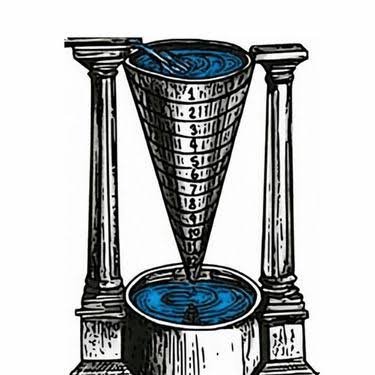
The ancient Greek clepsydra, or water clock, was one of the most practical timekeeping technologies of antiquity.
Unlike a sundial, it did not depend on sunlight.
Water could continue flowing:
At night.
Indoors.
During cloudy weather.
During legal proceedings.
The device was relatively simple in principle.
Water flowed into or out of a container.
The changing water level indicated elapsed time.
But making that system reliable required surprisingly sophisticated engineering.
The Basic Principle
A simple clepsydra could consist of a vessel containing water.
As water entered or left, the water level changed.
Marks on the container could indicate intervals.
The process converted fluid movement into time measurement.
Why Constant Flow Was Difficult
The pressure pushing water through an opening changes as the water level changes.
This means that a simple hole does not necessarily produce a constant flow rate.
As the water level drops, the pressure decreases.
The flow slows.
This makes accurate measurement difficult.
Ancient engineers had to understand this problem through observation.
Greek Mathematical Thinking
Greek engineers were interested in fluids, pressure, and mechanical systems.
Later Greek and Hellenistic engineers developed increasingly sophisticated hydraulic devices.
The clepsydra became part of this broader technological tradition.
Water Clocks in Athenian Courts
One of the most historically important uses of the water clock was in legal proceedings.
In Athens, the duration of speeches could be controlled by a clepsydra.
This was essential because courtroom debates involved competing speakers.
A time limit could be physically enforced.
The water clock became a legal instrument.
Democracy and Timekeeping
This is a fascinating connection.
Athenian democracy depended on procedures.
Citizens needed opportunities to speak.
But unlimited speeches would make decision-making impossible.
The clepsydra helped regulate political and legal participation.
A technological device therefore became part of democratic administration.
Water Clocks and Astronomy
Water clocks could also be used in scientific and astronomical contexts.
Time measurement was essential for observations.
The more accurately time could be tracked, the more precisely celestial events could be recorded.
Ctesibius and Hydraulic Engineering
The Hellenistic engineer Ctesibius of Alexandria made major contributions to hydraulic and pneumatic technology.
His innovations included improved water clocks.
Some later designs used mechanisms that could compensate for changing water levels.
This demonstrates the evolution from a simple container to a sophisticated mechanical system.
Automatic Displays
Hellenistic engineers developed water-powered mechanisms capable of moving indicators.
In advanced systems, water could drive mechanical components.
This created a fascinating combination:
water became power.
The flow of liquid could move gears, indicators, and other mechanisms.
Why the Clepsydra Matters
The water clock represents a major conceptual achievement.
Humans took a natural process—water flowing—and converted it into standardized measurement.
It could regulate:
Court speeches.
Scientific observation.
Daily activities.
Religious events.
Time became something that could be measured mechanically.
Long before mechanical clocks, ancient Greek engineers were already asking:
How can nature itself be transformed into a machine for measuring time?