
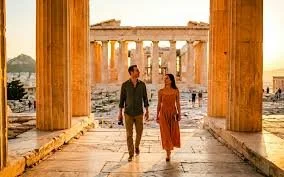
Few archaeological sites in the world are as recognizable as the Acropolis of Athens.
Rising above the modern Greek capital, the rocky hill has served different functions across more than three millennia. It has been a fortified settlement, sacred sanctuary, architectural showcase, Christian religious center, Ottoman-era site, military target, and modern archaeological monument.
For the modern visitor, walking across the Acropolis is therefore more than visiting the Parthenon.
It is an encounter with several layers of history.
The Acropolis contains the remains of buildings associated with Classical Athens, but its story begins much earlier and continues long after the fifth century BCE.
Understanding the Acropolis Before You Visit
The word Acropolis simply means "upper city."
Many Greek settlements possessed elevated fortified areas, but the Acropolis of Athens became particularly important.
UNESCO records fortification on the hill as far back as the Mycenaean period, with the religious character of the summit becoming increasingly prominent in later centuries.
The monuments that dominate the modern image of the Acropolis were largely created during the fifth century BCE.
This was the period associated with the extraordinary development of Athenian architecture, sculpture, drama, philosophy, and political institutions.
Beginning the Walk
A visit is best approached as a sequence rather than a single monument.
Before focusing on the Parthenon, take time to understand the hill itself.
The Acropolis rises approximately 156 meters above sea level and occupies a naturally defensible position. Its steep sides provided natural protection, while the summit offered commanding views over Athens and the surrounding landscape.
Look outward.
The surrounding city makes the geography clearer.
The Acropolis was not an isolated temple complex.
It was embedded within a city.
The Propylaea
The monumental entrance to the Acropolis is the Propylaea.
Constructed during the fifth century BCE, it created an impressive transition between the ordinary city below and the sacred summit above.
The Propylaea was designed by the architect Mnesicles.
Its scale demonstrates that movement itself could be architectural theater.
Visitors did not simply walk through an ordinary doorway.
They approached a monumental threshold.
The experience would have communicated that they were entering a special environment.
The Temple of Athena Nike
Near the entrance stands the small Temple of Athena Nike.
Athena Nike represented Athena in her aspect as a goddess of victory.
The temple is much smaller than the Parthenon but extremely important architecturally.
Its position beside the entrance allowed the concept of victory to become part of the visitor's movement onto the Acropolis.
The monument also reminds us that the Acropolis was not dedicated to only one abstract concept.
Athena possessed multiple identities, including associations with wisdom, warfare, crafts, and civic protection.
The Parthenon
Then comes the building that has become the international symbol of ancient Greece:
the Parthenon.
Constructed between approximately 447 and 432 BCE, it was dedicated to Athena.
Its architects are traditionally identified as Ictinus and Callicrates, while Pheidias played a major role in the sculptural program.
UNESCO identifies the Parthenon as one of the defining masterpieces of the Acropolis complex and a major influence on architectural traditions far beyond Greece.
The building looks relatively simple from a distance.
It is not.
Ancient Greek architects incorporated subtle optical refinements into the structure.
Columns are not perfectly straight in the simplistic geometric sense often imagined by modern observers.
The platform and architectural elements contain carefully calculated adjustments.
The result is a structure designed to appear visually harmonious.
Looking at the Sculptures
The Parthenon's sculptural program was extensive.
Metopes, pediments, and the famous frieze presented mythological and religious imagery.
These sculptures were not merely decorative.
Ancient Greek temples communicated stories and cultural values through visual language.
The surviving sculptures are also part of a complicated modern history.
Many were removed from the Acropolis during the nineteenth century, and portions are now held outside Greece.
Their ownership and appropriate location remain subjects of continuing international discussion.
For visitors, this means that what is seen on the Acropolis today represents only part of the original sculptural environment.
The Erechtheion
The Erechtheion is one of the most architecturally distinctive buildings on the Acropolis.
Its unusual design reflects the complexity of Athenian religious traditions.
Unlike a simple rectangular temple dedicated to one deity in one straightforward form, the Erechtheion incorporated multiple sacred associations.
It is especially famous for the Caryatids, sculpted female figures used architecturally as supports.
The southern porch is one of the most recognizable views on the Acropolis.
Athena and Poseidon
The Acropolis was associated with the mythological contest between Athena and Poseidon for patronage of Athens.
According to tradition, each deity offered a gift.
Poseidon produced a source of water or, in some versions, a saltwater spring.
Athena offered the olive tree.
Athena won.
The story helped explain the city's relationship with its patron goddess.
The Acropolis should therefore be understood not only as architecture but as a landscape filled with mythology.
Looking Toward the Ancient City
One of the best experiences on the Acropolis is simply looking outward.
From the summit, visitors can see much of Athens.
This helps reconstruct the ancient relationship between the sacred hill and the urban community below.
The Acropolis was visible throughout the city.
Its buildings therefore served as permanent statements of identity and power.
Remembering That the Acropolis Was Not Always a Ruin
The modern visitor sees ancient ruins.
Ancient Athenians did not.
For them, these buildings were functioning sacred spaces.
Later civilizations transformed the site.
The Parthenon became a Christian church.
It was subsequently used as a mosque under Ottoman rule.
The building suffered catastrophic damage in 1687 when an explosion occurred during a Venetian siege after Ottoman forces stored gunpowder inside the structure.
Much of the building's modern ruined appearance is therefore the product of centuries of historical events rather than simple age.
The Acropolis and Modern Archaeology
The Acropolis has undergone extensive conservation and restoration.
UNESCO notes that restoration work follows scholarly and conservation principles, including reversibility and respect for ancient structural systems.
Visitors should therefore distinguish between ancient surviving material and modern conservation interventions.
The aim is not simply to reconstruct a perfect ancient building.
The objective is to preserve surviving evidence while making the monuments understandable and structurally secure.
Practical Advice for Visitors
Because the Acropolis is an exposed archaeological hill, preparation matters.
Wear comfortable footwear.
Bring water, especially during hot weather.
Protect yourself from direct sunlight.
Allow enough time to move slowly rather than rushing between monuments.
Check official opening schedules and ticket arrangements before traveling because visitor procedures can change.
The site can also become crowded, particularly during peak travel periods.
Early or less crowded periods can make it easier to appreciate the architecture.
How to Approach the Acropolis Historically
One of the biggest mistakes visitors can make is treating the Acropolis as simply "the place where the Parthenon is."
Instead, ask questions as you walk.
Why was this hill sacred?
Why did Athens invest so heavily in monumental architecture?
What did these buildings communicate to citizens?
How did religion and politics overlap?
Why were myths represented in sculpture?
What did the Acropolis look like before it became a ruin?
These questions turn sightseeing into historical interpretation.
Conclusion
Walking through the Acropolis is essentially walking through layers of Greek history.
The Mycenaean fortifications reveal a much older world.
The fifth-century monuments reveal the ambitions of Classical Athens.
The temples demonstrate religious traditions.
The sculptures reveal mythological and civic identities.
The later alterations reveal Christianity, Ottoman history, warfare, and modern archaeology.
The Acropolis therefore deserves more than a quick photograph.
It is a place where architecture becomes historical evidence.
And once the visitor understands that, the Parthenon becomes more than an iconic building.
It becomes part of a much larger story about religion, politics, art, engineering, identity, conflict, and the extraordinary cultural history of Athens.







