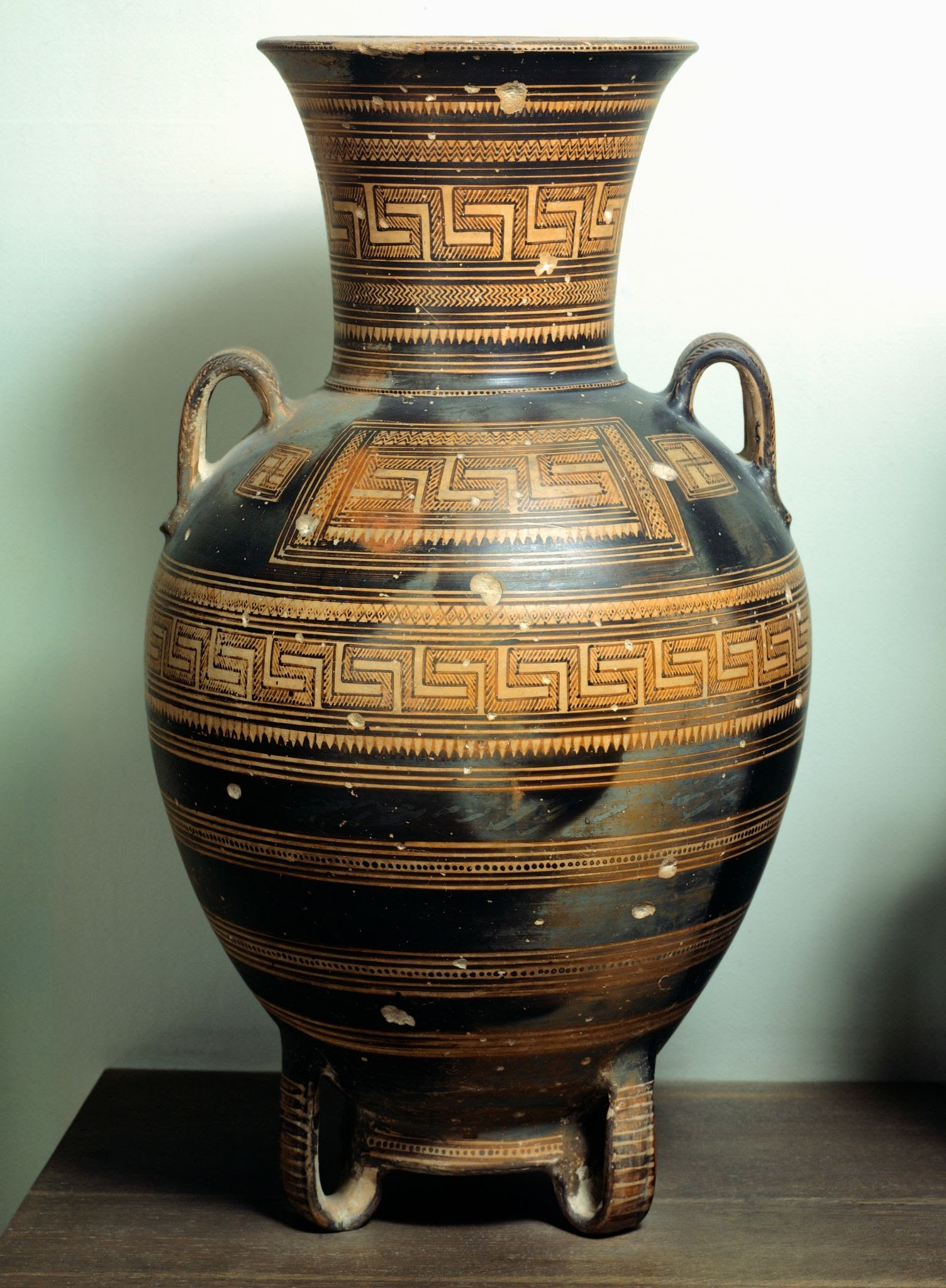
During the Greek Dark Ages and the early Archaic period (roughly 900 to 700 BCE), visual culture was dominated by the Geometric style. Best preserved on large ceramic vessels like the Dipylon amphorae, this artistic movement abandoned fluid, natural forms in favor of strict mathematical symmetry, linear grids, and repeating abstract motifs. Far from being a short-lived pottery trend, the spatial logic and design principles developed during the Geometric era became the fundamental blueprints for classical Greek stone architecture.
Structural Grid Logic and Architectural Ornamentation
The core contribution of Geometric art to architecture was the concept of the modular grid. On a Geometric vase, the painter carefully mapped out the surface into distinct horizontal bands (zones), using a compass and ruler to balance the lines perfectly against the shape of the vessel.
When early builders transitioned from mudbrick and wood to monumental limestone and marble temples, they applied this exact same structural logic. The facade of a classical Doric temple is essentially a grand geometric grid, where the rhythmic alternation of triglyphs and metopes creates a balanced, predictable visual pattern across the upper framework.
Furthermore, the specific linear patterns drawn by Geometric vase painters became the permanent decorative language of Greek stone buildings. The most famous of these, the meander pattern (or Greek key), was used to frame complex burial scenes on pottery before being carved into stone lintels, painted onto architectural architraves, and chiseled into temple moldings.
By treating structural space as a series of repeating, mathematically precise relationships, Geometric art trained the Greek eye to equate perfect symmetry with divine harmony, laying the aesthetic foundations for iconic monuments like the Parthenon.