The Ancient Greek Monster With the Body of a Lion, the Head of a Goat, and a Serpent's Tail
Few monsters of Greek mythology are as visually bizarre as the Chimera.
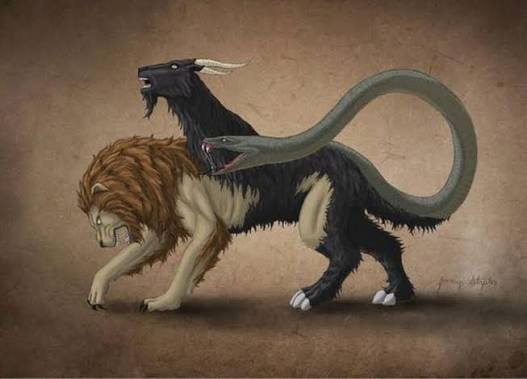
It was traditionally described as a hybrid creature combining several animals:
Lion.
Goat.
Serpent or dragon.
Most famously, the Chimera was said to breathe fire.
The creature became one of the defining monsters of Greek mythology.
Where Did the Chimera Come From?
The Chimera was traditionally associated with Lycia, in southwestern Anatolia.
The monster's genealogy varies among ancient sources, but it is often connected with Typhon and Echidna, two primordial monstrous beings.
This places the Chimera within a larger family of terrifying creatures.
A Monster of Contradictions
The Chimera combined animals that would never naturally exist as one creature.
The lion represented power.
The goat represented another form of animal strength and fertility.
The serpent represented danger and the mysterious earth.
Together they created a creature that violated the normal boundaries of nature.
Why Did It Breathe Fire?
Fire transformed the Chimera from an unusual hybrid into a supernatural threat.
The creature could attack from a distance.
It was not merely physically powerful.
It possessed an unnatural weapon.
Bellerophon
The hero chosen to defeat the Chimera was Bellerophon.
He was one of the great heroes of Greek mythology.
But he could not defeat the creature through ordinary strength.
He needed the help of Pegasus, the famous winged horse.
Pegasus and the Battle
Bellerophon mounted Pegasus and attacked from above.
This gave him an enormous advantage.
He could remain out of reach of the Chimera's body while attacking it from the air.
The story became an early example of heroic strategy defeating a monstrous force.
The Lead-Tipped Weapon
One famous version of the myth describes Bellerophon using a spear with a lead component.
He placed the weapon into the Chimera's fiery mouth.
The intense heat supposedly melted the lead.
The molten metal then obstructed the monster's breathing and killed it.
Whether understood literally or symbolically, the story emphasizes cleverness rather than brute force.
Why the Chimera Was Important
The Chimera represented a threat to human order.
It was:
Hybrid.
Violent.
Fire-breathing.
Wild.
Uncontrollable.
Greek heroes repeatedly confront monsters that represent forces outside civilization.
The hero restores order by defeating them.
The Word “Chimera”
The creature became so famous that its name eventually entered broader language.
Today, “chimera” can describe an impossible combination or unrealistic idea.
The biological term chimera also refers to an organism containing genetically distinct cell populations.
The modern scientific meaning is unrelated to the mythological creature's literal existence, but the metaphor survived because the original monster represented impossible combination.
The Chimera in Ancient Art
The creature appears in Greek and later Mediterranean art.
Artists experimented with representing its hybrid body.
The visual challenge itself was attractive.
How do you combine several animals into one coherent monster?
The answer became an artistic convention.
Why the Myth Survived
The Chimera remains memorable because it embodies an impossible creature.
A lion.
A goat.
A serpent.
Fire.
All combined into one terrifying form.
It is a perfect example of the Greek imagination transforming familiar animals into something completely unfamiliar.