Which Volcanoes Are Active in Greece and Should We Be Concerned?
In Iceland, around 4,000 residents of the small coastal town of Grindavik were recently forced to evacuate their homes due to fears of an eruption of the Fagradalsfjall volcano. In Sicily, a new eruption of Mount Etna created a “lava fountain” on its snow-covered slopes, while thousands of kilometers away in Mexico, the Popocatépetl volcano, one of the most active in the world, erupted, prompting a “yellow” alert in the region.
“Fortunately, unlike earthquakes, volcanoes always provide warnings,” says Christos Evangelidis, a researcher at the Geodynamic Institute of the National Observatory of Athens, discussing the recent global volcanic activity. However, the head of the National Seismological Network of the NOA explains that the recent volcanic events in these three regions are entirely unrelated. “These are random events occurring at some of the hundreds of active volcanoes worldwide. The risk of volcanic activity is always present.”
Five Active Volcanic Zones in Greece
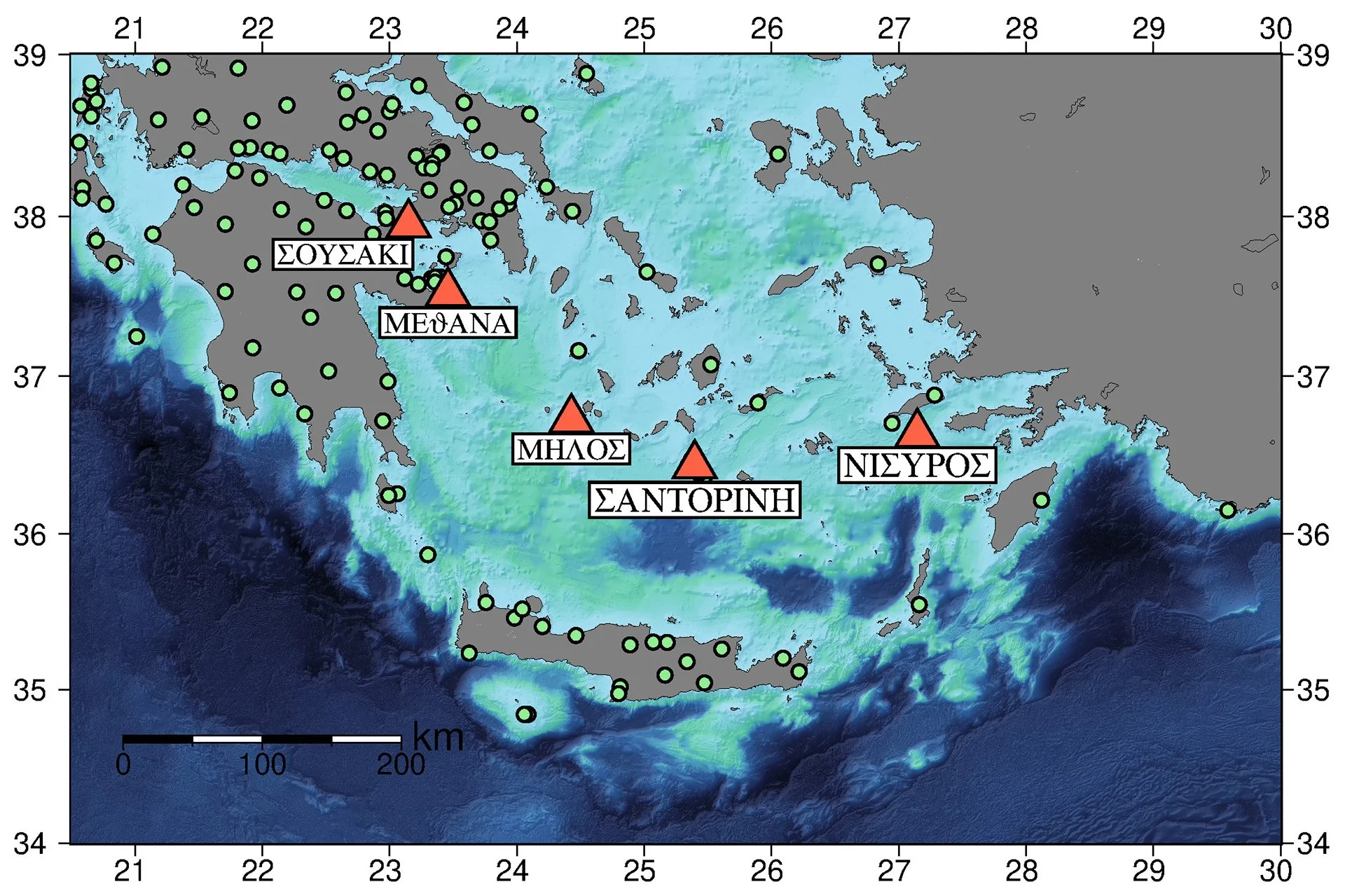
What about Greece, where the active volcanic arc extends across five key locations from west to east?
“The active arc starts from Sousaki in Corinthia and extends to the broader volcanic centers of Methana, Milos, Santorini, and Nisyros. Most of these have both terrestrial and underwater volcanic cones, such as Kolumbo, which lies northeast of Santorini,” explains Evangelidis. However, he reassures that none of these volcanoes are currently in a phase of volcanic unrest.
Greece's five volcanoes :
Santorini (Nea Kameni) – The most famous and potentially the most dangerous, as it has had major eruptions in the past, including the Minoan eruption (~1600 BC). It remains active, with ongoing monitoring.
Nisyros – Another active volcano, with a caldera and fumarolic activity. Scientists closely monitor it for potential unrest.
Milos – A dormant volcano, but still geologically active with hot springs and hydrothermal activity.
Methana – A less-known volcanic center, with its last eruption recorded in the 18th century.
Sousaki (Corinthia) – More of a geothermally active area rather than a true volcano, but still part of Greece’s volcanic arc.
“The most potentially active areas are the broader volcanic centers of Santorini and Nisyros. Methana has lower volcanic potential, but it is located just 40 km from the metropolitan center of Athens,” he adds.
Volcanic Monitoring Stations
A volcanic observatory consists of numerous dispersed seismological, geodetic, geochemical, and atmospheric monitoring stations, as well as thermal cameras. Methana has six seismological stations and two GPS units, while Santorini has more than ten seismological stations, along with 2-3 GPS stations, geochemical sensors, and a tide gauge.
According to Evangelidis, these resources are sufficient for these two regions. However, he notes that Nisyros, with only three seismological stations, and Milos, with just two, need more monitoring infrastructure.
“Volcanic unrest can be detected early using dense seismological and geodetic networks. In Greece, these networks are primarily operated by the Unified National Seismological Network,” he explains. “The main challenge is the inadequate maintenance of these stations, a common issue across the network, which relies on competitive research programs rather than stable government funding. It is the responsibility of the state to support and fund their uninterrupted operation and maintenance systematically.”
Daily Seismic Activity in Volcanic Regions
The seismological stations of the National Observatory of Athens and academic institutions, which form the Unified National Seismological Network, record daily seismic activity within and around volcanic centers.
“The primary cause of this seismic activity is the existing tectonic stresses and the deformation of the upper crust. The earthquakes recorded are generally small but numerous. However, when volcanic unrest begins, the number of earthquakes increases, and they become concentrated in a specific area, which may shift over time,” Evangelidis explains, recalling that the highest number of earthquakes ever recorded in a Greek volcanic region occurred during the 2011-2012 unrest of Santorini’s volcano.
How Volcanic Eruptions Can Impact Global Climate
The intense activity of a volcano, mainly due to the movement of fluids and magma inside it, is detected by specialists through seismic recordings, which can often be distinguished from tectonic earthquakes. “A volcanic unrest phase, whether explosive or not, can last for years,” notes the Geodynamic Institute researcher.
“A major volcanic eruption can affect the global climate for years.”
While climate change drastically impacts the planet, volcanoes remain unaffected. “Even if human activity makes Earth uninhabitable, volcanoes will continue to exist and function for millions of years,” says Evangelidis. “On the other hand, a massive volcanic eruption could alter the global climate for years.”
“During large eruptions, enormous amounts of volcanic gases, aerosol droplets, and ash enter the stratosphere. Volcanic gases, such as sulfur dioxide, can cause global cooling, while volcanic carbon dioxide—a greenhouse gas—contributes to global warming.”
According to the Greek scientist, several major eruptions in the past century have caused a drop in the Earth's average surface temperature by up to 0.3 degrees for one to three years, as was the case with the 1991 eruption of Mount Pinatubo in the Philippines.
“The eruption of Mount Pinatubo on June 15, 1991, was one of the largest eruptions of the 20th century, injecting a cloud of 20 million tons of sulfur dioxide into the stratosphere. It caused what is believed to be the greatest stratospheric aerosol disturbance of the past century. As a result, it affected global climate for three years following the eruption, with a peak cooling of 0.7°C. In comparison, the 1783-1784 eruption of Laki in Iceland released a much greater amount of sulfur dioxide—around 120 million tons. This additional atmospheric sulfur dioxide caused regional cooling in Europe and North America,” concludes the head of the National Seismological Network of the NOA.