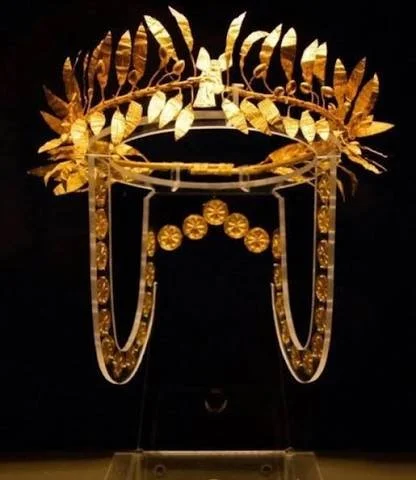
Precious funerary ornaments, ancient craftsmanship, and the social meanings of burial in central Greece.
Gold as a Marker of Identity and Prestige
Gold has attracted human attention for thousands of years because of its appearance, durability, and relative rarity. In ancient societies, objects made from precious metals could express wealth, religious devotion, family identity, and social standing. Their significance depended on how they were made, displayed, used, and eventually deposited.
Among the most striking forms of ancient ornamentation is the gold wreath. Shaped to resemble leaves, branches, or other plant forms, a wreath could evoke victory, honor, celebration, or ritual symbolism. Its delicate appearance required specialized craftsmanship, particularly when individual leaves were made from thin sheets of metal.
The proposed discovery of Archaic gold wreaths in Boeotian burial mounds suggests a connection between luxury objects and funerary traditions. However, the specific finds described in the title remain unverified without an identifiable excavation report, museum catalog, or other reliable documentation.
Boeotia During the Archaic Period
Boeotia, in central Greece, contained several important ancient communities. During the Archaic period, conventionally dated from approximately the eighth through the early fifth century BCE, settlements developed distinctive political institutions, religious practices, artistic traditions, and patterns of exchange.
The region's position between central Greece and neighboring areas encouraged contact with other communities. Agricultural production supported settlement life, while sanctuaries and burial grounds preserve evidence of how people expressed religious beliefs and remembered the dead.
Funerary practices were not uniform throughout Boeotia. Different communities used different burial arrangements, and the objects placed with the dead varied according to period, local custom, and individual circumstances.
A gold ornament found in a burial might reflect personal wealth, family status, ritual practice, or an object that had been used during life. Its meaning cannot be established simply by noting that it was made from a valuable material.
The Craftsmanship of a Gold Wreath
A gold wreath could be constructed from individual metal leaves attached to a supporting structure. Each leaf required shaping, cutting, and finishing, while the finished ornament needed to remain light enough to wear or place carefully during a ceremony.
The manufacturing process can leave evidence of the craftsperson's methods. Researchers may examine how leaves were attached, whether the metal was hammered or cut, how symmetrical the design appears, and whether the object contains traces of repair.
Comparisons with other ancient ornaments can help identify artistic similarities and possible influences. Yet stylistic resemblance does not automatically prove that two objects were made in the same workshop or at the same date.
Scientific analysis can also reveal the composition of the gold and the presence of other metals. However, the composition alone rarely establishes the geographical source of the material. Gold may have circulated through exchange networks before being worked into a finished object.
Understanding Burial Mounds
A tumulus is a mound of earth or other material raised over one or more burials. Such monuments appear in different regions and periods, and their construction reflects varied funerary traditions.
A mound can contain a central grave, several burials, later additions, or evidence of repeated use. It may also have been disturbed by agriculture, construction, looting, or earlier excavation.
For this reason, archaeologists must establish the date of a burial mound before interpreting its contents as Archaic. The presence of an old-looking monument does not necessarily mean that every object inside belongs to its original construction period.
The location of a wreath within a grave is equally important. If it was found near a person's head, researchers might investigate whether it was worn during burial preparation. If it was recovered elsewhere, it could have been deposited differently or moved by later disturbance.
Funerary Objects and Social Difference
Burial goods provide a partial view of how ancient communities represented the dead. Objects placed in graves could communicate family identity, social relationships, religious beliefs, or the memory of an individual's achievements.
However, archaeologists must avoid equating wealth with political power too quickly. A gold ornament does not automatically identify a ruler, and a grave with fewer objects does not necessarily belong to someone of low social standing. Burial customs reflect choices, traditions, and circumstances that may not correspond directly to a person's wealth during life.
The strongest interpretations emerge when researchers compare multiple graves, examine burial arrangements, and study the wider settlement and regional context.
How a Gold Wreath Discovery Could Be Verified
A credible report would provide the exact site, excavation history, burial context, object dimensions, photographs, and conservation information. Researchers would also need to establish the object's chronology and document whether the burial had been disturbed.
If the wreath were recovered during controlled excavation, its relationship to other objects and human remains could be assessed more confidently. If it came from an undocumented collection, some of that contextual information might be permanently lost.
The particular Archaic gold wreaths described in this title remain unverified. A confirmed discovery could contribute to the study of ancient craftsmanship, funerary symbolism, and social identity in Boeotia, but the interpretation would depend on evidence from the object and its archaeological setting.
The Meaning of Precious Objects in the Ancient World
Gold wreaths bring together artistry, material value, and the rituals through which communities remembered the dead. Their delicate forms can reveal how ancient craftspeople transformed a durable metal into objects associated with beauty and meaning.
A careful investigation of any Boeotian example would therefore need to consider more than the wreath itself. Its date, manufacture, placement, and relationship to the burial would all help explain what it meant to the people who created and deposited it.