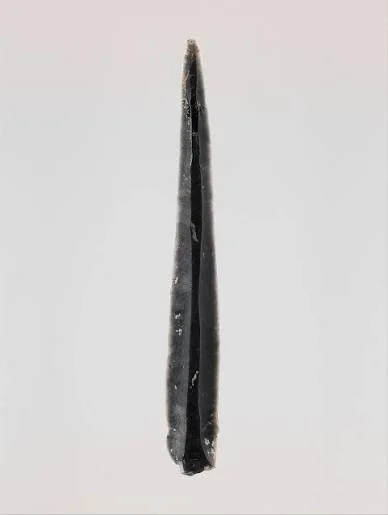
Volcanic glass, prehistoric craftsmanship, and the maritime networks that connected the ancient Cyclades.
The Remarkable Material Known as Obsidian
Long before bronze and iron became widespread materials for tools, prehistoric communities relied on stone to cut, scrape, shape, and process the materials of everyday life. Among the most valuable stones was obsidian, a naturally occurring volcanic glass that can fracture into exceptionally sharp edges.
Obsidian was useful because a skilled craftsperson could remove thin flakes with controlled strikes, producing cutting surfaces suitable for a wide range of tasks. Depending on the form and size of a tool, it might be used to process animal products, work plant materials, prepare food, or perform other activities requiring a sharp edge.
Its distinctive appearance also makes obsidian especially valuable to archaeologists. Unlike many ordinary stones, obsidian can sometimes be traced to a geological source through chemical analysis. This allows researchers to reconstruct patterns of movement and exchange that would otherwise remain difficult to see.
The proposed discovery of Cycladic obsidian blades in caves on Antiparos provides a setting for exploring prehistoric technology and island connections. The particular cache described in the title, however, remains unverified without a documented excavation or archaeological report.
The Cyclades and the Movement of Raw Materials
The Cyclades form an island group in the Aegean Sea. Their communities were separated by water, yet maritime travel enabled people to exchange food, tools, raw materials, and ideas.
One of the best-known sources of prehistoric Aegean obsidian is Melos, also called Milos. Obsidian from this island circulated widely during prehistoric periods, providing evidence that communities maintained connections across significant stretches of sea.
The movement of obsidian does not necessarily mean that a tool traveled directly from Melos to its final destination. Raw material might pass through several settlements, while finished blades could be exchanged repeatedly. A person carrying an obsidian tool might also have moved between islands for reasons unrelated to trade.
By identifying an artifact's geological source, researchers can begin to distinguish between local production and the arrival of materials from elsewhere. When combined with dating and settlement evidence, these findings help reconstruct the scale and organization of prehistoric exchange.
Why Caves Are Important Archaeological Sites
Caves can preserve traces of human activity because some provide shelter from weather and direct sunlight. Deposits may accumulate gradually, forming layers that record repeated visits, occupation, or other activities over long periods.
However, caves were not used for one universal purpose. A cave might serve as temporary shelter, a place for storage, a burial location, a refuge, or a setting for ritual activity. Some were visited only occasionally, while others became part of a settlement's regular use of the surrounding landscape.
The position of an obsidian blade within a cave deposit would therefore be crucial. A blade found beside a hearth and animal remains might suggest everyday activity. A group of unfinished flakes could indicate that tools were produced at the site. An isolated object in a disturbed layer might provide much less information.
Researchers must also consider whether natural processes or later human activity moved the objects from their original positions.
How Obsidian Blades Were Manufactured
Obsidian toolmaking required knowledge of the material's fracture properties. A craftsperson had to select a suitable piece, prepare a surface, and strike it at a controlled angle to remove a flake. Further shaping could produce a blade with a particular length, thickness, or edge.
Archaeologists examine the shapes of tools and the small fragments left behind during production. A concentration of flakes, cores, and unfinished pieces may indicate a workshop area, whereas a few finished tools could represent objects brought to the site for use.
Microscopic wear analysis may reveal whether an edge was used for cutting, scraping, or another activity. These interpretations must be made cautiously because damage can result from burial conditions, later handling, or natural breakage.
The tools also provide evidence of human skill. Producing a consistent blade required practice and an understanding of how force, angle, and material quality affected the result.
Antiparos and Prehistoric Island Life
Antiparos belongs to a region where the sea could function both as a barrier and as a route. Islands maintained distinct local environments, but boats connected them to neighboring communities and larger networks of exchange.
A securely dated obsidian assemblage from an Antiparos cave could help researchers investigate how residents obtained tools, how frequently people moved between islands, and whether a cave was used for domestic or specialized activities.
The interpretation would depend on more than the presence of obsidian. Researchers would examine the source of the material, the forms of the tools, the surrounding artifacts, the cave's stratigraphy, and the relationship between the site and nearby settlements.
What the Blades Could Tell Us
Obsidian blades are valuable because they preserve evidence of both technology and connection. They show how people adapted a natural resource into practical tools and how materials could move across a maritime world long before modern transportation.
The specific discovery of Cycladic obsidian blades in Antiparos caves remains unverified here. If supported by reliable excavation records and scientific analysis, such finds could contribute to our understanding of prehistoric settlement, cave use, and the exchange networks that connected the islands of the Aegean.