
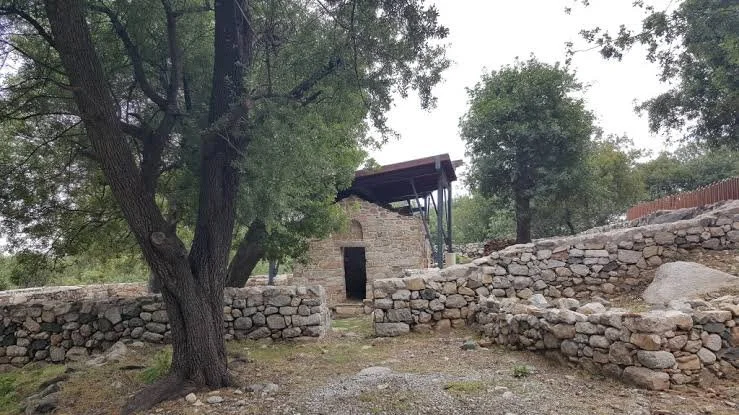
Stone fortifications, early Greek settlement, and the archaeology of a sacred island.
Walls at the Edge of a Settlement
Ancient walls can survive long after the buildings and communities they protected have disappeared. Their foundations may be hidden beneath vegetation, incorporated into later structures, or scattered across fields and hillsides.
Samothrace offers a rich setting for this kind of archaeological investigation. Its ancient city had substantial enclosure walls, while its sanctuary of the Great Gods became an important center of religious activity. The Archaeological Museum of Samothrace notes that much of the ancient city remains essentially unexplored, despite the identification of major wall sections and gates.
The proposed Archaic walls near village outskirts would therefore need to be distinguished from already documented fortifications and other structures.
The Archaic Period and Defensive Architecture
The Archaic period of Greek history is conventionally dated from approximately the eighth to the early fifth century BCE. During these centuries, settlements developed different forms of civic organization, religious architecture, and defensive construction.
Walls varied according to available materials, terrain, building traditions, and strategic needs. Some used large irregular boulders, while others employed more carefully shaped blocks arranged in regular courses.
Masonry style can suggest a date, but it rarely establishes one conclusively. Builders sometimes reused older techniques, and walls could be repaired or rebuilt over centuries.
Samothrace's Ancient City
The ancient city of Samothrace developed through successive phases of settlement. Its enclosure included substantial stonework and several gates, while the city's relationship with the nearby sanctuary shaped movement across the landscape.
Archaeological research can help establish how the city was organized and how its defensive structures changed. However, a wall discovered near a modern village would need precise mapping and architectural study before it could be connected to the ancient city's fortifications.
Researchers would examine the wall's alignment, masonry, construction layers, and relationship to known archaeological features.
How Archaeologists Date a Wall
Dating a wall often requires evidence from the soil layers beneath it, materials embedded in its construction, or objects found in deposits associated with its use. Pottery fragments, coins, inscriptions, and datable organic remains may help establish a chronology.
Geophysical surveys can locate buried extensions without extensive excavation. Aerial imagery and topographic mapping can reveal alignments that are difficult to see at ground level.
Archaeologists must also consider whether a wall is defensive, agricultural, terracing-related, or part of another kind of structure. A strong stone boundary does not automatically represent a city fortification.
Protecting an Archaeological Landscape
Samothrace's archaeological significance extends beyond individual monuments. Roads, walls, cemeteries, workshops, and settlement boundaries may together reveal how people inhabited the island.
Unrecorded excavation or stone removal can destroy the evidence needed to understand these relationships. Any suspected ancient wall should be reported to the appropriate heritage authorities rather than dismantled or privately excavated.
A Question for Future Survey
The proposed Archaic walls near Samothrace's village outskirts remain unverified as a specific discovery. Yet the island's documented ancient city and the large areas still awaiting detailed investigation make systematic survey worthwhile.
A careful study could establish whether a newly identified wall belongs to the known urban defenses, a separate settlement, or a later agricultural landscape. The answer depends on archaeological context rather than masonry appearance alone.







