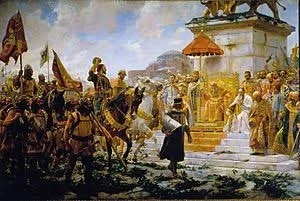
Military migration, the Catalan Company, and the transformation of medieval Athens.
The Arrival of the Catalan Company
In the early fourteenth century, the Catalan Company emerged as a powerful military force in the eastern Mediterranean. Its members included experienced soldiers associated with the Crown of Aragon, many of whom had served as mercenaries in Byzantine territory. Their military experience, organization, and ability to operate across political boundaries made them influential during a period of intense competition among regional powers.
The company's history became especially significant in Greece after its conflict with Walter V of Brienne, Duke of Athens. In 1311, the Catalans defeated Walter's forces at the Battle of Halmyros, also known as the Battle of the Cephissus. The defeat transformed the political situation in the Duchy of Athens and allowed the Catalans to establish control over important territories.
Their arrival was not merely a temporary military episode. The company became involved in governing land, maintaining strategic positions, negotiating political arrangements, and managing relationships with local communities.
The title's reference to Catalan mercenary camps in the Attica hinterlands raises questions about the practical geography of their military presence. The particular camps described, however, remain unverified without specific archaeological or documentary evidence.
Why Armies Needed Camps and Supply Bases
A medieval army required an extensive support system. Soldiers needed food, water, weapons, clothing, and places to rest. Horses and other animals required fodder, while equipment needed repair and supplies had to reach troops operating away from major settlements.
A military camp could be a temporary arrangement of tents and shelters, a fortified position, or a settlement occupied repeatedly by soldiers. Some camps may have used existing villages or buildings rather than creating entirely new structures.
The distinction matters archaeologically. A temporary camp could leave little trace, particularly if its occupants stayed only briefly. A longer-term military base might produce more visible remains, including hearths, refuse deposits, repairs to existing buildings, or defensive structures.
Even then, identifying a camp as Catalan would require more than discovering medieval objects. The same pottery, tools, or weapons might have belonged to local residents or other military forces.
Attica's Strategic Importance
Attica contained Athens and its surrounding agricultural territory, as well as routes connecting the region to central Greece and coastal destinations. Control over these routes could affect the movement of soldiers, merchants, and supplies.
The Catalan rulers needed to maintain authority across a landscape that included settlements, cultivated land, fortified positions, and roads. Their political control depended not only on victories in battle but also on the ability to secure resources and establish working relationships with the population.
Military activity in the hinterlands would have been shaped by practical considerations. Camps needed access to water and food, while positions overlooking important roads could help monitor movement and respond to threats.
However, a location that appears suitable for a camp cannot be identified as one without supporting evidence. Historical geography can suggest where soldiers might have stayed, but it cannot independently establish that a particular site was used by the Catalan Company.
The Relationship Between Mercenaries and Local Communities
Mercenaries were professional soldiers who served for payment or other agreed benefits. Their relationship with the communities around them could be complicated, particularly when military forces became responsible for governing conquered territory.
Soldiers required supplies, and local inhabitants could be expected to contribute food, labor, taxes, or other resources. Such arrangements might support a local economy in some circumstances but create hardship or resentment in others.
The impact depended on the size of the force, the duration of its presence, the political arrangements governing the territory, and the behavior of individual commanders. It would be misleading to assume that all interactions between Catalan soldiers and local residents followed one pattern.
Archaeological Evidence for a Military Camp
Researchers investigating a suspected camp would examine the terrain, access to water, proximity to medieval roads, and the relationship between the site and known settlements. Excavation might uncover pottery, metal objects, animal bones, hearths, or traces of temporary structures.
The chronology of these remains would be essential. A medieval object could have been deposited before or after the Catalan presence, and a site might have been occupied repeatedly by different groups.
A stronger identification would combine archaeological evidence with historical descriptions, securely dated objects, inscriptions, or records referring to a particular location. Researchers would also consider alternative explanations for the remains.
The Limits of Medieval Military Records
Medieval chronicles often emphasize major battles, rulers, and political decisions. Everyday logistics receive less attention, especially when a camp did not become the site of an important event.
The absence of a named camp in a surviving chronicle does not prove that soldiers never stayed in the area. Nevertheless, the general likelihood of military movement cannot be used as proof of a specific camp.
This distinction is particularly important when a modern article uses a dramatic title that implies a newly discovered archaeological site.
A Mercenary Force Becomes a Territorial Power
The Catalan Company's history illustrates how a military organization could move beyond paid service and become a ruling power. Its experience in Greece reveals the importance of military organization, strategic geography, and the political challenges of controlling conquered territory.
The specific camps in the Attica hinterlands described by this title remain unverified. Future archaeological and documentary research could clarify where Catalan soldiers were stationed, how long they remained, and how their presence affected the surrounding settlements.